


Web Desk: The government has been gradually dismantling barriers on vehicle imports as part of wider trade reforms linked to its National Tariff Policy and a $7 billion International Monetary Fund-backed economic program.
The changes represent a major shift for an industry that has relied for decades on high import duties and regulatory protections. Islamabad says the reforms are intended to strengthen competition, improve efficiency and make the domestic industry more competitive in export markets.
At the same time, manufacturers and parts suppliers have warned that moving too quickly could undermine investment, employment and the network of local companies supporting vehicle production.
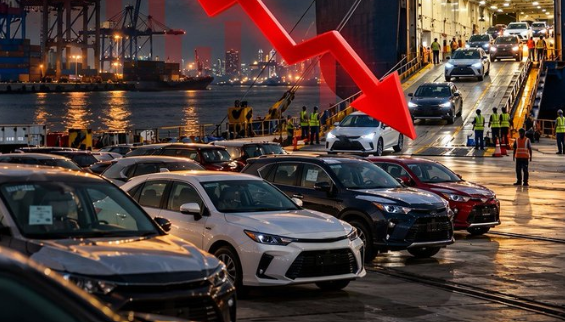
Pakistan legalised commercial imports of used vehicles last year, initially allowing cars up to five years old. From July 1, the age restriction was removed, while the regulatory duty on commercially imported used vehicles was cut from 40% to 30%. The duty is scheduled to decline further over time.
The Engineering Development Board, which oversees the sector under the Ministry of Industries and Production, also relaxed commercial import requirements on Sept. 30. It removed a minimum capital requirement and allowed tax-registered individuals and businesses to import vehicles commercially without mandatory registration with the Securities and Exchange Commission of Pakistan.
Car dealers say the reforms could force domestic assemblers to become more competitive on pricing, quality and product variety.
Shahid Ali, senior vice president of the All-Pakistan Car Dealers Association, said greater access to imported vehicles would ultimately benefit buyers by increasing their options.
He estimated that prices of smaller cars with engines around 600cc could fall by roughly Rs300,000 to Rs400,000, while savings on vehicles priced near Rs20 million could reach about Rs1.5 million.
According to Ali, the effects could become more apparent within six months as importers complete regulatory procedures, place orders and bring additional vehicles into the country.
The increase in imports is already visible in official data. Pakistan brought in 2,276 used vehicles in September, compared with 1,445 in August and 843 in June, according to Commerce Ministry figures.
However, most of the September vehicles entered through the existing gift scheme rather than the newly opened commercial-import channel, meaning the full effect of the latest policy changes has yet to emerge.
The reforms come as Pakistan’s domestic auto sector shows signs of recovery following a sharp downturn during the country’s recent economic crisis.
Government figures indicate that passenger-car production increased by more than 51% year-on-year during the first nine months of the fiscal year that ended in June. Output of light commercial vehicles, jeeps, SUVs and pickups also rose by about 24%.
Industry representatives, nevertheless, argue that increased dependence on imported vehicles could weaken domestic production and place additional pressure on Pakistan’s foreign-exchange reserves.
Aamir Allawala, a former chairman of the Pakistan Association of Automotive Parts and Accessories Manufacturers, said imports could increase demand for foreign currency while reducing the contribution of local manufacturers.
He estimated that domestic vehicle production currently saves Pakistan between $1.8 billion and $2 billion annually in foreign exchange.
Allawala also warned that a decline in local manufacturing could affect government tax collections and weaken the broader industrial ecosystem built around vehicle assembly and parts production.
Pakistan has faced repeated balance-of-payments pressures in recent years, prompting authorities to restrict imports during periods of acute foreign-exchange shortages.
The Commerce Ministry did not respond to requests for comment on the concerns raised by industry representatives.
The auto reforms form part of a broader government strategy to reduce Pakistan’s dependence on high tariffs as a means of protecting domestic industries.
Under the IMF-supported tariff reform program, Islamabad plans to move toward four principal customs-duty rates of zero, 5%, 10% and 15%, while gradually eliminating additional customs and regulatory duties.
For the automobile industry, the government has committed to significantly reducing tariff protection by the end of the decade.
The IMF has identified greater liberalisation of vehicle imports as part of Pakistan’s wider reform agenda. The program also calls for lower tariff protection and the introduction of updated safety and environmental requirements covering both imported and locally produced vehicles.
Allawala argued that applying broad tariff reductions without considering the structure of individual industries could create unintended consequences.
He described the automotive sector as a closely connected chain involving raw materials, parts manufacturing and final vehicle assembly. A decline in local parts production, he said, could eventually weaken the economic foundation for maintaining vehicle assembly operations in Pakistan.
The tariff changes are taking place as the government prepares a new five-year policy for the automotive industry.
The proposed framework is intended to replace the Auto Industry Development and Export Policy 2021-26, which expired in June. Prime Minister Shehbaz Sharif reportedly gave in-principle approval to the framework in September.
The proposed policy would tie incentives more closely to localisation and exports while introducing further tariff reductions through 2030-31. However, the framework still requires additional review and government approval before it can take effect.
The Pakistan Automotive Manufacturers Association, which represents major vehicle assemblers including Toyota, Honda and Suzuki, has called for greater consultation over the proposed policy.
PAMA Director General Razi ur Rahman said manufacturers were concerned by reports that a draft had already been prepared and could soon be presented to the prime minister.
He said the proposed framework could include tougher measures for manufacturers that fail to meet export targets, including higher tariffs and potentially the cancellation of manufacturing licences.
Rahman said the industry supported expanding exports but favoured incentives over punitive measures.
He called for a predictable and transparent policy framework with achievable targets and sufficient incentives for manufacturers and parts suppliers to invest in exports and improve international competitiveness.
Beyond manufacturers, industry representatives have also raised concerns about employment.
One industry stakeholder, speaking anonymously, estimated that as many as one million workers across vehicle manufacturing and related sectors, including auto parts and steel, could face employment risks if import liberalisation proceeds without adequate safeguards.
That estimate could not be independently verified.
The stakeholder also pointed to Yamaha’s exit from Pakistan as an indication of the challenges facing the domestic vehicle industry. Yamaha Motor Co. ended motorcycle manufacturing in Pakistan in September 2025.
However, the company’s departure came before the latest tariff reductions and relaxation of used-vehicle import rules, and Yamaha did not attribute its decision to those reforms.
Pakistan’s auto reforms are therefore setting up a difficult balance for policymakers.
For consumers, greater access to imported vehicles could mean more models, stronger competition and potentially lower prices. For domestic manufacturers and parts suppliers, however, faster tariff cuts could increase pressure on an industry still rebuilding after a prolonged economic downturn.
The outcome will depend largely on how Islamabad sequences tariff reductions, import liberalisation and incentives for local production and exports.
With the new auto policy still under review, the government faces growing pressure to ensure that opening the market delivers greater consumer choice without eroding the domestic industrial base it has spent decades building.
Read more: Govt Announces New Fitness Rules for Private Cars