


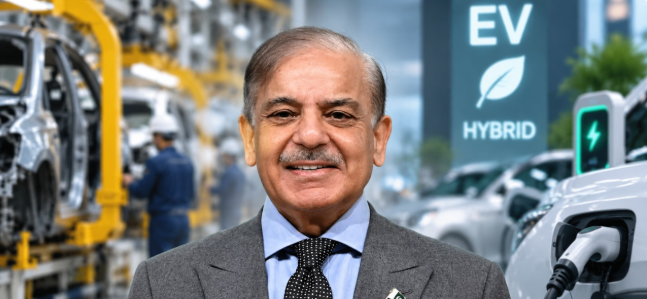
Web Desk: Pakistan Prime Minister Shehbaz Sharif has approved a five-year automotive policy aimed at boosting vehicle exports, encouraging electric vehicle adoption and strengthening local manufacturing, while rejecting an International Monetary Fund proposal to raise the sales tax on electric vehicles to 18%, according to policy documents.
The policy introduces a phased reduction in import duties, lower tax rates for several categories of electric vehicles and stricter export targets for automakers. It also proposes financial incentives for companies that increase exports, alongside penalties for those that fail to meet mandatory targets.
The policy seeks to make electric vehicles more affordable by maintaining a 1% sales tax on battery electric vehicles from 2026 to 2031, according to the document.
It also sets out separate tax rates for other electric vehicle categories, including 6% for range-extended electric vehicles and 9% for plug-in hybrid vehicles.
In addition, the government plans to reduce import duties on electric vehicles gradually and introduce lower tariffs for small EVs priced below $15,000.
To encourage consumers to switch to electric mobility, the policy proposes increasing the financing limit for electric vehicles from 3 million rupees to 10 million rupees. The maximum financing period would also rise from three years to five years.
The measures place particular emphasis on making smaller vehicles more accessible to lower-income consumers.
Meanwhile, the document proposes imposing a 10% federal excise duty on electric vehicles valued above $75,000.
The new policy seeks to make Pakistan’s automotive industry more competitive by gradually lowering import duties and reducing tariffs to 15% by 2030-31.
However, automakers would face mandatory export targets, with companies that fail to meet their obligations facing financial penalties.
Under the proposed incentive structure, manufacturers that increase exports could receive compensation equivalent to 5% of their export value. Companies that exceed their previous year’s export performance could qualify for an additional 10% incentive.
The government also plans to withdraw incentives from companies that fail to meet local production targets. Manufacturers that miss their export targets for two consecutive years could lose their manufacturing certificates.
These measures are intended to encourage local production, expand export capacity and reduce the industry’s reliance on imported vehicles and components.
The policy proposes an Automotive Development Levy on vehicles with engine capacities above 1,000cc.
The government estimates that the levy could generate more than 232 billion rupees over five years. The proceeds would help finance export incentives, industrial development programmes and technology upgrades for auto-parts manufacturers.
Additionally, the government plans to establish a Pakistan Automotive Testing Institute to strengthen research, certification and independent auditing across the sector.
Read more: Dirty game exposed as Pti backed youtubers yearn for money to make narrative