



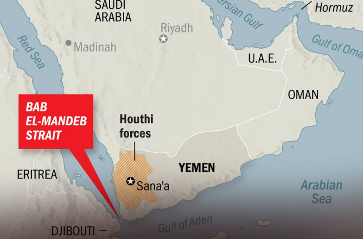
Web Desk: Yemen’s Iran-aligned Houthi rebels have threatened to impose a naval blockade on Saudi Arabia through the Bab al-Mandab Strait, a move that could disrupt one of the world’s busiest maritime chokepoints, send energy prices higher and intensify supply chain pressures if fully enforced.
The announcement marks a significant escalation in the broader regional conflict involving Iran, the United States and its allies. Although shipping through the strait has not been completely halted, analysts warn that even the threat of prolonged disruption could have far-reaching consequences for global trade, inflation and energy markets.
The Bab al-Mandab Strait links the Red Sea to the Gulf of Aden and the Indian Ocean, making it a critical gateway for vessels traveling to and from the Suez Canal.
The waterway, only about 29 kilometers (18 miles) wide at its narrowest point, carries roughly 10% to 12% of global seaborne trade and an estimated 8 million to 9 million barrels of crude oil and petroleum products every day. It also handles a substantial share of global liquefied natural gas (LNG) shipments and container traffic between Europe and Asia.
For Saudi Arabia, the route is especially important because it provides access to European and North American markets. With the Strait of Hormuz already under severe disruption during the ongoing conflict, Bab al-Mandab has become an increasingly vital export corridor for Gulf energy producers.
The Houthis said the blockade was a response to what they described as Saudi Arabia’s continued blockade of Yemen. Shortly afterward, the Saudi-led coalition announced plans to protect commercial shipping and warned it would respond militarily.
Markets reacted immediately. Oil prices briefly rose before retreating as investors weighed the possibility of renewed diplomatic negotiations. However, shipping insurers increased war-risk premiums for vessels operating in the Red Sea, signaling heightened concern among maritime operators.
Analysts say a prolonged closure of the Bab al-Mandab Strait could remove around 7% of global oil supplies from international markets by restricting Saudi exports and forcing tankers to take longer alternative routes around Africa.
Combined with disruptions in the Strait of Hormuz, where conflict has already affected energy exports, total interruptions could exceed 15% of global oil flows, creating the risk of another major energy shock.
Beyond energy markets, a blockade would significantly affect international commerce.
Ships unable to transit the Red Sea would likely reroute around the Cape of Good Hope at Africa’s southern tip, extending voyages between Asia and Europe by 10 to 15 days and adding thousands of nautical miles to each journey.
Longer voyages would increase fuel consumption, freight charges and insurance costs while delaying deliveries of manufactured goods, electronics, automobiles, food products and industrial materials.
Economists say sustained shipping disruptions could revive supply chain bottlenecks similar to those experienced during the COVID-19 pandemic, placing renewed upward pressure on consumer prices worldwide.
Developing economies that rely heavily on imported fuel and food would likely face the greatest economic strain.
Despite the latest escalation, diplomatic channels remain active.
Iran’s Foreign Ministry confirmed that mediators had submitted proposals aimed at reducing tensions, although officials provided no details.
Separately, a senior Iranian official said Tehran had received a proposal for a 10-day ceasefire designed to preserve an interim agreement reached last month and create conditions for broader peace negotiations.
Pakistani government officials also said Iranian Interior Minister Eskandar Momeni had requested Islamabad’s assistance in reviving mediation efforts before traveling to Pakistan for further discussions.
Diplomatic activity has unfolded alongside an intensifying military campaign.
US Central Command announced another round of strikes on Iranian targets, while Iran’s Revolutionary Guard said it had launched attacks on U.S. military facilities across the region.
The Pentagon identified two US soldiers killed during Iran’s attack on an American military base in Jordan and said investigators had recovered unidentified remains believed to belong to a third missing service member. Separately, another US service member died in northern Iraq while disposing of unexploded ordnance from a downed Iranian drone.
President Donald Trump defended the latest strikes, saying they were intended to respond decisively to attacks that killed American personnel and warning Tehran against further assaults on US forces.
Regional security conditions continued to deteriorate as Iran’s Revolutionary Guard reported explosions involving two oil tankers near the Strait of Hormuz, although the claims could not be independently verified.
Separately, the United Kingdom Maritime Trade Operations agency reported that a commercial vessel was struck by an unidentified projectile off Oman’s coast near the strategic waterway.
Iran also reported explosions in several cities, including Tabriz, Chabahar, Konarak, Bandar Mahshahr and Bandar Imam Khomeini. State media said one person was killed and several others were injured near Tabriz.
Meanwhile, air raid sirens sounded across Bahrain, and Kuwait said its air defenses intercepted another wave of Iranian drones early Tuesday.
For now, global shipping continues through the Bab al-Mandab Strait under heightened military protection.
However, shipping companies, commodity traders and governments are closely monitoring developments, warning that any sustained disruption at both the Bab al-Mandab and the Strait of Hormuz could trigger one of the most severe shocks to global trade and energy markets in decades.
With nearly one-fifth of global petroleum consumption normally moving through the Gulf region and a significant share of Europe-Asia trade dependent on Red Sea shipping lanes, the economic impact of a prolonged blockade would likely extend well beyond the Middle East, affecting businesses and consumers worldwide.
Read more: OGRA sets new fuel prices; petrol falls slightly, diesel jumps