
Web Desk: The latest BRICS summit in New Delhi has drawn criticism over the absence of several prominent leaders, a controversial official dinner menu and a series of awkward moments involving some of the bloc’s most powerful members.
The gathering brought together leaders and senior representatives from the BRICS group, but the level of participation and several highly visible diplomatic exchanges sparked debate in Indian political and social-media circles over the outcome of the summit.
One of the main talking points was the absence of some expected leaders from the summit’s high-profile events.
Brazilian President Luiz Inácio Lula da Silva did not attend the BRICS gathering, while Saudi Arabia was represented by a foreign ministry official rather than its top leadership.
The reported absence of UAE leader Sheikh Khaled bin Mohamed bin Zayed from the official dinner also attracted attention.
The limited participation has prompted questions over whether the summit succeeded in generating the level of high-level diplomatic engagement normally associated with a major international gathering.
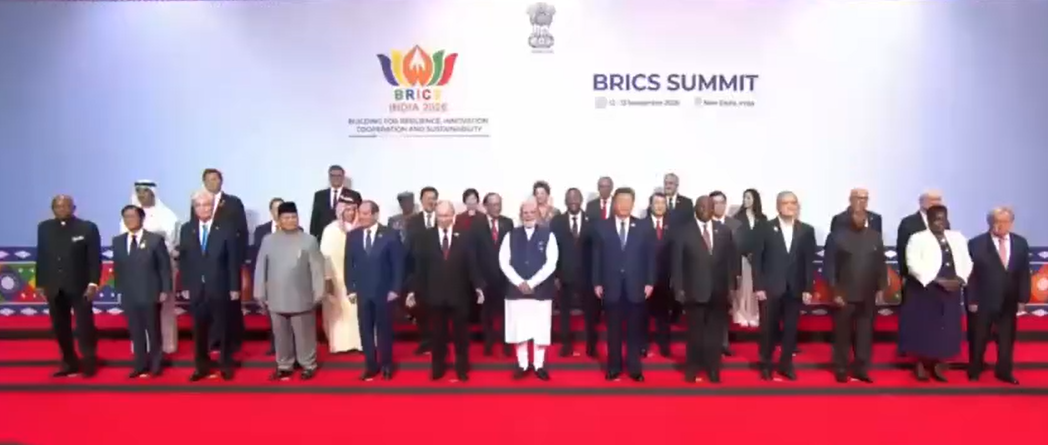
Another closely watched moment came during a group photograph involving senior leaders.
Indian Prime Minister Narendra Modi appeared to gesture toward Russian President Vladimir Putin and Chinese President Xi Jinping as leaders positioned themselves for the photograph. The interaction was widely discussed because Xi appeared reluctant to move from his position, creating an uncomfortable-looking exchange.
The body language and facial expressions of several leaders during the event also became a subject of discussion online, with viewers interpreting some of the interactions as evidence of diplomatic unease.
However, such interpretations remain subjective, and facial expressions or brief exchanges do not by themselves establish the nature of private discussions among leaders.
Tensions surrounding India-China relations added another layer to the summit’s optics.
During Modi’s opening remarks, Xi was seen appearing reserved, while Modi repeatedly sought confirmation during the proceedings. The interaction quickly became a talking point among observers following the event.
The two countries have maintained a complicated relationship, marked by economic engagement as well as continuing strategic and border-related differences. As a result, even seemingly minor public interactions between their leaders often receive significant attention.
The official dinner also generated controversy after reports that the menu offered only vegetarian dishes.
The decision triggered criticism from some delegates and users on Indian social media, with questions raised about whether foreign leaders and visiting delegations had been given sufficient dietary choice.
The controversy became particularly prominent because India was hosting an international gathering involving leaders and senior officials from countries with widely differing culinary traditions and dietary preferences.
Congress leader P. Chidambaram also questioned the practical results of recent BRICS summits, arguing that India’s participation in several major international groupings had not produced enough tangible benefits.
He questioned what India had gained from its membership of BRICS, the Shanghai Cooperation Organisation, the Group of 20 and the Quad, while noting that earlier BRICS meetings had produced more concrete outcomes.
The summit’s joint declaration condemning Israeli actions in Palestine was another significant development.
The position places India in a potentially delicate diplomatic position because New Delhi has developed close strategic and defence ties with Israel while also maintaining longstanding support for the Palestinian cause.
The declaration therefore drew attention to the balancing act facing India as it seeks to maintain relationships with Israel, Arab states and emerging global powers within BRICS.
However, describing the declaration alone as proof that the summit was a failure would be an interpretation rather than an established fact. The significance of the statement depends on how it affects subsequent diplomatic and policy decisions.
An interview conducted by an Indian television channel with Malaysian Prime Minister Anwar Ibrahim also attracted attention after the interviewer did not secure the strongly anti-Pakistan comments some Indian commentators may have expected.
The episode was subsequently discussed in the context of India-Pakistan diplomatic competition and New Delhi’s efforts to shape international narratives around regional issues.
The summit also faced demonstrations linked to China’s participation.
Members of the Tibetan Youth Congress protested against Xi’s presence at Bharat Mandapam, the venue hosting the event. Delhi Police detained more than 50 protesters, according to the information provided.
The demonstrations highlighted the sensitivity surrounding China’s participation in an international event hosted by India, particularly given longstanding tensions involving Tibet and Beijing’s policies.
The controversy surrounding the summit has also fuelled domestic political debate.
Opposition voices have questioned whether recent BRICS meetings have delivered measurable gains for India, while critics have focused on the level of foreign participation, the dinner arrangements and the public interactions among leaders.
At the same time, supporters of the summit can point to the participation of major emerging economies and the adoption of a joint declaration as evidence that the forum continues to provide India with an important diplomatic platform.
Read more: Sohail Chaudhry appointed IG Islamabad Police, Ali Nasir Rizvi appointed DG NCCIA