


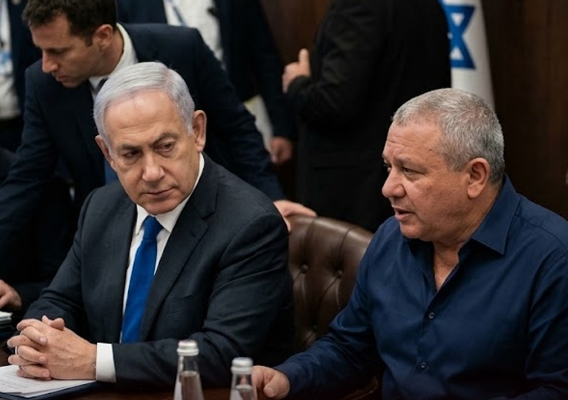
Web Desk: Benjamin Netanyahu faces an uncertain political future after preliminary election results left his right-wing bloc short of a parliamentary majority, opening a potential path for opposition parties to form the country’s next government.
Netanyahu’s bloc is projected to win 53 seats in the 120-member Knesset, while the opposition alliance led by former military chief Gadi Eisenkot is expected to secure 48. Parties led by Palestinian citizens of Israel are projected to hold a record 19 seats, making their support potentially decisive in determining who governs the country. Neither main bloc has reached the 61 seats required for a majority.
Although Netanyahu’s Likud party remains the largest individual party, the broader coalition arithmetic presents a significant challenge. The opposition could assemble a parliamentary majority with support from Arab-led parties, but political disagreements and campaign commitments have complicated that prospect.
The election has placed Arab-led parties at the centre of negotiations over Israel’s political future. Their projected 19 seats could give the opposition a numerical route to power if its constituent parties agree to cooperate with them.
Yousef Jabareen, leader of the Joint List, has indicated that his party is prepared to help remove Netanyahu’s government. However, he has ruled out joining an Eisenkot-led coalition outright, citing disagreements over Israel’s military campaign in Gaza and its presence in southern Lebanon. He has left open the possibility of supporting an opposition-led minority government from outside the coalition.
Mansour Abbas, leader of the Ra’am party, has expressed greater willingness to participate in a government led by Eisenkot. Ra’am previously joined a governing coalition in 2021 under then-Prime Minister Naftali Bennett, marking a significant precedent for an independent Arab party in Israeli coalition politics.
Nevertheless, opposition unity remains uncertain. Several Jewish opposition leaders have rejected cooperation with Arab-led parties, despite the possibility that their support could provide the votes needed to displace Netanyahu.
Eisenkot and his allies now face a choice that could determine whether Netanyahu remains in office: negotiate an arrangement with Arab-led parties or explore other political combinations that could leave the current prime minister with another opportunity to govern.
Yair Golan, leader of the centre-left Democrats and a member of the opposition bloc, has publicly backed cooperation with Palestinian citizens of Israel. He has argued that opposition parties should not exclude potential partners simply because of their Arab political base.
Other opposition figures have been more cautious. Eisenkot ruled out forming a government with Arab parties during the election campaign, citing differences over national identity and the definition of Israel as a Jewish and democratic state.
That position could become a major obstacle to an opposition government. Without support from outside its current bloc, Eisenkot’s alliance remains well below the parliamentary threshold. However, if its leaders reach an agreement with Arab parties, they could potentially secure enough backing to challenge Netanyahu’s hold on power.
The preliminary results have complicated expectations that the opposition would emerge as the largest parliamentary grouping. As counting progressed, Netanyahu’s bloc moved ahead of Eisenkot’s alliance, but neither side secured a majority.
The outcome has weakened Netanyahu’s immediate position without automatically transferring power to his rivals. His 53-seat bloc remains eight seats short of a majority, while Eisenkot’s 48-seat alliance needs additional support from other lawmakers or parties.
The remaining ballots were not expected to dramatically alter the overall balance, although the final allocation of seats and subsequent coalition negotiations will determine the available options.
Meanwhile, Netanyahu’s Likud party has alleged that Arab-led parties compromised election integrity. Israel’s election authorities and police have said there is no evidence supporting claims that the election was stolen, according to reports by Israeli media. citeturn187934search0turn187934search1
President Isaac Herzog, who is responsible for assigning the mandate to form a government, has urged political leaders to keep an open mind and make every effort to avoid another election.
The coming negotiations are likely to focus on whether Eisenkot can persuade his allies to accept some form of cooperation with Arab-led parties. Such an arrangement could take the form of a formal coalition or an agreement under which Arab lawmakers support a minority government on confidence votes without joining the cabinet.
However, both options carry political risks. A minority administration could struggle to survive parliamentary challenges, while a formal coalition would require the parties to reconcile significant disagreements over security, the Palestinian issue and Israel’s national identity.
If neither Netanyahu nor his opponents can secure sufficient parliamentary support, Israel could face another election, leaving Netanyahu in charge of a caretaker government in the interim.
The election has created a credible opportunity for Netanyahu’s opponents to end his tenure, but the outcome will depend on political decisions rather than seat projections alone.
The opposition’s potential route to power rests on whether its leaders are willing to negotiate with parties they have previously excluded from coalition discussions. The Arab-led parties, meanwhile, have gained substantial leverage and are seeking political change and greater equality for their constituents.
For now, Netanyahu cannot count on the parliamentary majority needed to form a government on the strength of his existing bloc. Yet the opposition has not secured that majority either.
The decisive question is whether Eisenkot and his allies can turn their combined parliamentary strength with Arab-led lawmakers into a workable governing arrangement. If they can, Israel could see a change of leadership; if they cannot, Netanyahu may yet find a way to remain in office.
Raed more: Fact Check: Taliban social media proxies spread false blast claims inside KP