
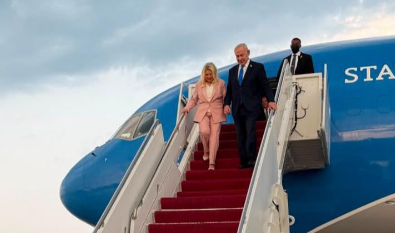
Web Desk: Israeli Prime Minister Benjamin Netanyahu arrived in Washington on Tuesday for talks with US President Donald Trump, with Iran expected to top the agenda as both leaders weigh the next steps in a widening regional confrontation.
Netanyahu is expected to press Trump on Tehran’s nuclear ambitions, ballistic missile program and regional military influence, while seeking continued U.S. support for Israel’s security concerns.
The meeting comes as Washington and Tehran exchange mixed signals over diplomacy following weeks of military confrontation. Trump said the United States and Iran were engaged in “very friendly talks,” but warned that the opportunity for negotiations may not last indefinitely.
“Right now, there are very friendly negotiations going on,” Trump said, while adding that Washington could return to military action if talks fail to deliver results.
For Israel, the central question remains how Washington plans to deal with what it considers a long-term threat from Iran.
Analysts say Netanyahu is likely to urge Trump to maintain pressure on Tehran and prevent Iran from advancing its nuclear and missile capabilities.
Alex Vatanka, a senior fellow at the Middle East Institute in Washington, said Netanyahu may again promote the idea of political change in Iran, although he questioned whether Trump would support such a strategy.
“I don’t think it will go down well with President Trump because he doesn’t want to do that,” Vatanka said, noting that military escalation remains politically sensitive in the United States.
He added that Israeli officials view Iran as a major security threat, while the Trump administration faces constraints over how far it is prepared to go militarily.
Meanwhile, Iran challenged Washington’s characterization of ongoing discussions.
Iranian officials said there were no formal negotiations with the United States, although intermediaries may be delivering messages between the two sides.
Tehran said it would continue using diplomacy to protect its interests but signaled that it was not prepared to accept pressure from Washington.
The disagreement highlights the uncertainty surrounding efforts to prevent another escalation after weeks of strikes and counter-strikes involving Iran and the United States.
At the same time, Saudi Arabia condemned a drone attack launched by Iran-backed groups in Iraq that targeted Riyadh and oil facilities in the kingdom’s Eastern Province.
The attack renewed concerns over the vulnerability of critical energy infrastructure in the Gulf, where previous strikes on oil facilities have affected global markets.
Saudi officials said they would continue strengthening defenses around strategic assets as regional tensions remain elevated.
Separately, the Israeli military said it intercepted an unmanned aerial vehicle near the Jordan border.
The military said the drone did not enter Israeli territory and that authorities were investigating where the launch originated.
Jordan has faced repeated drone-related incidents linked to Iran since the United States resumed strikes against Iranian targets earlier this month.
The latest incident has increased fears that the conflict could expand beyond existing battle lines and involve additional countries.
Although Trump said military pressure had encouraged Tehran to return to discussions, analysts questioned whether Iran had significantly changed its position.
Vatanka said Iran’s leadership appeared prepared to withstand additional pressure rather than make major concessions.
He said the pause in hostilities appeared more connected to Washington’s effort to explore diplomacy than a major shift by Tehran.
According to regional officials cited by The Associated Press, mediators including Qatar and Pakistan have been working to narrow differences between Washington and Tehran and revive an interim ceasefire arrangement.
Beyond Iran, diplomatic efforts are also continuing along Israel’s northern border.
A new round of Israel-Lebanon talks is scheduled for August 4 in Rome, according to a U.S. State Department official.
The discussions will focus on implementing a framework agreement signed in June, including border issues, security arrangements and expanding a pilot withdrawal process.
The agreement calls for the Lebanese army to restore authority across Lebanese territory and includes provisions linked to Hezbollah’s disarmament before further Israeli redeployment.
The conflict has also drawn increased international scrutiny over civilian impacts and military conduct.
UN High Commissioner for Human Rights Volker Turk said his office had documented violations of international law by Israel in Lebanon, with some incidents potentially amounting to war crimes.
The remarks added pressure on governments involved in the conflict to address humanitarian concerns and comply with international legal obligations.
Meanwhile, Russian President Vladimir Putin praised Iran’s use of smaller naval vessels, describing the country’s so-called “mosquito fleet” as an example of modern military tactics.
Putin said Russia was developing similar capabilities, emphasizing the effectiveness of smaller, heavily armed platforms that can operate close to shore and challenge larger naval forces.
Iran’s fleet reportedly includes small submarines and fast attack boats designed for coastal operations.
Ukraine’s reported strike on an Iranian vessel in the Caspian Sea has also attracted attention in Washington.
William Courtney, a former U.S. ambassador and senior fellow at the RAND Corporation, said the operation could improve ties between Kyiv and the Trump administration because it targeted Iranian military supplies linked to Russia.
However, he said Ukraine had no interest in becoming directly involved in the U.S.-Israel confrontation with Tehran.
“Ukraine has no interest in joining the war in Iran with the war in Ukraine,” Courtney said, adding that Kyiv’s focus remained on limiting Iranian military support for Russia.
Meanwhile, global energy markets continue to monitor developments around the Strait of Hormuz, one of the world’s most important oil shipping routes.
Marine traffic data showed 29 verified vessel crossings through the waterway between July 24 and July 26, including ships entering and leaving the strategic route.
Any prolonged disruption in the Strait of Hormuz could affect global oil supplies and increase pressure on energy markets.
As Trump and Netanyahu prepare to meet, the focus will remain on whether Washington chooses a diplomatic path with Tehran or increases pressure through further military action.
Israel is expected to seek stronger guarantees against Iran’s nuclear and missile programs, while Trump faces the challenge of balancing regional security concerns with his stated interest in reaching a diplomatic agreement.
With tensions continuing across the Middle East, the outcome of the meeting could influence the next phase of the Iran crisis and determine whether diplomacy can prevent further escalation.
Read more: Fakhar Durrani shares more evidence of conversation with RAW agent