

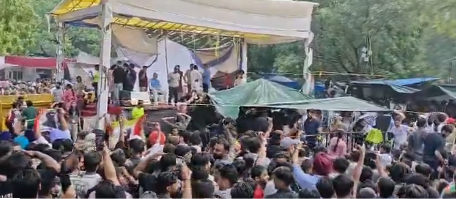
Web Desk: India’s youth-led Gen Z protest movement has warned of renewed demonstrations after accusing the government of failing to honor assurances made to student protesters following nationwide unrest over examination irregularities.
The Cockroach Janta Party (CJP), which organized large-scale protests against alleged exam paper leaks and failures in India’s competitive examination system, said authorities had detained or targeted hundreds of students despite earlier commitments that protesters would not face retaliation.
The group said it would restart its campaign if authorities do not release detained students and withdraw police cases filed against demonstrators.
“If the government does not honour the agreement and release everyone detained or arrested, we will be compelled to resume the protest,” CJP spokesperson Ashutosh Ranka told reporters on Monday.
The CJP had suspended its nationwide agitation after Education Minister Dharmendra Pradhan resigned, following intense public pressure over allegations of examination failures.
Senior leaders from the ruling Bharatiya Janata Party (BJP) had assured protesters that students involved in the demonstrations would not face punitive action.
However, the group said the government had failed to follow through on those assurances, citing arrests and criminal cases against students in several states.
According to the CJP, at least 100 people have been arrested across India, with many facing strict non-bailable charges.
Police complaints have been registered against protesters in Delhi, Assam, West Bengal and Bihar, states where the BJP holds political influence.
The movement said the legal action has intensified concerns among students who participated in demonstrations demanding reforms in the examination system.
Meanwhile, Neha Bora, a leader of the All India Students Association and a prominent figure within the protest movement, traveled to Bihar on Monday to pressure authorities to withdraw cases against students.
A police officer in Bihar was suspended after allegations that an assault rifle was used while dispersing student protesters during demonstrations on Saturday.
As legal pressure increases, the CJP has established a fund to support students facing criminal proceedings, according to movement spokesperson Saurav Das.
The group said the initiative aims to provide financial assistance to protesters who cannot afford legal representation.
The CJP has gained millions of followers on social media since its launch in May by Abhijeet Dipke, a 30-year-old public relations graduate.
The movement has attracted large numbers of young Indians, particularly students, who say repeated failures in competitive examinations have damaged trust in the system.
Hundreds of thousands of protesters gathered in New Delhi and other cities last week, demanding accountability and wider reforms.
The demonstrations became a major political challenge for the government and marked the first time a senior minister in the Modi administration stepped down following public pressure.
The protests were fueled by anger over allegations of exam paper leaks, administrative failures and uncertainty affecting millions of students seeking government jobs and higher education opportunities.
Tensions escalated in New Delhi on July 20 when large crowds attempted to march toward parliament from the Jantar Mantar protest site.
Police used tear gas and batons to disperse protesters, leading to clashes and a wave of detentions.
Following the incident, India’s chief justice called for an independent inquiry after a petition was filed in the Supreme Court alleging excessive use of force by police.
The court emphasized that peaceful and lawful protest remains a constitutional right.
The issue also entered parliament, where opposition lawmakers demanded an explanation from the government over the police response and the handling of student demonstrations.
Opposition leaders criticised the crackdown and called for greater accountability in managing the examination system.
The government, however, has defended its response and said it is working to address the concerns that triggered the protests.
In response to growing pressure, authorities have announced plans to overhaul India’s examination framework through a review panel.
The government has also introduced legislation seeking tougher penalties for examination paper leaks, aiming to prevent future disruptions.
However, protesters say reforms must be accompanied by action against those responsible for systemic failures and the release of detained students.
The standoff between the government and the Gen Z-led movement has created a new test for authorities as they attempt to balance public demands for reform with maintaining law and order.
With student leaders warning of renewed protests, the coming days will determine whether dialogue can resolve the dispute or whether India faces another wave of youth-led demonstrations over education, transparency and accountability.
Read more: Trump-Netanyahu meeting: What Israel wants from Washington on Iran?