



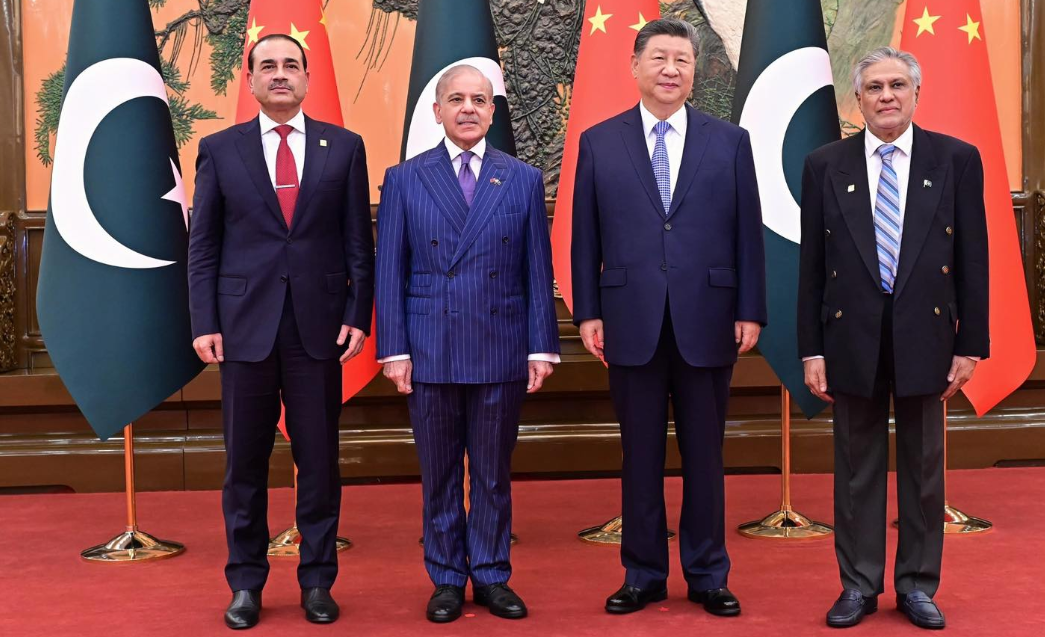
Web Desk: China and Pakistan pledged to accelerate cooperation under the China-Pakistan Economic Corridor (CPEC), expand defense and technology ties, and deepen strategic coordination on regional and global issues during Prime Minister Shehbaz Sharif’s four-day official visit to China, according to a joint statement issued on Tuesday.
Prime Minister Shehbaz Sharif visited China from May 23 to May 26 at the invitation of Chinese Premier Li Qiang. During the visit, Chinese President Xi Jinping and Premier Li held separate meetings with Sharif, with both sides reaffirming what they described as the “All-Weather Strategic Cooperative Partnership” between the two countries.
The two sides also marked the 75th anniversary of diplomatic relations between Beijing and Islamabad, describing their longstanding partnership as “rock solid” despite changing regional and international dynamics.
China and Pakistan agreed to push forward the upgraded phase of CPEC, known as CPEC 2.0, with renewed emphasis on infrastructure, industrial development and regional connectivity.
Both countries agreed to convene a meeting of the CPEC Joint Cooperation Committee and advance the phased realignment of the Karakoram Highway linking northern Pakistan with China.
In addition, the two sides pledged to further develop Gwadar Port into a regional connectivity hub and improve land trade routes through the Khunjerab Pass.
The statement said China and Pakistan would welcome third-party participation in CPEC projects under mutually agreed arrangements.
Furthermore, the two countries agreed to strengthen cooperation in mining, oil and gas exploration, energy, digital economy, artificial intelligence, telecommunications and finance.
China also pledged support for Pakistan’s agricultural modernization, including expanded investment by Chinese enterprises and broader market access for Pakistani agricultural exports.
Meanwhile, Beijing and Islamabad agreed to establish a “China-Pakistan Security Partnership” aimed at strengthening bilateral and multilateral counter-terrorism cooperation and military coordination.
The Chinese side reiterated support for Pakistan’s sovereignty, territorial integrity and efforts to maintain national security and stability.
Pakistan, in turn, reaffirmed its commitment to the “One China” policy and voiced support for Beijing’s positions on Taiwan, Xinjiang, Tibet, Hong Kong and the South China Sea.
The joint statement underscored closer strategic coordination at a time of shifting geopolitical alignments in Asia and increasing regional security challenges.
The two countries also agreed to expand cooperation in science, technology and education, including artificial intelligence, communications and peaceful space exploration.
China confirmed that two Pakistani astronauts would receive training in China and said it looked forward to a Pakistani astronaut becoming the first foreign visitor to enter the Chinese space station at an early stage of its international cooperation program.
In addition, Beijing pledged to continue offering 3,000 training opportunities to Pakistan between 2025 and 2029, while both sides agreed to expand educational, cultural and provincial-level exchanges.
China praised Pakistan’s economic stabilization efforts under the government’s “URAAN Pakistan” economic transformation plan, while Pakistan endorsed China’s global initiatives on development, security and governance proposed by President Xi Jinping.
The statement highlighted a series of recent bilateral exchanges, including visits by Pakistani President Asif Ali Zardari, National Assembly Speaker Ayaz Sadiq and senior Chinese officials earlier this year.
Both governments agreed to maintain frequent high-level contacts and deepen strategic dialogue to sustain momentum in bilateral relations.
The visit comes as China seeks to strengthen economic and strategic partnerships across South Asia, while Pakistan aims to attract foreign investment and accelerate infrastructure development amid broader economic reforms.
Read more: FM Syed Asim Munir receives warm reception from Chinese president