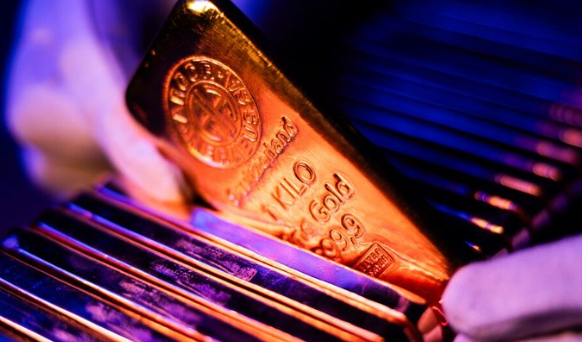

Web Desk: Gold has regained momentum after a turbulent start to 2026, with investors increasingly turning to the precious metal as concerns about government debt, currency weakness and monetary policy reshape financial markets.
The noble metal climbed above $4,600 an ounce in August for the first time since May, marking a sharp recovery from its earlier decline. Gold had surged for several years before reaching more than $5,500 an ounce in January, but subsequently fell sharply and at one point approached the psychologically important $4,000 threshold.
The recent recovery has prompted investors to reconsider whether the latest move represents the beginning of another sustained advance.
One of the main factors influencing gold has been growing uncertainty over US fiscal policy and interest rates.
Investors have been closely watching the US Treasury market as authorities seek to contain borrowing costs and manage a large government debt burden. At the same time, President Donald Trump has repeatedly called for lower interest rates.
These developments have contributed to concerns that major economies could tolerate weaker currencies or pursue policies that effectively reduce the real burden of government debt.
The US dollar has consequently weakened against a broad group of currencies, including those of emerging markets, strengthening the appeal of gold as an alternative store of value.
Another indicator drawing investor attention is the US money supply.
US M2, a broad measure of money circulating in the economy, has started to increase. Rising liquidity can be supportive for gold because investors often seek hard assets when they anticipate easier monetary conditions or a loss in the purchasing power of currencies.
Gold also tends to respond to movements in government bond yields and the shape of the yield curve.
Ian Williams, manager of the YFS Charteris Gold and Precious Metals Fund, has said gold and silver historically respond to seasonal patterns and that the recent period of weakness could give way to a stronger phase.
He also argues that gold generally performs better when the yield curve steepens.
Despite gold’s recent gains, several major financial institutions continue to see potential for higher prices.
Morgan Stanley has projected that gold could move above $5,000 an ounce in 2027, while warning that the path is unlikely to be smooth.
Deutsche Bank analyst Michael Hsueh has raised his price target to $4,800, while Citi analysts have also cited a $4,800 target. Citi has maintained a longer-term six-to-12-month target of $5,000.
State Street has offered an even more ambitious long-term outlook, with its head of gold suggesting that prices could eventually reach $10,000 an ounce.
Such forecasts have helped attract fresh money into gold-backed investment products.
According to Morgan Stanley, gold exchange-traded funds accumulated about 70 metric tons in July and August, reversing roughly 93 tons of withdrawals recorded during May and June.
Gold prices have recently come under pressure after the US Federal Reserve adopted a more hawkish position on interest rates in an effort to reassure bond investors.
Higher interest rates can weigh on gold because the metal does not generate interest income, making it relatively less attractive compared with yield-bearing assets.
Still, some investors believe a prolonged period of rate increases is unlikely and expect monetary easing to return, potentially providing another boost to gold.
There is also a less obvious risk to the bullish gold outlook.
A large part of the current investment case assumes that inflation remains elevated, energy costs increase, economic growth slows and governments struggle to control fiscal deficits.
However, a stronger-than-expected productivity boom driven by artificial intelligence could produce the opposite outcome.
If AI reduces labour costs, lowers rental pressures and contributes to cheaper energy and faster economic growth, inflation could moderate. Stronger growth could also increase government revenues and make it easier for major economies to reduce their deficits.
Such a deflationary environment could weaken demand for gold.
The possibility should not be dismissed, although supporters of gold argue that the fiscal and monetary risks facing major economies remain significant.
Beyond Western markets, China is emerging as an increasingly influential force in global gold demand.
Analysts at S&P Global have described gold as a strategically important mineral for China and expect Beijing to continue increasing its holdings while supporting the domestic gold industry.
China’s central bank has also remained active in the market. It purchased nearly 15 metric tons of gold in June, its largest monthly addition since October 2023, according to the data cited in the analysis.
Poland’s central bank has also continued to buy gold, highlighting the broader interest among central banks in diversifying reserves.
Meanwhile, physical gold trading is becoming increasingly concentrated in China, with Shanghai playing a growing role in the international market.
Investors seeking exposure to the gold rally do not necessarily have to buy the metal itself.
Gold-mining companies could benefit disproportionately if bullion prices continue climbing, particularly smaller and mid-sized producers whose profits can rise rapidly when the price of gold increases.
That makes smaller mining companies an area worth watching as a potential gold upcycle develops.
One investment vehicle highlighted by analysts is the UK-listed Golden Prospect Precious Metals investment trust, which focuses on small and mid-cap mining companies.
The trust recently changed its management team and appointed Baker Steel Capital Managers LLP. The new managers already oversee a precious-metals unit trust with a strong performance record.
The investment trust has also announced an enhanced dividend policy equivalent to 6% a year and is considering a move to the Main Market.
Gold’s recent rebound has revived expectations of another major rally, supported by concerns over fiscal deficits, a weaker dollar, central-bank purchases and the possibility of lower interest rates.
However, investors face a divided outlook. A return to monetary easing and persistent concerns about government debt could push gold higher, while an unexpected productivity-driven period of deflation could undermine the metal’s appeal.
For now, the combination of fiscal uncertainty, central-bank demand and renewed investment flows suggests that gold remains firmly on the radar of global investors.
Read more: Germany EU card opens job opportunities for skilled Pakistanis