


A new report by the US-based Jamestown Foundation has made startling revelations, alleging that the Afghan Taliban are using the country’s mineral wealth, worth trillions of dollars, for their own interests through serious corruption and elite exploitation.
According to the report, the mining sector is being used as a means of private financial funding rather than for national development. The document also highlights serious issues including child labour, environmental damage and the displacement of local communities.
Key Points of the Report
The Jamestown Foundation report, titled “The Taliban’s Mining Economy,” states that the Taliban are bringing national resources under central control and using them as a means to strengthen political power.
According to the report, mining revenues, contracts and royalties are being channelled into specific elite networks instead of transparent state accounts. This lack of transparency increased further after the appointment of Hidayatullah Badri, who was under UN sanctions in July 2024, as Minister of Mines and Petroleum.
The report also makes clear that the race for short-term financial gains has led to issues such as forced child labour, environmental destruction and the forced displacement of local communities.
Value of Mineral Resources and Taliban Strategy
According to estimates by the US Geological Survey, Afghanistan’s mineral wealth could exceed $1 trillion, while more than 1,400 mineral deposits have been identified across the country’s 34 provinces.
These deposits include zinc, lead, copper, antimony, lithium, rare earth elements and cobalt, which have attracted the attention of several regional and global powers, including China, India, Pakistan and the United States.
According to the report, the Taliban have so far awarded more than 205 mining contracts to over 150 companies. In September 2023, the Taliban announced new mineral agreements worth more than $6.5 billion, while in May 2024, the Taliban Ministry of Mines claimed that more than $7 billion in investment had been secured from China, Qatar, Türkiye, Iran and the United Kingdom.
Official figures show that more than 95% of reported revenue in 2024 was recorded during the first seven months, while only $1 million in revenue was publicly reported during the following five months. Due to such financial irregularities, Afghanistan was suspended from the Extractive Industries Transparency Initiative (EITI) in June 2024.
However, details of these agreements have still not been made public. The report stresses that despite this large-scale international activity, the Taliban are treating mineral resources as a central source of revenue rather than as part of a long-term national development plan.
Transparency Crisis and Badri’s Appointment
According to the report, transparency declined further following the appointment of UN-sanctioned Taliban leader Hidayatullah Badri as head of the Ministry of Mines. Following his appointment, official reporting on mining sales declined significantly.
According to official figures, more than 95% of reported mining revenue for 2024 was recorded during the first seven months, while only around $1 million was publicly reported during the remaining five months.
This decline has further strengthened concerns over whether Afghanistan’s mineral wealth is being used for public welfare or is instead being confined to Taliban elite networks.
According to Afghan observers, a so-called “mineral mafia” operates within the Taliban, collecting taxes, royalties, licence fees and direct payments from miners, transporters, exporters and local traders. Afghanistan’s suspension from the EITI in June 2024 has also been described as clear evidence of this lack of transparency.
Environmental and Social Damage
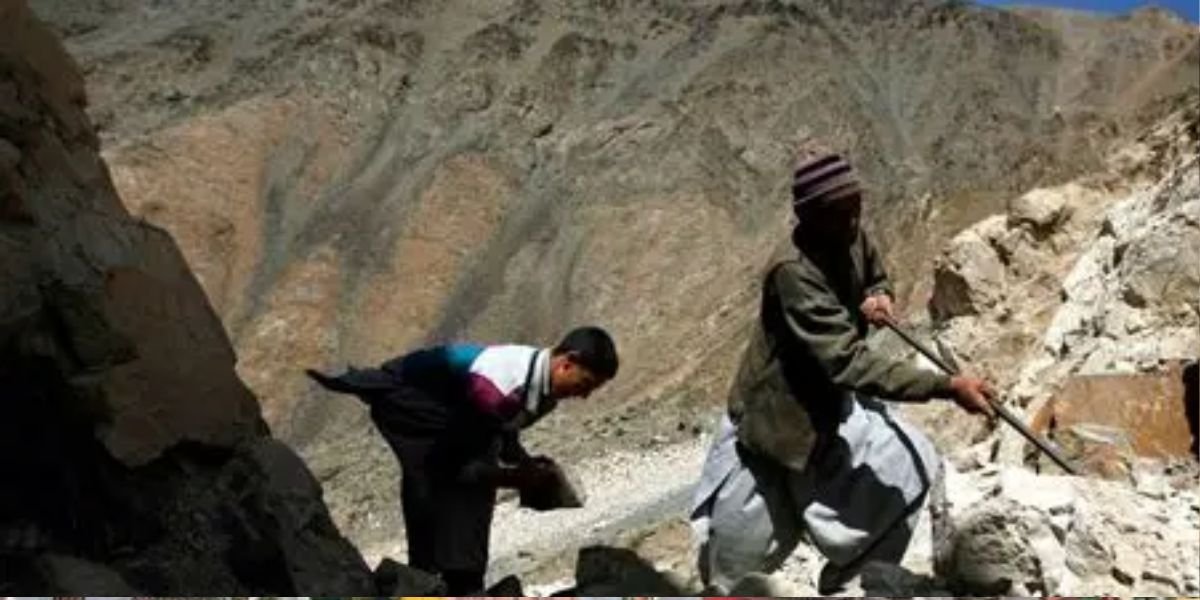
The report also mentions the serious social and environmental consequences of the Taliban’s mining economy. Although mining has boosted business activity to some extent, the sector is also consuming scarce resources such as water and is linked to dangerous labour practices.
According to the report, children as young as eight years old have been seen working in northern Afghanistan’s coal mines without machinery or protective equipment.
In northern provinces such as Badakhshan and Takhar, gold mining has expanded under the patronage of Taliban-linked local leaders, while local communities have complained of displacement and being deprived of profits.
In some areas, disputes over control of mines have also turned into deadly clashes, including disputes linked to Chinese-backed mining interests.
The Taliban returned to power in Afghanistan in August 2021, after which the mining sector became one of the group’s most important sources of revenue.
During the war that followed the September 11, 2001 attacks, the Taliban taxed mining activities, controlled transportation routes and collected fees from traders to fund their insurgent activities.
After returning to power, these same practices were institutionalised. Nangarhar province, which is rich in minerals such as chromite, talc and nephrite, has received the largest number of mining contracts issued by the Taliban. A global report in 2018 also highlighted that talc from the province had been an important source of Taliban revenue.
At the end of June last month, the Taliban leadership deployed around 1,000 special forces personnel to Badakhshan to further strengthen direct control over the province’s mines.
This is not the first time the Taliban have taken coercive measures to tighten their grip over mineral resources.
Also Read: Indian Air Force serving wing commander arrested for leaking defence information