
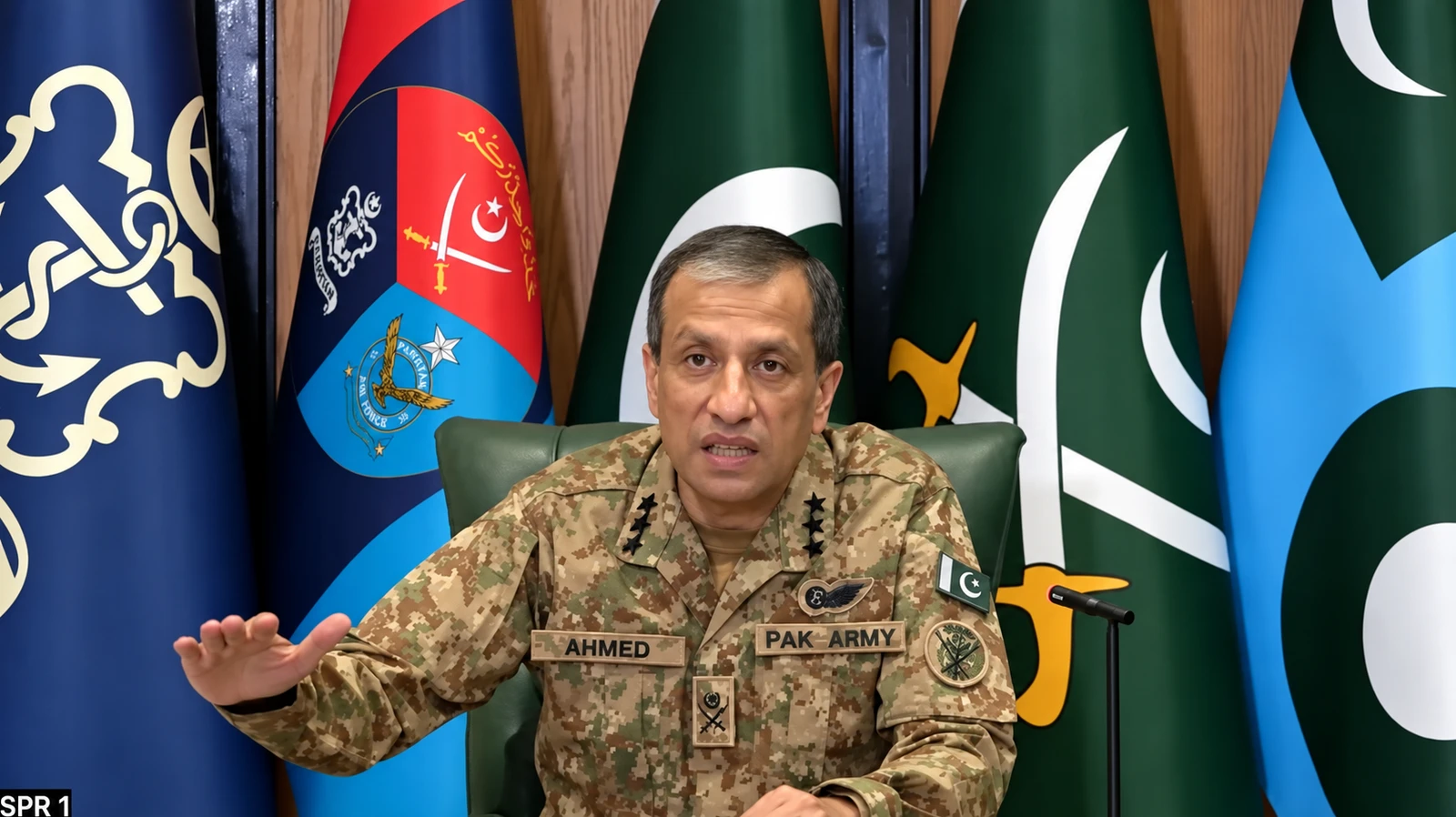
ISLAMABAD: Pakistan will go “to any extent” to defend Saudi Arabia against foreign aggression, the spokesperson for Pakistan’s military said in an interview with Arab News.
The remarks by Lt. Gen. Ahmed Sharif Chaudhry, head of Inter-Services Public Relations, come as escalating Houthi strikes test new collective-defense agreements linking nuclear-armed Pakistan to the Kingdom.
“Pakistan fully stands with the Kingdom of Saudi Arabia, both diplomatically and physically,” Lt. Gen. Ahmed Sharif Chaudhry, Director General of Inter-Services Public Relations (ISPR), emphasized in an interview with Arab News on Thursday. “And I would like to underscore here the word physically … We will go to any extent.”
Unconditional Security Commitments
Furthermore, Ahmed Sharif Chaudhry stressed that Islamabad’s commitment explicitly covers the defense of Saudi sovereign territory as well as Islam’s two holiest sites in Makkah and Madinah. “There should be no doubt on that,” he affirmed. “So, in a nutshell, we are there and we will continue to defend the Kingdom of Saudi Arabia against any aggression.”
Notably, Chaudhry’s assertive language marked a distinct shift from Islamabad’s more reserved public formulation last week. At that time, the Foreign Office stated that no immediate Pakistani military response was under active consideration pursuant to the Makkah Agreement — a trilateral defense pact under which an armed attack on Pakistan, Saudi Arabia, or Turkiye is deemed an attack on all three — while nevertheless adding that Pakistan would act “when the time comes.”
Nuclear Ambiguity and Troop Deployment
Although neither agreement’s full operational provisions have been made public, lingering questions remain regarding the precise operational triggers required for military action. In the meantime, Pakistan already maintains a substantial military presence on the ground inside Saudi Arabia.
“Our commitment to Saudi security is unconditional,” Chaudhry reiterated. “It stems from an emotive, deep-rooted, historical, and unbreakable bond between the people of Pakistan, the people of the Kingdom of Saudi Arabia, and the political and military leaderships of both countries.”
Meanwhile, Saudi Arabia has actively approached several global allies — including Pakistan, Britain, France, and Egypt — seeking operational support as repeated Houthi missile and drone strikes place unprecedented strain on the Kingdom’s air defense inventories, according to an Associated Press report earlier this week. Consequently, when pressed on whether Riyadh had formally requested additional troops, air-defense batteries, or direct kinetic participation against the Houthis, Chaudhry declined to disclose specific operational details.
Similarly, he refrained from either confirming or ruling out whether Pakistan’s nuclear deterrent falls within the scope of its defense guarantees. This ambiguity follows previous conflicting signals from Pakistani officials: Defense Minister Khawaja Asif initially noted after the 2025 bilateral pact was signed that Pakistan’s strategic nuclear capabilities could be extended to Saudi Arabia if required, though he subsequently clarified to Reuters that nuclear weapons were “not on the radar” of the agreement.
Back-Channel Diplomacy and the Islamabad MoU
Parallel to these defense assurances, Islamabad is actively pursuing high-level diplomatic channels to prevent the broader regional conflict from spiraling out of control. Specifically, Pakistan has sought to serve as a key mediator in the ongoing U.S.-Iran confrontation, while simultaneously conveying Riyadh’s stern warnings to Tehran regarding its leverage over Houthi forces.
In line with these diplomatic efforts, Field Marshal Syed Asim Munir, Pakistan’s Army Chief and Chief of Defense Forces, held a telephone conference on Wednesday with Iranian Foreign Minister Abbas Araghchi during the latter’s official visit to Beijing. While Iranian state media reported that the leaders discussed overarching regional developments, official readouts did not explicitly disclose whether Houthi strikes were directly addressed.
Commenting on the diplomatic call, Lt. Gen. Ahmed Sharif Chaudhry stated: “The politico-military leadership of Pakistan remains in continuous communication with the esteemed leadership of the Kingdom of Saudi Arabia on all these matters.” He further added that Pakistan’s political leadership and Foreign Office are holding ongoing consultations across regional capitals to secure “a negotiated and peaceful outcome” to the broader regional crisis.
Ultimately, Pakistan’s diplomatic positioning builds upon months of painstaking mediation between Washington and Tehran, which previously yielded the landmark Islamabad Memorandum of Understanding in June. Although that agreement established a baseline framework for resolving disputes over Iran’s nuclear program and regional security architecture, subsequent follow-up negotiations have stalled amid renewed kinetic escalation.
Nevertheless, Chaudhry reaffirmed Pakistan’s commitment to the framework, characterizing the Islamabad MoU as “a consensus document which we think provides the only real pathway forward for getting out of this complex military situation.”
Asked whether Islamabad expects to bring Washington and Tehran back to the negotiating table in the near future, DG ISPR offered no definitive timeline, emphasizing instead that Pakistan remains committed to finding common ground despite persistent mistrust and external spoilers.