

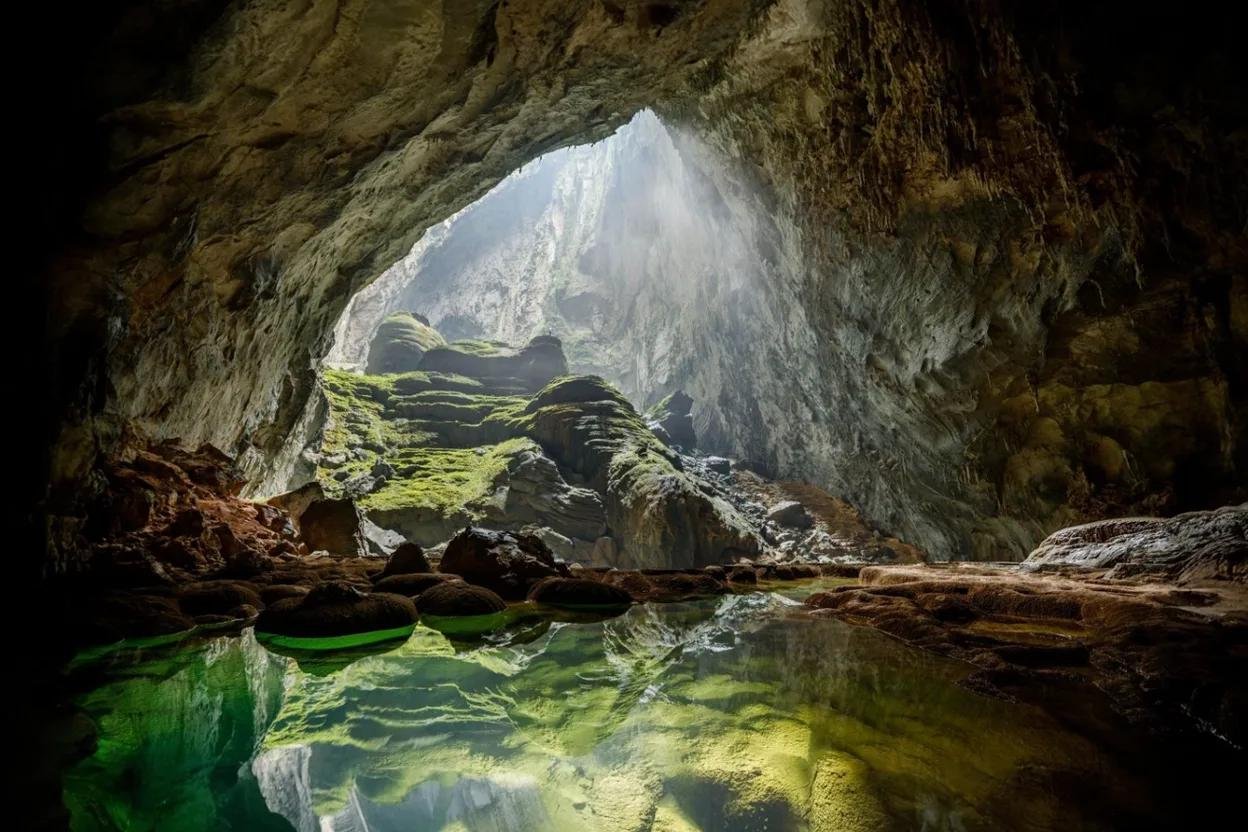
Web Desk: Deep beneath the forests of central Vietnam lies Son Doong Cave, a colossal underground system widely recognised as the world’s largest cave by volume. Located in Phong Nha-Ke Bang National Park, the cave stretches for roughly 9 kilometers and contains an estimated 38.5 million cubic meters of space. Its enormous chambers reach heights comparable to skyscrapers, creating an underground landscape unlike almost anywhere else on Earth.
However, Son Doong’s extraordinary size is only part of its significance. The cave contains underground rivers, dense vegetation, unusual wildlife and atmospheric conditions that allow clouds and mist to develop beneath the surface.
The cavern formed through a lengthy geological process involving water and limestone. Rainwater gradually dissolved the rock, while underground rivers widened cracks and passages over millions of years. Geological faults also contributed to the development of the enormous chambers.
The limestone itself is far older than the cave. Some of the surrounding formations date back hundreds of millions of years and contain fossils of ancient marine organisms, offering evidence of a time when the region was covered by an ancient sea.
Although a local man discovered the cave entrance decades ago, its true scale remained unknown until an expedition explored the system in 2009. Further exploration later confirmed its extraordinary dimensions.
Inside Son Doong, the environment can resemble a world above ground. Temperature differences between the cave and the outside atmosphere create mist and clouds in its enormous chambers. Underground rivers carry water through the cavern, while seasonal flooding can dramatically change conditions.
In some areas, water has carved passages through limestone and created pools, waterfalls and mineral formations. Elsewhere, stalactites and stalagmites have developed over extremely long periods, with some formations reaching remarkable sizes.
Perhaps the most unusual feature of Son Doong is its underground rainforest. Sections of the cave roof have collapsed, creating huge openings known as dolines. Sunlight enters through these openings, allowing plants to grow hundreds of meters below the surrounding surface.
Trees, mosses, algae and other vegetation have adapted to the unusual environment. Some trees grow tall and slender as they compete for sunlight. The soil is enriched by organic material, including bat guano accumulated over long periods.
The forest also supports a variety of animals, including insects, snakes and monkeys. Researchers have documented hundreds of plant and animal species throughout the cave environment, demonstrating how sunlight entering through the collapsed sections can transform an underground chamber into a functioning ecosystem.
Away from the skylights, darkness dominates the cave. Some organisms have adapted by relying less on sight and more heavily on other senses. Blind fish inhabit underground pools, while cave insects have developed specialised ways to locate food.
The cave also contains rare formations such as cave pearls, which develop as minerals gradually accumulate around tiny particles. Some examples can become remarkably large after centuries of mineral deposition.
One of Son Doong’s most famous obstacles is an enormous limestone formation known as the Great Wall of Vietnam. Explorers encountered the barrier during early expeditions before eventually developing a way to cross it.
Beyond the wall, the route continues toward the cave’s exit, where natural light gradually becomes visible. The journey demonstrates the extraordinary range of environments contained within a single underground system.
Despite its international fame, access to Son Doong remains strictly controlled. Authorities and expedition operators limit visits to reduce the impact of tourism on the cave’s delicate formations and wildlife.
Son Doong is therefore more than a record-breaking cave. It is a complex underground environment where ancient geology, rivers, forests, wildlife and unusual weather conditions coexist. Its discovery has offered scientists and explorers a rare glimpse into a hidden ecosystem shaped over millions of years, while its restricted access underscores the importance of preserving the natural world beneath Vietnam’s forests.
Read more: Pakistan starts exporting locally manufactured car