


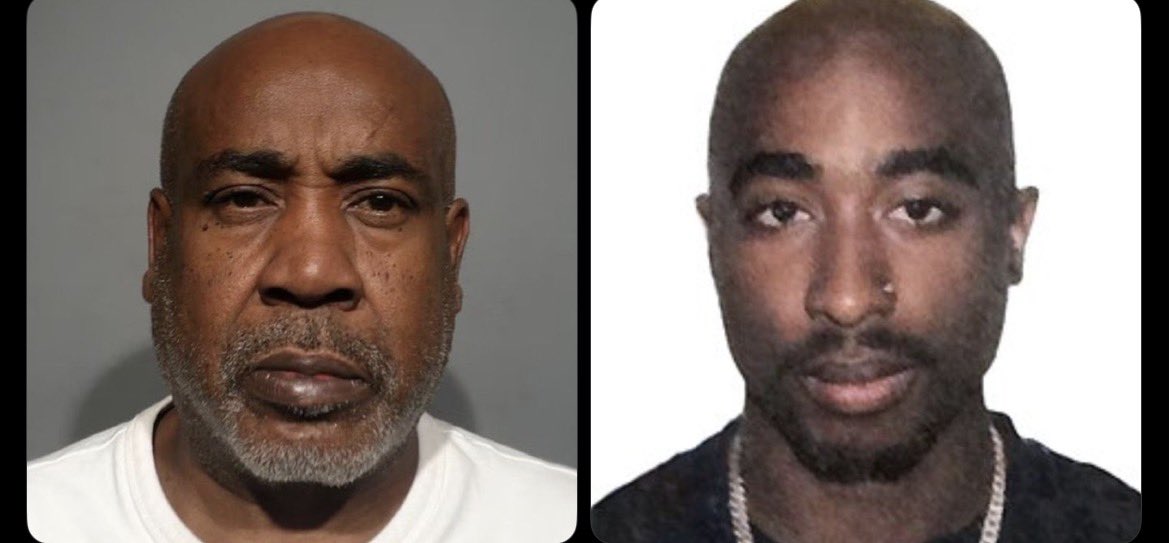
Web Desk: Former gang leader Duane “Keffe D” Davis has been sentenced to at least 40 years in prison for his role in the 1996 killing of rap icon Tupac Shakur, bringing a landmark chapter in one of the United States’ most closely watched cold cases to a close.
A Nevada jury convicted Davis, 63, in September of murder with a deadly weapon in connection with the drive-by shooting that killed Shakur in Las Vegas on Sept. 7, 1996. Davis has maintained that he will appeal the conviction.
Although Davis did not pull the trigger, prosecutors argued that he organized the attack and provided the firearm used in the shooting.
Authorities said Davis, a former leader of the South Side Compton Crips, was inside a white Cadillac when gunfire erupted at Shakur’s vehicle. Prosecutors alleged that his nephew, Orlando Anderson, was the gunman.
Anderson, whom Davis identified in accounts of the incident, was killed in an unrelated shooting in 1998. He denied involvement in Shakur’s death before his own killing.
Prosecutor Marc DiGiacomo told the court during Tuesday’s sentencing that Davis had spent years publicly discussing and boasting about his connection to the killing.
He argued that Shakur’s death had consequences far beyond the music industry and continued to affect his family, fans and the wider culture.
Shakur’s sister, Sekyiwa Shakur, told the court that the rapper’s death devastated their family and cut short a life filled with ambition.
“The loss of Tupac, for a long time, crippled my family,” she told the court, describing her brother as someone who wanted to improve his community and create a better future.
She urged the judge to impose the maximum possible sentence, telling Davis that prison would give him time to reflect on the consequences of his actions.
Shakur’s brother, Maurice Shakur, also addressed the court and called for the longest sentence available.
Before imposing the punishment, Judge Carli Kierny told Davis that he could not take another person’s life and simply walk away from the consequences.
She noted that Shakur remained remembered around the world decades after his death.
Davis’ public comments about the killing became central to the prosecution’s case.
During a confidential 2008 police interview connected to the investigation into the death of fellow rapper Christopher Wallace, known as The Notorious B.I.G., Davis discussed his alleged role in Shakur’s killing.
Authorities had initially agreed not to prosecute Davis in exchange for information. However, prosecutors later argued that his subsequent public disclosures breached that protection.
Davis expanded on his account in his 2019 memoir, “Compton Street Legend,” and discussed the killing in several media interviews.
A judge subsequently ruled that his earlier police statements could be used against him at trial.
The defence argued that Davis’ accounts were exaggerated or fabricated for publicity and financial gain, portraying them as part of an effort to sell his book and build his public profile.
Shakur’s killing remained unsolved for almost 30 years, fueling theories and speculation among fans and investigators.
Journalist Cathy Scott, who covered the case when it happened and later wrote about the killing, said the combination of Shakur’s enormous fame, the Las Vegas setting and the mystery surrounding the unsolved case helped turn it into a lasting cultural phenomenon.
The case attracted renewed attention as Davis continued to speak publicly about his alleged involvement.
Scott said the unresolved nature of the investigation helped keep public interest alive for decades.
Shakur was 25 when he was killed, at a time when his career was reaching new heights. He became one of hip-hop’s most influential artists, with more than 75 million records sold worldwide.
His death, followed by Wallace’s killing several months later, became one of the defining tragedies of 1990s hip-hop.
Davis’ conviction marked the first successful prosecution in Shakur’s murder and ended decades of uncertainty surrounding one of music’s most famous unsolved killings.
Davis has said he intends to appeal the verdict.
Read more: Tupac Shakur’s murder mystery ends after 30 years