


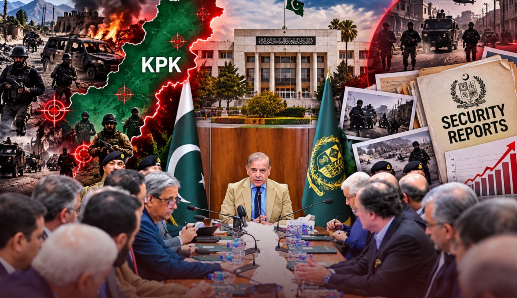
Web Desk: A high-level cabinet committee chaired by Prime Minister Shehbaz Sharif began a key meeting to review the deteriorating security and governance situation in Khyber Pakhtunkhwa, with two special security reports on the province expected to be presented, officials said.
The reports, prepared by the Khyber Pakhtunkhwa police and intelligence agencies, are expected to highlight a sharp rise in militant attacks, operational shortcomings and gaps in the province’s counterterrorism preparedness.
According to the reports, terrorism incidents in Khyber Pakhtunkhwa increased by 195% between March 1, 2024, and Sept. 23, 2026.
The reports describe the sustained increase in attacks as a major security challenge for the province. They also identify links between terrorist networks, local facilitators and illegal activities as an increasing threat to law and order.
Intelligence assessments attributed the worsening security environment to several factors, including the presence of terrorist elements in Afghanistan, local support networks and weaknesses in provincial preparedness and counterterrorism policies.
The reports are also expected to examine whether gaps in governance and inadequate attention to security measures have allowed terrorist groups to expand their operational space.
Police and other security institutions have borne much of the brunt of the violence.
The reports said 73% of terrorist attacks recorded in Khyber Pakhtunkhwa during 2026 targeted police and other security agencies, underscoring the growing pressure on frontline law enforcement personnel.
At the same time, terrorists have increasingly adopted drones as part of their tactics. While no drone attack against police or security agencies was reported in 2024, the number of such attacks reached 170 in 2026, according to the assessment.
The reports also pointed to a rise in improvised explosive device attacks. The number of IED attacks climbed to 181 in 2025, while 159 incidents had already been recorded through September this year.
The security assessments identified significant shortages in the Khyber Pakhtunkhwa police, including more than 9,000 vacant positions.
The police and Counter Terrorism Department also face shortages of modern weapons, operational equipment, surveillance systems and intelligence-gathering technology, according to the reports.
Night-vision and thermal-imaging equipment remains insufficient, while police in the province’s merged districts continue to face shortages of training, resources and operational capacity.
The reports further highlighted a lack of armored and protected vehicles in the southern districts, among the areas most affected by terrorism. The shortage has restricted police mobility and weakened their ability to conduct operations in high-risk areas.
The Counter Terrorism Department is also struggling with a shortage of specially trained personnel despite its specialised role, the reports said.
The department continues to rely on regular police personnel to meet manpower requirements, while its district offices, operational facilities and specialised infrastructure remain inadequate for the scale of the threat.
The reports called for modern and dedicated infrastructure to strengthen the CTD’s ability to respond to increasingly sophisticated terrorist tactics.
The security assessment also noted that the Safe City initiative, intended to strengthen surveillance and crime prevention across Khyber Pakhtunkhwa, remains limited to Peshawar rather than covering the province as a whole.
The reports argued that law enforcement agencies need greater technological and operational capacity to keep pace with the changing methods used by terrorist groups.
The cabinet committee is expected to conduct a detailed review of the province’s deteriorating law-and-order situation, including the causes behind the increase in terrorism and the responsibilities of relevant institutions.
The meeting will also examine gaps in security preparedness, the capacity of law enforcement agencies and the effectiveness of existing counterterrorism measures.
Officials said the committee would assess the institutional weaknesses and governance challenges contributing to the deteriorating security environment and consider measures to strengthen the province’s ability to confront the growing threat.
Read more: KP Police Issue New Guidelines for Handling Protests and Riots