


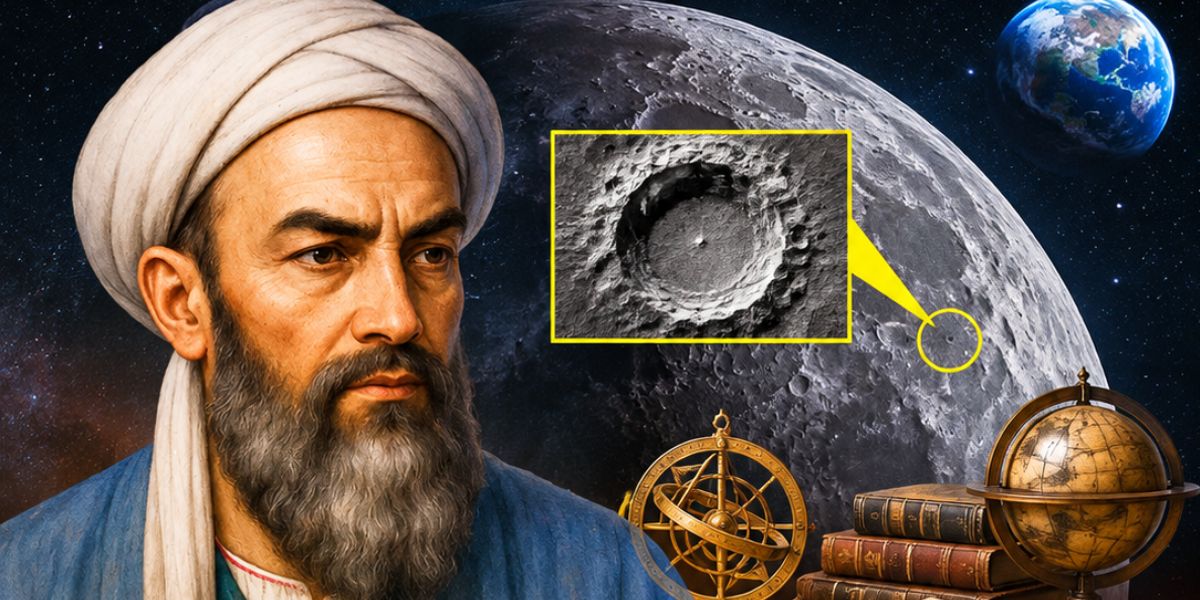
Did you know that a massive crater on the Moon is named after a Muslim scientist who made remarkable contributions to astronomy, mathematics, geography and physics nearly 1,000 years ago?
The lunar crater, named after Abu Rayhan Al-Biruni, stands as a tribute to his extraordinary scientific achievements.
According to the official planetary nomenclature records maintained by the United States Geological Survey (USGS), the crater measures approximately 80 kilometres in diameter. Its name was officially approved by the International Astronomical Union (IAU) in 1970.
Who Was Al-Biruni?
Crater on the Moon was born in 973 AD in the region of Khwarazm. He was a renowned mathematician, astronomer, geographer, historian and researcher.
His scientific approach was based on observation, experimentation and mathematical calculations.
One of Al-Biruni’s most remarkable achievements was developing a method to calculate the Earth’s radius using the height of a mountain and the angle of the horizon.
At a time when modern telescopes and advanced space technology did not exist, his work represented an extraordinary scientific accomplishment.
How Did Al-Biruni’s Name Reach the Moon?
The naming of craters and other geographical features on celestial bodies follows guidelines established by the International Astronomical Union.
Over the years, lunar craters have been named after distinguished scientists, mathematicians and scholars in recognition of their contributions to human knowledge.
Al-Biruni was among those whose scientific legacy was immortalised through the naming of a geographical feature on the Moon.
Today, the name of the Muslim scholar who sought to measure the Earth remains engraved in lunar geography, hundreds of thousands of kilometres away from our planet.
The crater is more than a geographical feature; it represents Al-Biruni’s enduring scientific legacy and the remarkable contributions of Muslim scholars to human knowledge.
Also Read: New gene discovery could help restore hearing after decades of research