



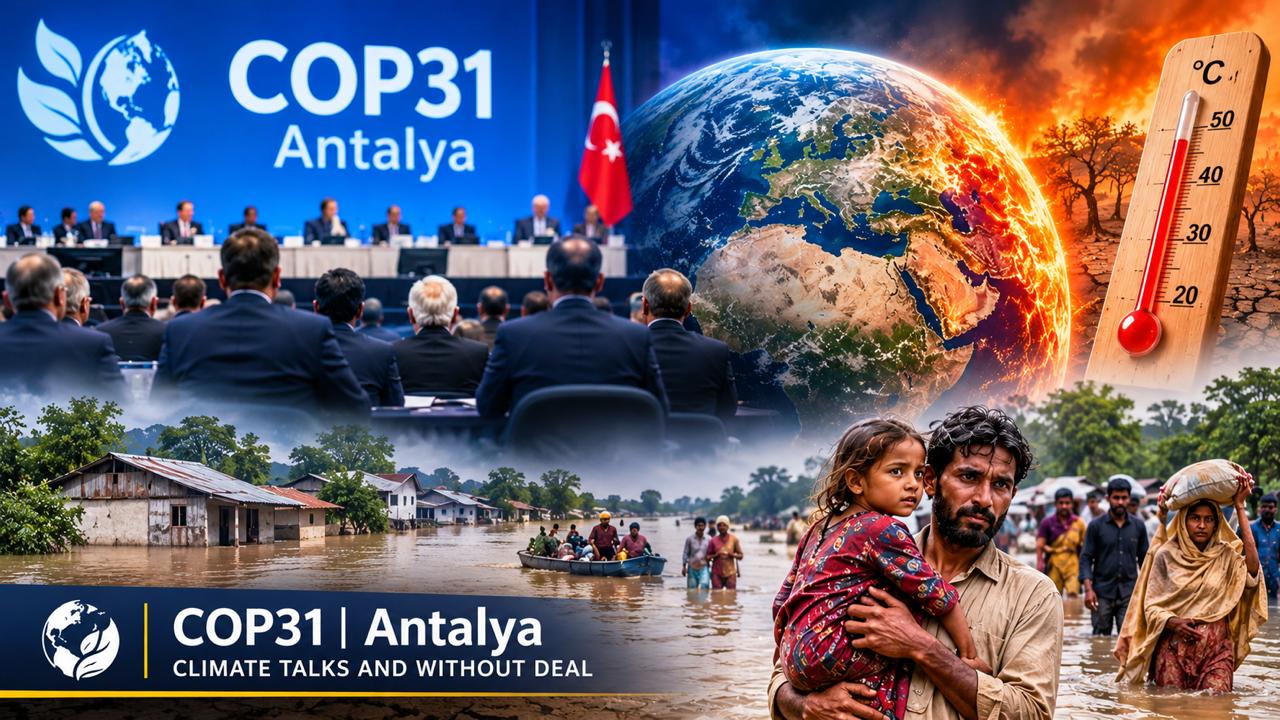
When we hear that COP31 ended without a pact in Antalya, it can easily sound like just another news headline: a failed draft, a rejected text, and leaders walking away empty-handed. After extending beyond its deadline and becoming the longest climate summit in history, the meeting broke down without an agreement after the European Union rejected a final draft that did not mention fossil fuels. On paper, this looks like a routine diplomatic failure. In reality, however, the consequences extend far beyond diplomacy. It is a warning of a crisis that could become an even bigger and longer-lasting threat to human life than COVID-19.
When negotiators spend weeks arguing over whether the words “fossil fuels” belong in an official agreement, they are not merely debating vocabulary. They are arguing over the primary driver of global warming. In human terms, failing to confront oil, gas, and coal means more extreme heatwaves, stronger storms, erratic monsoons, and faster glacier melt. It means more lives lost to climate-linked health emergencies and millions more people pushed into daily danger.
What appears to be a technical disagreement inside a conference hall in Türkiye translates into flooded homes, ruined harvests, and communities forced to flee rising waters. This is no longer a distant threat confined to one corner of the globe; it is already playing out in catastrophic floods across South Asia and Pakistan, just as severe flooding and extreme weather events are increasingly hitting cities across Europe and North America.
There is also a second human cost that often gets buried beneath diplomatic jargon: what stalled global cooperation means for ordinary people trying to build a future in developing nations. When climate finance and adaptation frameworks remain unresolved, the consequences are felt directly in everyday life. It can mean a family in a climate-vulnerable region waiting longer for a safe, flood-resilient home, a young generation losing access to clean infrastructure and sustainable development, or farmers lacking the tools and resilient seeds needed to survive shifting weather patterns.
Crucially, this issue should never be framed as charity or developing countries asking for handouts. Climate action is a matter of shared global responsibility, where every nation is contributing to the solution in its own capacity. Developing countries are already investing heavily from their own limited budgets to rebuild after disasters, plant forests, and shift towards renewable energy. When they call for predictable climate finance and technology transfer, they are not asking for favours; they are asking for fair partnership in solving a crisis that crosses all borders and affects everyone’s future.
At the same time, an honest and balanced assessment requires looking critically at both sides of the stalemate in Antalya. On one hand, major energy producers such as Saudi Arabia and Russia resisted stronger language on fossil fuels. India also opposed a uniform phase-out approach, arguing that countries must retain flexibility to protect energy security, economic growth and poverty reduction. These concerns reflect the difficult balance between climate commitments and national development priorities. Asking economies that rely heavily on traditional energy to dismantle their systems overnight without secure alternatives carries real domestic risks.
On the other hand, the European Union should not mistake rejecting an imperfect draft for being an environmental champion. Walking away from the table may look principled on the surface, but real climate leadership is not measured by blocking a weak text. True leadership is measured by delivering on shared commitments, addressing historical responsibility, and helping build practical pathways so that all nations can transition safely rather than leaving vulnerable countries to bear the immediate human cost of diplomatic inaction.
That deeper divide also explains why the draft text in Antalya leaned heavily on middle-ground formulas, including carbon capture, use, and storage (CCUS), a call to increase electricity’s share of final energy consumption to 35 percent by 2035, and an unprecedented acknowledgment that global warming is on course to pass the 1.5°C threshold set in the 2015 Paris Agreement. The 1.5°C threshold is not merely an abstract scientific target. It represents a critical limit beyond which climate impacts become far more destructive and much harder to reverse.
Admitting in a negotiating text that the world is on track to cross that threshold, while countries like France simultaneously warned against relying too heavily on underground carbon storage instead of making real structural changes, shows just how narrow our margin for error has become.
Viewed against the arc of earlier summits, from the hope of COP21 in Paris to the prolonged delays of COP25 in Madrid and the hard-won compromise on transitioning away from fossil fuels at COP28 in Dubai, Antalya feels less like a sudden accident and more like the result of years of fragile trust. Yet a collapsed summit is not the end of the road; it is a test of what comes next.
With Antalya ending without a deal, all eyes now turn towards the road to COP32 in Ethiopia. The failure in Türkiye means that the next summit cannot simply be business as usual. First, countries cannot afford to lose another year waiting for formal declarations; national governments, businesses, and regional alliances will have to accelerate clean energy and resilience projects on their own. Second, hosting COP32 in Africa, a continent that contributes minimally to global emissions yet suffers some of the harshest impacts of drought, food insecurity, and extreme weather, will place human survival and shared responsibility squarely at the centre of the table.
For COP32 to succeed where Antalya faltered, the months ahead must be used to rebuild trust before delegates even enter the main hall. That means moving past finger-pointing, making shared climate finance transparent and dependable, and recognising that energy security and climate safety must go hand in hand. Climate change does not pause for diplomatic fatigue, and its human toll will not wait for the next conference to find consensus. If the world treats the collapse of COP31 as just another routine setback rather than an urgent wake-up call, the human cost ahead will define an entire generation.