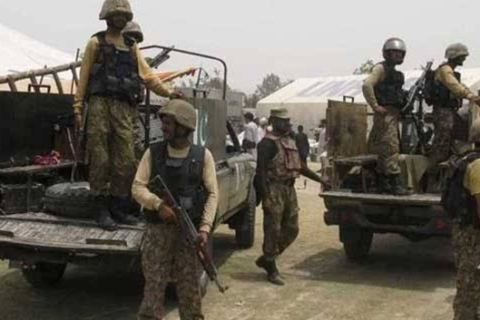

Web Desk: Various posts circulating on the social media platform X claiming that Pakistan is joining the International Stabilisation Force (ISF) alongside Israel are false. The post claims that, ‘according to the signed document, Pakistani soldiers will be working in close consultation and cooperation with Israel.’ The post further goes to claim that ‘Pakistan has not only recognised Israel but has also agreed to work under Netanyahu.’
The governing document of the body does not compel Pakistan, or any other participant, to deploy forces or take part in fighting in Gaza. Joining the mechanism is optional, and involvement in any operation depends entirely on the approval of individual members. While the charter calls on states to support peace-related activities in line with their own legal frameworks, it clearly states that no country can be forced to join a specific peace initiative without agreeing to do so.
As a result, Pakistan retains the option to contribute through non-military channels, including funding, logistical assistance or diplomatic engagement, without any obligation to send troops. The Foreign Ministry has underscored that Islamabad’s participation is centered on backing a lasting ceasefire and helping with Gaza’s reconstruction under a UN Security Council resolution, not on military deployment. Officials say Pakistan’s engagement remains diplomatic and humanitarian, carried out alongside other Muslim-majority countries such as Saudi Arabia and Egypt. Islamabad has also voiced hope that the arrangement will pave the way for a durable truce, increased humanitarian relief for Palestinians and the rebuilding of Gaza.
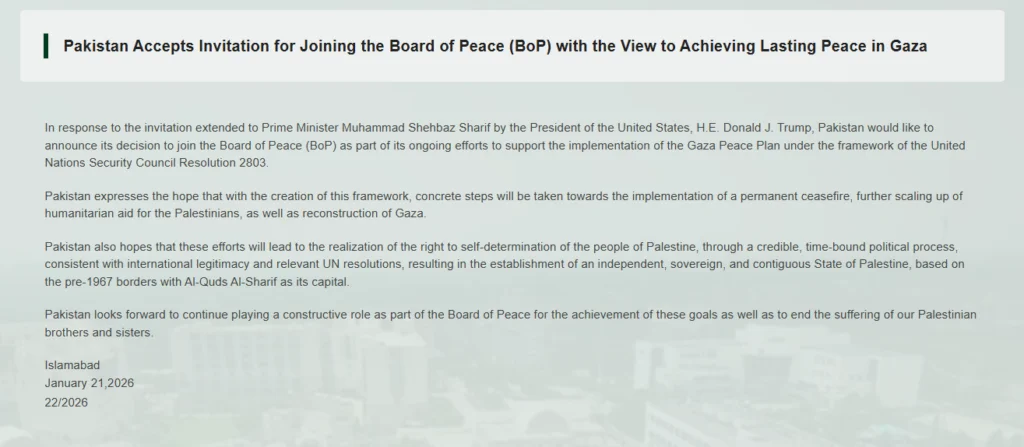
The board itself has a wide-ranging mandate. Its charter sets out goals of encouraging stability, rebuilding legitimate governance and fostering long-term peace in conflict-affected regions, but it stops short of detailing concrete actions beyond general peace-building principles. Although the body was originally focused on post-war recovery in Gaza, its remit was later broadened during the Trump administration to potentially take on crises elsewhere, prompting comparisons with institutions like the United Nations.
Within Gaza, proposed measures include supervising a body tasked with day-to-day reconstruction, supporting efforts to disarm Hamas and facilitating the presence of an international security force. The charter does not clearly define how the board will interact with the United Nations, though a Security Council resolution adopted in November 2025 endorsed its Gaza-related role through the end of 2027. What happens after that remains uncertain, and the relationship could overlap or even compete with existing UN mechanisms.
US President Donald Trump has publicly criticised the UN’s performance and at one point suggested the board could serve as a replacement, although he later said it would operate alongside the world body. As for Pakistan’s interaction with Israel, officials say any engagement would be indirect and limited to multilateral decision-making, similar to how both countries participate in forums such as the UN and the International Monetary Fund. Discussions would relate to collective issues like funding, reconstruction plans and peace initiatives, without establishing bilateral ties. Pakistan, they stressed, does not recognise Israel, and any cooperation would remain strictly within the board’s multilateral framework.
Read more: Trump says Pakistan PM honoured him for stopping India-Pakistan war