


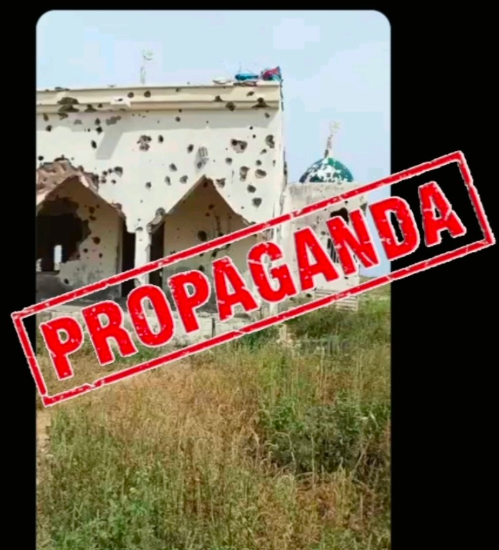
Web Desk: A social media post alleging that the Pakistan Army destroyed a mosque in Balochistan has raised questions about the authenticity of an image circulated alongside the claim, with the supplied fact-check account identifying the photograph as originating from Nigeria rather than Pakistan.
The post, attributed to an account named Waqar Khan and described as being associated with Pakistan Tehreek-e-Insaf (PTI) supporters in the United States, claimed that Pakistani troops used heavy and light weapons to demolish a mosque in the southwestern province.
However, the fact-check account disputes the image’s connection to Balochistan, saying it depicts the aftermath of a 2016 incident in a Nigerian area affected by Boko Haram’s insurgency.
The image’s original source and the precise circumstances in which it was taken require independent verification.
According to the supplied account, the social media post claimed that Pakistani security forces attacked and destroyed a mosque during an operation in Balochistan.
It further alleged that the military had justified the operation by claiming militants were receiving training inside the religious building.
The post also attributed statements to local residents who reportedly denied the presence of any armed group at the location.
However, the material provided contains no independently authenticated military statement supporting the claim that the army described the mosque as a militant training facility.
Similarly, no verifiable testimony from the purported local residents was included.
These omissions raise questions about the reliability of the account accompanying the image.
The supplied fact-check account identifies the photograph as showing a mosque damaged during a 2016 incident connected to Boko Haram’s insurgency in Nigeria.
It also refers to the death of a senior Nigerian military officer during an attack, although the precise location, date and circumstances of that incident were not established in the material provided.
If the image’s Nigerian origin is confirmed, its presentation as evidence of a recent Pakistani military operation would be misleading.
Nevertheless, establishing that a photograph was taken outside Pakistan would disprove its claimed location, not necessarily resolve every allegation about military operations in Balochistan.
Beyond the photograph, the post reportedly claimed that Pakistan’s military had acknowledged attacking the mosque because militants were using it for training.
That assertion requires separate scrutiny.
The supplied information does not include an official military press release, operational report or authenticated statement supporting such an explanation.
Consequently, the alleged justification should not be presented as an established position of Pakistan’s armed forces.
Likewise, claims that local residents contradicted the military’s account remain unverified without identifiable witnesses or independently documented testimony.
The supplied commentary also accuses PTI-linked social media accounts, Afghan proxy networks and Indian intelligence-linked accounts of coordinating disinformation campaigns targeting Pakistan.
However, it provides no technical evidence, independently verified account attribution or documented coordination establishing those alleged relationships.
The circulation of misleading content by an individual account does not, by itself, demonstrate that a political party or foreign intelligence service directed the activity.
Images from earlier conflicts can gain renewed attention when users attach them to current political or security developments.
Without clear information about their original location and date, such photographs may create a false impression that an event occurred in a different country or under different circumstances.
This risk is particularly significant in Balochistan, where security operations, violence and competing political narratives frequently attract public attention.
For journalists and readers, verifying the origin of visual material is therefore essential before treating it as evidence of a specific incident.
The supplied material raises a substantial concern that an image showing a mosque destroyed by Pakistani forces in Balochistan was taken from an unrelated incident in Nigeria.
Read more: PTI Left KP in Ruins After 13 Years of Misrule: Tariq Fazal Chaudhry