


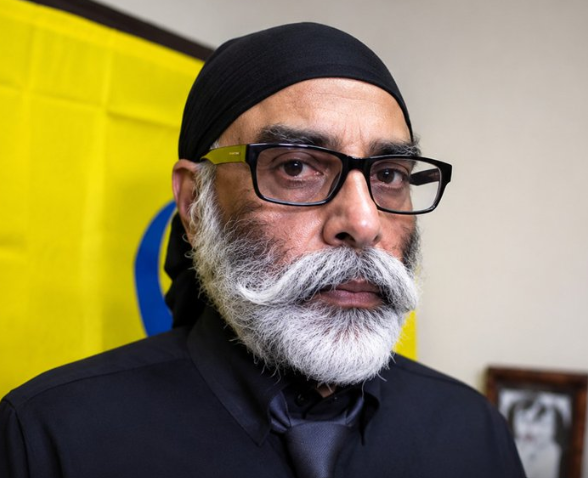
Web Desk: India’s national security establishment faces renewed scrutiny following reports that legal documents linked to a US lawsuit over a plot to assassinate Sikh separatist leader Gurpatwant Singh Pannun have been transmitted to the Indian government.
Indian media reports, citing US diplomatic correspondence, said documents associated with the civil lawsuit were forwarded to Indian authorities in October 2026. The case names senior Indian security officials, including National Security Adviser Ajit Doval, and raises questions about allegations of Indian intelligence operations beyond the country’s borders.
The development comes amid continuing legal proceedings in the United States over an alleged 2023 assassination plot targeting Pannun, a US-based advocate of an independent Sikh homeland known as Khalistan.
According to reports attributed to Indian newspapers The Hindu and Outlook, documents connected to proceedings in a New York court were transmitted to the Indian government through diplomatic channels.
Outlook reported that summonses and court notices were forwarded to the Indian Embassy on Oct. 9, 2026.
The reported transmission concerns a civil lawsuit filed by Pannun in September 2024 against the Indian government and several individuals allegedly connected to the assassination plot.
Those named in the lawsuit include Doval, former Research and Analysis Wing (RAW) chief Samant Goel, former Indian intelligence officer Vikram Yadav and Indian national Nikhil Gupta.
However, the transmission of court documents does not establish that those named committed wrongdoing. Nor does a summons amount to a judicial finding of responsibility.
The reported October 2026 development could not be independently verified from the material provided.
The legal controversy stems from allegations that individuals linked to India’s intelligence establishment attempted to arrange Pannun’s killing on American soil in 2023.
US prosecutors alleged that an Indian government employee directed a plot involving Gupta, who was accused of attempting to recruit a criminal intermediary to carry out the assassination.
Instead, the purported intermediary was working with US law enforcement, allowing investigators to uncover the operation.
American authorities subsequently brought criminal charges against Gupta, turning the case into a major diplomatic dispute between Washington and New Delhi.
The allegations intensified concerns over whether foreign intelligence operations had crossed into criminal activity within the United States.
The supplied account, citing Reuters, says Gupta pleaded guilty in February 2026 to three charges connected to the alleged assassination conspiracy.
If confirmed by the relevant US court records, that development would mark a significant step in the criminal proceedings.
Nevertheless, any admission of guilt by Gupta would not, by itself, establish criminal responsibility for Doval or the other individuals named in Pannun’s separate civil lawsuit.
The civil and criminal proceedings involve different legal standards and must be considered independently.
The Pannun case follows another controversy involving allegations of Indian involvement in the killing of Sikh separatist leader Hardeep Singh Nijjar in Canada.
In September 2023, then-Canadian Prime Minister Justin Trudeau said Canadian authorities were investigating credible allegations linking Indian government agents to Nijjar’s killing in British Columbia.
The dispute triggered diplomatic tensions between Ottawa and New Delhi and brought wider international attention to allegations concerning India’s treatment of Sikh separatist activists overseas.
However, the Canadian allegations and the US proceedings concern separate incidents and should not be treated as proof of one another.
Meanwhile, Pakistan’s military has repeatedly accused Indian intelligence agencies of supporting militant networks and conducting covert operations beyond India’s borders.
Pakistan’s military spokesperson, the director general of Inter-Services Public Relations (ISPR), has previously alleged that Indian security officials, including Doval, played a central role in planning or facilitating activities Pakistan describes as state-sponsored terrorism.
These remain allegations advanced by Pakistani authorities, rather than findings established by the U.S. proceedings involving Pannun.
Islamabad has long called for international scrutiny of cross-border intelligence operations, while India has rejected accusations that it sponsors terrorism.
The reported transmission of legal documents adds another dimension to the controversy surrounding India’s overseas security operations.
However, significant legal questions remain, including whether the US court has established jurisdiction over each defendant, whether service of process has been completed and how the civil proceedings will advance.
For now, the case highlights growing international scrutiny of alleged transnational assassination operations and the legal challenges involved in holding foreign government officials accountable.
Any determination of individual responsibility will depend on evidence presented in court and subsequent judicial rulings.
Read more: Banned JAAC opens unprovoked fire security forces, five injured, AJK Police