


Web Desk: India did not send an official high-level delegation to Iran for ceremonies following the deaths of senior Iranian figures, a decision that has drawn political scrutiny as New Delhi continues to deepen its strategic partnership with Israel.
By contrast, Pakistan dispatched a senior delegation led by Prime Minister Shehbaz Sharif and Field Marshal Asim Munir to attend memorial events in Iran, underscoring Islamabad’s close diplomatic engagement with Tehran.
The Indian government did not announce a high-level delegation for the memorial events in Iran, and officials have not publicly detailed the reasons for the decision.
The absence of a senior Indian delegation has prompted debate among political observers and commentators, some of whom argue that New Delhi is seeking to avoid complicating its increasingly close relationship with Israel. However, the Indian government has not linked its decision to relations with Israel.
Pakistan was represented by Prime Minister Shehbaz Sharif and Field Marshal Asim Munir, who traveled to Iran to participate in official mourning ceremonies.
Islamabad has consistently emphasized the importance of maintaining close ties with neighboring Iran while calling for regional stability and dialogue during periods of heightened tension in the Middle East.
India and Israel have steadily strengthened diplomatic, economic and defense relations over the past decade.
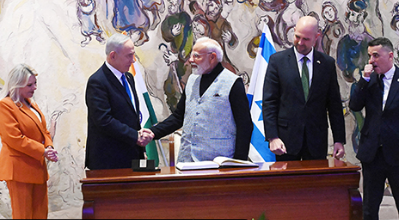
A milestone came in 2017 when Prime Minister Narendra Modi became the first Indian premier to visit Israel, marking a significant shift in bilateral relations. Since then, cooperation has expanded across defense, technology, agriculture, cybersecurity and trade.
India has emerged as one of Israel’s largest defense partners, while both countries have deepened strategic cooperation on regional and security issues.
The diplomatic contrast comes amid heightened tensions in the Middle East following recent military exchanges involving Israel and Iran.
Those developments have placed regional governments under increased pressure to balance competing diplomatic relationships while safeguarding their strategic interests.
India has traditionally maintained relations with both Israel and Iran. While New Delhi has significantly expanded cooperation with Israel in recent years, it also continues to view Iran as an important regional partner, particularly in areas such as connectivity and energy.
India’s decision not to send a senior delegation has fueled political discussion both domestically and internationally. Critics have argued that the move reflects New Delhi’s growing alignment with Israel, while supporters say India is pursuing a foreign policy based on its broader strategic priorities.
The Indian government has not publicly attributed its decision to any specific geopolitical consideration.
India established full diplomatic relations with Israel in 1992, but bilateral ties accelerated substantially after Narendra Modi took office in 2014. Modi’s landmark visit to Israel in 2017 was widely viewed as a turning point in the relationship, followed by reciprocal high-level engagements and expanded defense and technology cooperation.
Pakistan, meanwhile, has maintained close diplomatic engagement with Iran while also navigating broader regional security challenges. Islamabad’s decision to send both its prime minister and military chief to the memorial events highlighted the importance it places on relations with Tehran.
Read more: Field Marshal Asim Munir reaches Tehran