

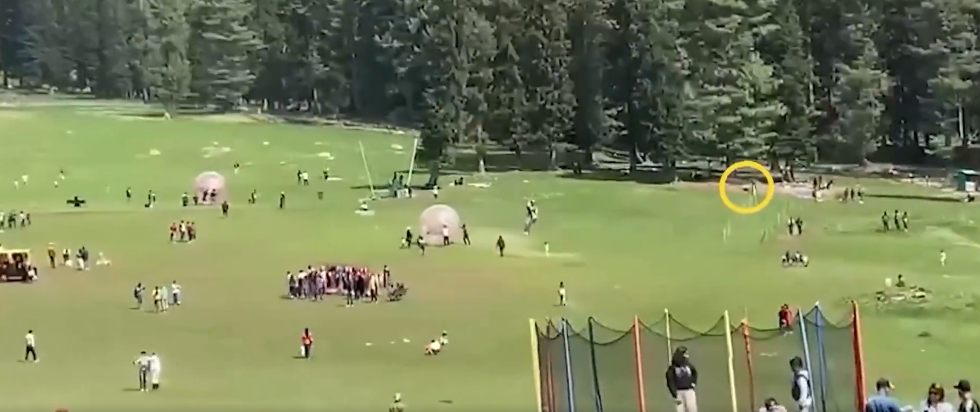
Web Desk: In May 2025, South Asia once again approached a dangerous flashpoint following an attack in Pahalgam. Within thirty minutes of the incident, social media platforms were flooded with hashtags blaming Pakistan, rising to the top of trending lists before any formal investigation had begun.
The speed of the accusations drew scrutiny. Observers questioned how assailants could travel across hundreds of kilometers in one of the world’s most heavily militarised regions without detection. Despite the absence of publicly verified evidence, India proceeded with what it described as targeted air and missile strikes. However, reports indicated that civilian areas and infrastructure were also affected.
Pakistan responded with what it named Operation Marka-e-Haq, or the Battle for Truth. Islamabad described the operation as a measured and deliberate act of deterrence rather than escalation.
According to Pakistani authorities, the operation focused on Indian military installations while deliberately avoiding civilian zones. Air defense systems were activated at full capacity, and multiple incoming threats were intercepted. During the confrontation, at least six Indian fighter jets attempting to enter Pakistani airspace were shot down.
Along the Line of Control, Pakistan carried out precision strikes targeting Indian military positions, damaging forward posts and logistical infrastructure. Officials also highlighted disruptions in communication systems, which they said exposed gaps in India’s operational planning. At the same time, Pakistan had also taken a leading role in cyber operations during the escalation.
Despite the intensity of the exchange, Pakistan emphasised restraint. DGISPR Ahmed Sharif Chaudhry stated that the response remained proportionate and defensive, underscoring that the objective was deterrence rather than further escalation.
Amid rising tensions, US President Donald Trump publicly commented on the situation, referencing Pakistan’s aerial performance and claims regarding Indian aircraft losses. He also stated that Indian Prime Minister Narendra Modi had requested a ceasefire.
Analysts such as Michael Kugelman suggested that beyond the battlefield, India also lost the global narrative war against Pakistan.
For many observers, the Pahalgam episode revived longstanding questions about whether such incidents follow a recurring pattern.
In 2019, the Pulwama attack killed more than 40 Indian paramilitary personnel. Pakistan was blamed almost immediately. However, later statements by Satya Pal Malik former governor of Indian Occupied Kashmir pointed to internal security lapses and administrative failures. He alleged that responsibility was deflected outward instead of being acknowledged domestically.
Pulwama soon became a focal point in India’s general election campaign. Nationalist sentiment surged and Narendra Modi secured re-election with a stronger mandate.
The crisis also led to the Balakot escalation and Pakistan’s Operation Swift Retort. During the aerial engagements, an Indian MiG-21 was shot down, and pilot Abhinandan Varthaman was captured. Pakistan later released him as a gesture aimed at de-escalation.
In September 2016, an attack in Uri killed 19 Indian soldiers. India quickly attributed responsibility to Pakistan and announced “surgical strikes” across the Line of Control. However, no independent international verification of such operations was conducted, and access to the claimed sites remained restricted.
The 2008 Mumbai attacks also triggered immediate accusations against Pakistan. While the perpetrators were eventually identified and prosecuted, subsequent investigations pointed to significant intelligence and coordination failures within Indian agencies.
In 2007, the Samjhauta Express bombing killed 68 people. Initial blame was directed at Pakistan, but later investigations linked the attack to Hindu extremist elements within India. Legal proceedings concluded without definitive convictions due to insufficient evidence.
The 2001 attack on the Indian Parliament brought India and Pakistan to the brink of war. Although Pakistan was blamed, debates over evidence and judicial transparency persisted.
Similarly, in March 2000, the killing of 35 Sikh civilians in Kashmir coincided with a visit by then US President Bill Clinton. While Pakistan was initially accused, alternative narratives later emerged, leaving the full context disputed and directing the blame toward Indian Army.
Even earlier, in 1971, the hijacking of an Indian Airlines aircraft was attributed to Pakistan. India subsequently used the incident to justify military action in West Pakistan.
Across decades, a recurring sequence appears to emerge. An incident occurs, blame is assigned rapidly, and political or strategic consequences follow.
Today, conflict in South Asia extends beyond conventional battlefields. It unfolds through diplomacy, cyber operations, water disputes and the contest for global perception.
As narratives continue to shape realities, the question remains whether future crises will be driven by evidence or by the speed at which stories take hold.
Read more: Pakistan has established itself as a good mediator, Najam Sethi tells Indian media