Web Desk: The conflict in the Middle East widened Thursday after Yemen’s Houthi movement claimed missile and drone attacks on two Saudi oil tankers in the Red Sea, raising concerns that a new maritime chokepoint could threaten global energy supplies alongside Iran’s control of the Strait of Hormuz.
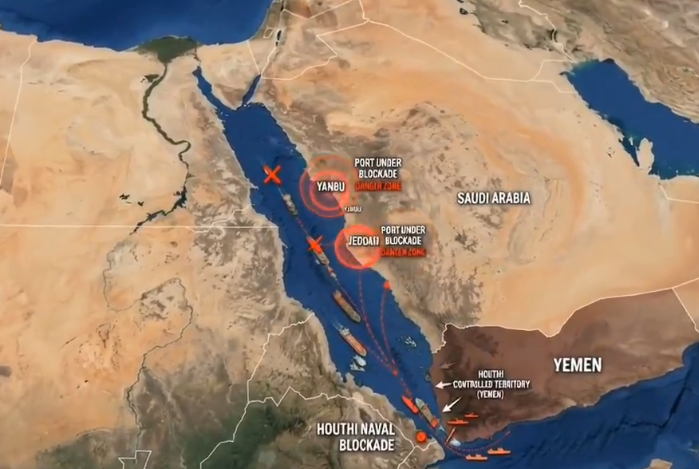
The Iran-aligned Houthis said the strikes were part of a naval blockade targeting Saudi Arabia, a move that could significantly expand the regional conflict and place additional pressure on global oil markets.
Meanwhile, the US military confirmed it carried out another round of strikes on Iran on Wednesday under orders from President Donald Trump, extending American operations to a 12th consecutive night.
The Houthis identified the targeted vessels as the Encelia and the Layla, saying both were hit with missiles and drones in the Red Sea.
Saudi state news agency SPA confirmed that the Encelia was struck, adding that the attack ignited a fire at the ship’s bow. However, Saudi authorities did not confirm an attack on the Layla.
A maritime security source said the Encelia issued a distress signal after reporting a missile strike near the Saudi port of Jizan late Wednesday.
The latest attacks have further disrupted commercial shipping. Five tankers altered course in the Red Sea on Wednesday to avoid the Bab el-Mandeb Strait, while three Saudi oil tankers bound for China and India reversed course a day earlier.
Shipping data also showed that two Chinese very large crude carriers carrying a combined 4 million barrels of Saudi crude were approaching the Bab el-Mandeb Strait on Thursday despite heightened security concerns.
Saudi Arabia has increasingly routed millions of barrels of crude each day through its Red Sea port of Yanbu to bypass the Strait of Hormuz.
However, if vessels are unable to pass through the Bab el-Mandeb Strait at the southern entrance to the Red Sea, shipments would be forced to rely on the longer northern route through the Suez Canal, increasing transit times and transportation costs.
Earlier this week, the Houthis announced they would prevent ships from loading or unloading at Saudi ports, a move that could disrupt Saudi oil exports and affect roughly 7% of global oil supplies if fully enforced.
Military and former US officials warned that such a blockade could open a second major maritime front in the conflict while stretching American military resources already committed to operations against Iran.
Before the latest Red Sea escalation, Trump warned Wednesday that the United States would target Iranian infrastructure, including bridges or power facilities, each time Tehran attacked shipping in the Strait of Hormuz.
Iran’s joint military command responded by threatening regional oil, gas, electricity and economic infrastructure if Washington carried out those plans. Iranian state media quoted officials as saying Tehran would prevent the export of “even a single drop of oil.”
Hours later, Iran’s Revolutionary Guards reported an explosion along what they described as a mined route south of the Strait of Hormuz. The Guards said one of three oil tankers caught fire while the remaining two turned back.
The force also declared that the strategic waterway was under Iranian control and “completely closed,” warning that no vessel could enter or leave without Tehran’s authorisation.
American military operations have broadened geographically since a ceasefire collapsed, with strikes now extending into western and central Iran.
US Central Command said the campaign would continue to reduce Iran’s capability to threaten international shipping.
Iranian media reported that US forces struck a military site near Bushehr twice on Thursday, marking the third attack in the area within two days. The location lies near Iran’s only operational commercial nuclear power reactor.
State television also reported that two people were killed and 11 others wounded in what local officials described as a US missile strike on the Shalamcheh border crossing with Iraq.
Despite repeated US assertions that Iran’s military capabilities have been significantly degraded, Tehran has continued launching missile and drone attacks across the region, including strikes this week on energy and water desalination facilities in Kuwait as well as US military positions in Kuwait, Bahrain and Jordan.
Iranian health officials said 53 civilians have been killed and 592 injured since late last month. Iranian authorities also say thousands have died and millions have been displaced since the broader conflict began on Feb. 28.
The US military maintains it does not deliberately target civilians, consistent with international humanitarian law. However, Trump has repeatedly threatened to strike civilian infrastructure if it is being used for military purposes.
The conflict has also claimed the lives of 18 US service members while injuring more than 450 troops.
On Wednesday, Trump attended a ceremony at Dover Air Force Base honoring four US service members killed in recent Iranian attacks, including three in Jordan and one in Iraq.
“For me it’s one of the hardest things to do as a president. But it has to be done,” Trump said before departing for the ceremony.
Later, during a speech in Georgia, Trump referred to the conflict as “a skirmish.”
Defense experts said the Houthi campaign could force Washington to divide military assets between the Persian Gulf and the Red Sea.
The Yemeni Houthis have survived years of Saudi-led coalition airstrikes as well as more recent US bombing campaigns that sought to secure international shipping routes.
Although Pentagon spokesman Sean Parnell said the US military possesses sufficient capabilities to execute the president’s orders, officials acknowledged that operations in Yemen would require substantial naval, air and intelligence resources.
More than 20 US Navy warships and hundreds of military aircraft are already deployed across the Middle East, with additional forces en route to support operations against Iran.
Opening another front could strain personnel, extend naval deployments and increase pressure on US weapons stockpiles, even as they noted that ongoing restrictions on Iranian supply routes could eventually limit the Houthis’ ability to sustain a prolonged campaign.
Read more: World’s giant vessel MSC Diletta departs from Karachi port