
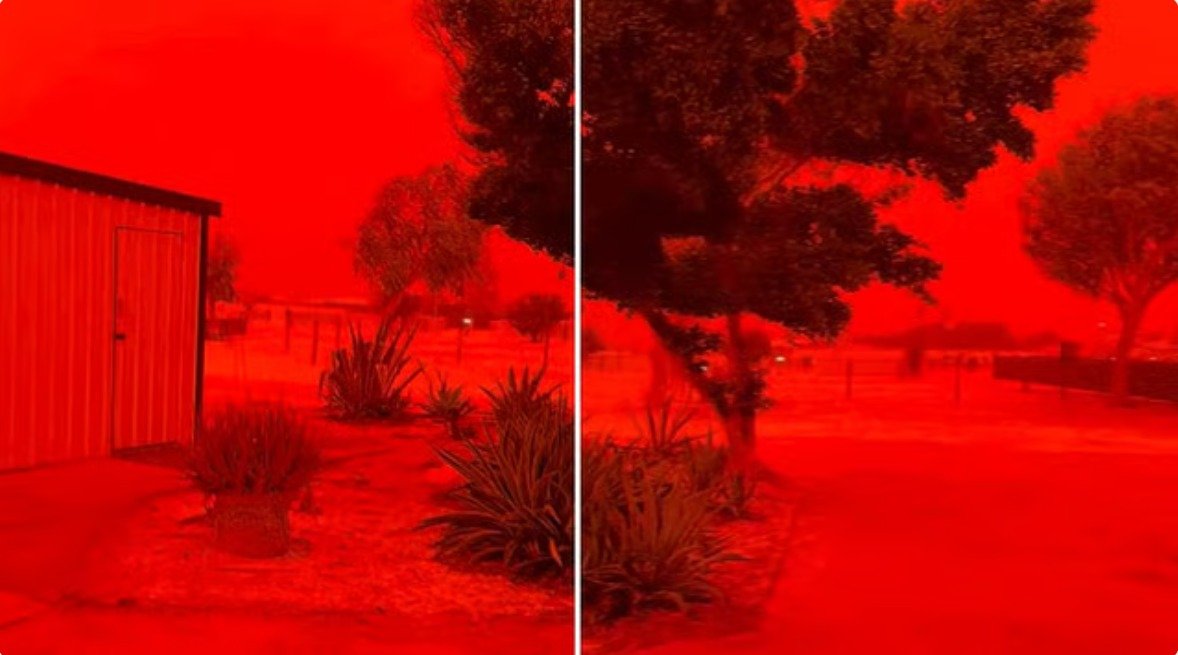
Web Desk: Residents across Western Australia witnessed a dramatic atmospheric transformation recently as the horizon turned a vivid blood-red. While the sight appeared otherworldly, scientists indicate that the phenomenon is a direct result of complex interactions between sunlight, coastal weather systems, and desert dust.
Sunlight consists of every color in the visible spectrum. Under normal conditions, the sky appears blue because shorter light wavelengths scatter easily when the sun is directly overhead. However, the current conditions in Western Australia have shifted this balance significantly.
At dawn and dusk, sunlight must travel through a much thicker layer of the Earth’s atmosphere. This journey filters out shorter blue wavelengths, leaving only the longer red wavelengths to reach the eye. In this instance, the proximity of Cyclone Narelle off the coast amplified the effect. Powerful winds from the storm system kicked up massive quantities of desert sand and dust into the upper atmosphere.
These larger dust particles trigger a specific process known as Mie scattering. Unlike standard scattering, this process specifically intensifies red and orange tones, creating the deep crimson appearance reported by local residents. Consequently, the high concentration of airborne particles provided the necessary fuel for these intense visual displays.
Furthermore, the ancient adage of “red sky in the morning” carries significant scientific weight in this context. A crimson morning sky often indicates that sunlight is reflecting off incoming clouds from the west. Because sunlight hits microscopic water and dust particles at low angles during these hours, the red hue serves as a natural signal that rain or a storm is approaching.
As a result, meteorologists continue to monitor the dust levels as Cyclone Narelle influences regional weather patterns. While the blood-red skies offer a striking visual experience, they remain a clear reminder of the powerful atmospheric forces currently at play over the Australian continent.
Read more: Rains continue across various parts of the Country