



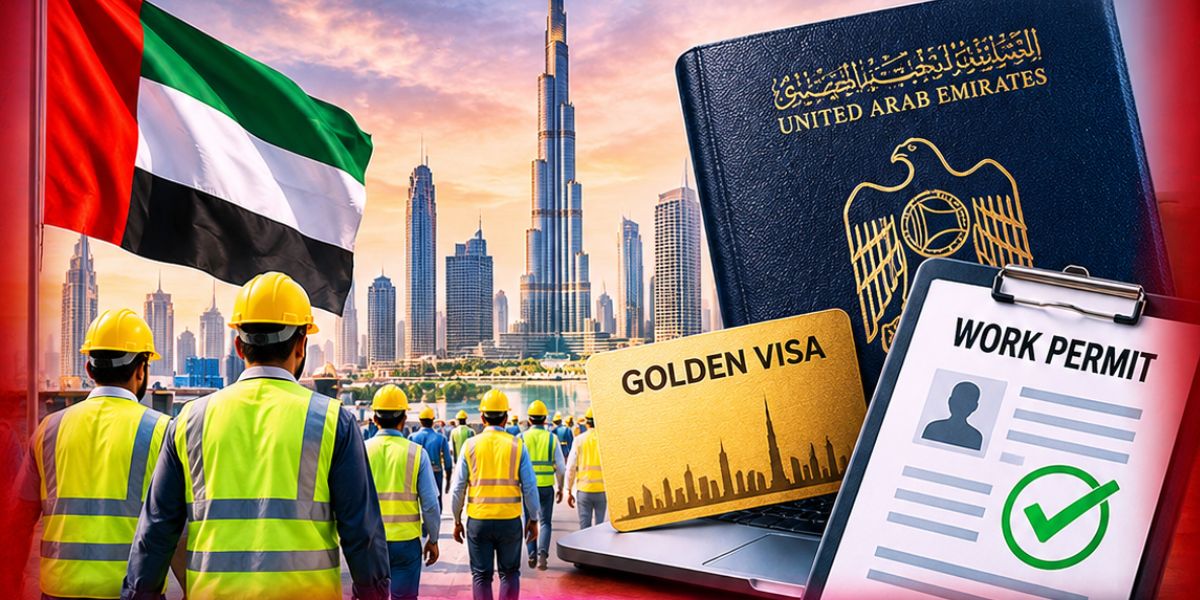
Under its “Zero Bureaucracy” initiative, the UAE has eliminated the requirement for all supporting documents for 13 types of work permits, including those for the Golden Visa, freelance roles, and overseas recruitment.
According to details, the UAE Ministry of Human Resources and Emiratisation (MoHRE) has implemented a major reform as part of the government’s “Zero Bureaucracy” program by removing the mandatory requirement for supporting documentation for 13 categories of work permits.
Reports from Gulf media indicate that, under these new reforms, the required information (data fields) in application forms for specific work permits has been reduced by 75% to 97%. Additionally, the time required for the issuance of these permits has been significantly shortened.
This will expedite and simplify the recruitment process for foreign workers—including the approximately 30,000 Pakistanis who obtain UAE visas each month.
All 13 of these services are now accessible through the Ministry’s unified digital channels, allowing employers to submit applications entirely online.
By reducing the number of fields in forms and eliminating the need to upload supporting documents, the processes for hiring staff from abroad, onboarding new recruits, and transferring employment will become much faster and easier.
According to the Ministry, the objective of these reforms is to facilitate private businesses, protect the rights of workers, and enhance the efficiency of the labor market.
Under the new decision, the documentation requirement has been waived for 13 types of work permits. These include work permits for recruitment from abroad (valid for two years), transfer work permits (valid for two years), Golden Residency work permits, and freelance work permits (which allow foreign nationals to work under their own residency sponsorship).
Additionally, the list includes work permits for residents sponsored by their family members, part-time work permits, temporary work permits, mission work permits, private tutoring permits, permits for student training or employment, work permits for juveniles (aged 15 to under 18), work permits for Emirati and GCC citizens, and national trainee work permits.
The Ministry has also announced the launch of a new phase of reforms aimed at simplifying procedures and expanding the provision of digital services.
Also Read: Top ranking US universities offer study visas for Pakistani students