



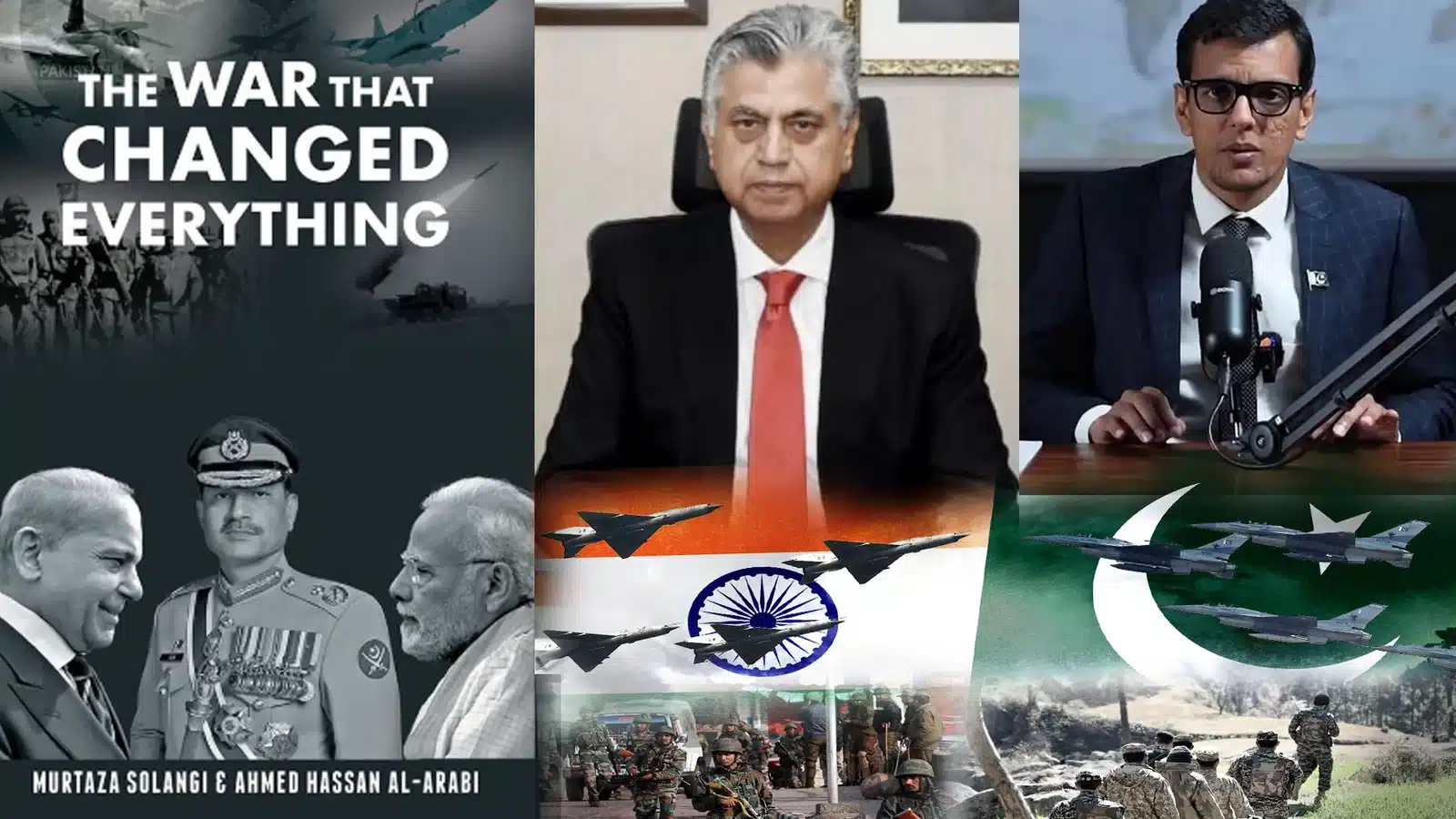
WEBDESK: A book named The War That Changed Everything by the journalist Murtaza Solangi and Ahmad Hassan Al-Arabi discloses the intelligence, military strategic and computer warfare that caused the 2025 Pahalgam incident. The book reveals the inner dynamics of the measured reaction of Pakistan to Indian aggressive attempts to stage a broader war.
After India launched missile strikes on the night of May 6-7, the Indian Director General of Military Operations (DGMO) asked for a formal talk the next morning. Pakistan responded firmly, saying dialogue would only happen after a strong retaliation. Pakistan remained silent for 48 hours, showing strategic patience rather than panic. During this time, India’s media spread false stories claiming Pakistani aggression to mislead the world.
On May 9, Pakistan’s National Security Council, led by Prime Minister Shehbaz Sharif, Defence, and Information Ministers, approved specific targets for a measured retaliation. Prime Minister Sharif focused on protecting civilians in the strikes. The Pakistan military confirmed the country’s readiness to respond firmly and carefully.
How Operation Bunyan-un-Marsoos Got Its Name and Who Named It
The book reveals that before the conflict, Pakistan’s Air Chief Babar Sidhu showed the Army Chief a picture of Pakistani fighter jets ready for action. The Army Chief and current Field Marshal Syed Asim Munir likened these scenes of prepared aircraft to an “Iron Wall” and recited a verse from the Quran. Inspired by this, they named the operation “Bunyan-un-Marsoos.” Afterwards, the operation plan was presented to the Prime Minister, who immediately approved the proposal to launch the operation against India.
India deterred from attacking Karachi During Pak-India Conflict after Pakistan’s firm warning
On May 10, Pakistan launched Operation Bunyan-un-Marsoos, hitting known targets of the Indian military intelligence with meticulous precision that dealt with sabotaging across the border. Pakistan warned India that an attack on Karachi would result in a counter action that will be far reaching and destructive. Such a warning prevented an Indian attack on Karachi.
Intelligence and Electronic Warfare: Pakistan’s Edge
Pakistani intelligence closely monitored India’s movements. It was aware that India received new Russian air defence systems (Igla-S VSHORADS) on May 2. Pakistani agencies intercepted plans for Indian air strikes in Azad Jammu and Kashmir (AJK) and warned the public. The Pakistan Air Force (PAF) successfully prevented these attacks through electronic countermeasures and strong air defence.
Air Combat and Drone Warfare
In aerial battles following India’s Operation Sindoor on May 6-7, Pakistan shot down six Indian aircraft without losing any of its own. India then turned to drone attacks using Israeli and Polish drones, but Pakistan destroyed nearly 78 drones using various defence systems.
Pakistan carried out over 4,400 cyber attacks during Pak-India conflict: The War That Changed Everything
Pakistan launched over 4,400 cyber attacks on India during the conflict. The Indian accussation of Chinese involvement was described as irresponsible and efforts to sugarcoat the failures of India.
The strategy adopted by Pakistan demonstrated that missiles are not the only part of modern warfare but also about stories and digital infrastructure. The intelligence and also the military actions of Pakistan compelled India to go defensively and this eliminated threats before they could occur.
India’s false claims of China’s involvement debunked in book ‘The War That Changed Everything’
The book clarifies that China was not a participant in the conflict. India’s efforts to involve China in the crisis were deceitful and intended to excuse its own strategic blunders.