


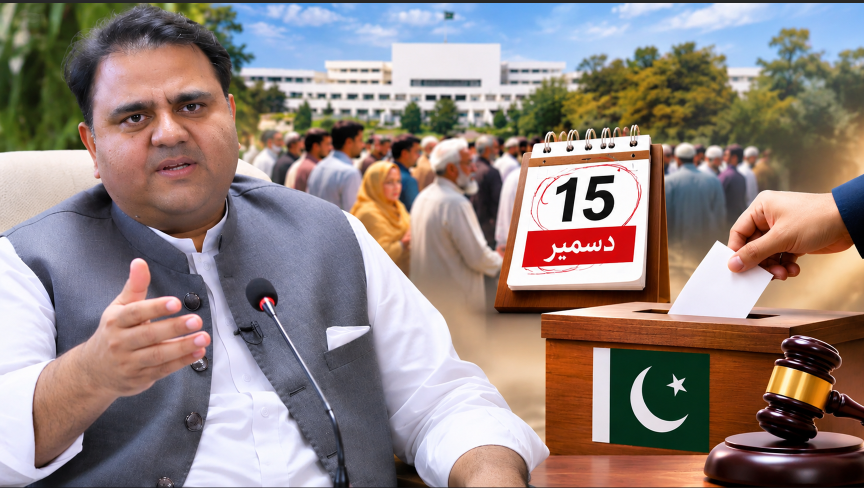
Web Desk: Former federal minister Fawad Chaudhry has claimed that Pakistan will hold a referendum on the creation of new provinces by Dec. 15, followed by a constitutional amendment to formalise the proposed administrative changes.
Speaking to reporters in Jhelum, Chaudhry said preparations for the referendum had entered their final stages, describing the proposed restructuring as a significant development in Pakistan’s political and administrative landscape.
Chaudhry said the establishment of new provinces had long been part of Pakistan Tehreek-e-Insaf’s (PTI) political manifesto, adding that former Prime Minister Imran Khan and the party leadership supported the proposal.
He claimed that Khan had reaffirmed his support for creating new provinces during a meeting with his lawyers a day earlier.
According to Chaudhry, the proposed referendum would precede a constitutional amendment aimed at implementing the administrative changes.
However, he did not provide details about the proposed provincial boundaries, the number of new provinces or the constitutional process required to establish them.
Under Pakistan’s Constitution, altering provincial boundaries requires parliamentary approval and the consent of the affected provincial assembly through the prescribed constitutional process.
Turning to political developments in Punjab, Chaudhry criticised Chief Minister Maryam Nawaz over her remarks concerning Federal Minister Chaudhry Salik Hussain.
He alleged that Maryam’s criticism of Salik Hussain was unjustified and suggested that Interior Minister Mohsin Naqvi was the intended target of the political confrontation.
Chaudhry argued that Salik Hussain was being used as a pretext in a broader dispute involving influential figures within the federal government.
Furthermore, he referred to Salik Hussain’s position that he had neither joined the federal government at the direction of the Pakistan Muslim League-Nawaz (PML-N) nor intended to leave the coalition at its request.
Chaudhry maintained that decisions concerning participation in the Punjab government or the federal political arrangement were not solely determined by the Punjab chief minister.
Criticising the country’s political environment, Chaudhry claimed that the existing political arrangement had emerged primarily from opposition to PTI.
He argued that political setups in Pakistan typically lasted three to four years but suggested that the current arrangement was beginning to weaken.
According to the former minister, growing political tensions and disagreements among political stakeholders indicated increasing pressure on the existing system.
Discussing the political landscape in Khyber Pakhtunkhwa, Chaudhry described PTI as the province’s leading political force, followed by Jamiat Ulema-e-Islam-Fazl (JUI-F).
He claimed that the Pakistan Peoples Party (PPP) and PML-N had comparatively limited political influence in the province.
Chaudhry characterised the two parties as having a relatively marginal presence in KP politics, contrasting their position with the influence of PTI and JUI-F.
His assessment reflected his political views rather than an independently established ranking of the parties’ current support.
Chaudhry also commented on JUI-F chief Maulana Fazlur Rehman’s political and religious standing.
He said Fazlur Rehman occupied a position that extended beyond conventional party politics because of his role as a religious leader.
Consequently, Chaudhry urged him to exercise greater caution when commenting on sensitive political and religious matters.
He suggested that religious leaders involved in politics carried additional responsibilities because their public statements could influence both political debate and religious opinion.
Meanwhile, Chaudhry stressed the need for meaningful engagement among Pakistan’s major political forces to address the country’s continuing political divisions.
He argued that confrontation between rival parties had undermined the prospects for political stability and called for an environment that would encourage negotiations.
According to Chaudhry, dialogue among political stakeholders was essential to restoring a functioning political system and reducing tensions.
He maintained that political reconciliation, rather than continued confrontation, offered a path towards greater stability.
His remarks come amid continuing debate over constitutional reforms, provincial governance and the future direction of Pakistan’s political system.
Read more: Mohsin Naqvi Calls for Referendum on New Provinces, Vows Action Against Corruption, Land Mafia