
Web Desk: The Cockroach Janta Party movement traces its origins to comments made on May 15 by Chief Justice of India Surya Kant during a court hearing. Kant compared certain unemployed young activists to “cockroaches,” suggesting that some individuals without stable employment gravitate toward activism or media roles and criticise institutions.
Although the judge later said his remarks had been taken out of context and were aimed at individuals using fraudulent credentials, the comparison triggered widespread backlash among educated but unemployed youth.
Within days, Abhijeet Dipke, an Indian political communications strategist based in the United States, launched a parody social media account titled the Cockroach Janta Party. The term “janta,” meaning “people,” features prominently in the names of several Indian political parties, including the ruling Bharatiya Janata Party (BJP).
The CJP branded itself as a voice for the “lazy and unemployed,” embracing satire to spotlight grievances over job scarcity, rising living costs and concerns about transparency in competitive examinations.
The group’s Instagram following surged within days, surpassing that of several established political accounts and eventually crossing 22 million followers. Memes, satirical posts and pointed criticism of public institutions spread rapidly, reflecting simmering frustration among young Indians.
However, what began as an online joke quickly took on a more serious tone. As anger over examination irregularities grew, organizers called for a peaceful rally in New Delhi.
Police permitted the demonstration but heightened security around the protest zone near parliament and at key transit points. By midday, large crowds had assembled, chanting slogans and waving national flags. Organizers encouraged participants to carry books as symbols of equal access to education and opportunity.
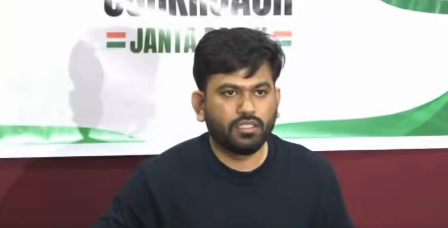
CJP spokesperson Saurav Das said the movement aims to amplify youth concerns at a time when economic pressures weigh heavily on younger generations.
“Young people make up a significant share of the population, yet they face unemployment, inflation and uncertainty about their future,” he said, describing the initiative as a decentralized, leader-light effort coordinated by a small core team.
Political analysts say the phenomenon reflects broader social unease. Ranabir Samaddar, a political scientist, said the chain of events underscores discontent over inequality and perceived mismanagement in the education sector.
The Rashtriya Swayamsevak Sangh (RSS), the ideological parent of the BJP, initially criticized the CJP as politically engineered and part of a broader left-leaning ecosystem. It later softened its stance.
The rise of the CJP mirrors youth-led mobilizations across South Asia, where digitally driven movements have challenged governments in countries such as Sri Lanka, Bangladesh and Nepal in recent years. In 2025, loosely organized protests in parts of Asia and Africa have also highlighted generational frustration over unemployment, governance and inequality.
In India, where young people account for a substantial share of the population, limited job creation and controversy surrounding competitive examinations have intensified disillusionment with mainstream politics.
Thousands of students, job seekers and activists gathered at Jantar Mantar in the Indian capital on Saturday, rallying behind a satirical social media movement that has rapidly transformed into a street protest demanding accountability over education and employment issues.
Wearing cockroach masks and carrying placards and flowers, demonstrators called for the resignation of Education Minister Dharmendra Pradhan following a series of alleged question paper leaks in university entrance examinations. Climate campaigner Sonam Wangchuk and several left-leaning student groups joined the rally.
The protest marked the first major on-the-ground mobilization by the Cockroach Janta Party (CJP), a parody political platform that emerged online last month and has since amassed millions of followers.
Following Saturday’s rally, organizers said they plan to stage similar demonstrations in other cities, culminating in another gathering in the capital. They have pledged to continue until the education minister steps down, though they have not announced a timeline.
Political activist Yogendra Yadav described the development as more than a fleeting trend, arguing it represents an undercurrent of civic energy that could reshape public debate.
Still, observers caution that sustaining momentum beyond viral attention poses a significant challenge. Building grassroots networks, coordinating volunteers and maintaining public engagement require resources and organisational stamina.
For now, the cockroach recast by supporters as a symbol of resilience has moved from meme to movement, signaling a new chapter in India’s evolving youth politics.
Read more: India Calling actions of banned JAAC “Operation Sindoor 2,” Says Rana Sanaullah