


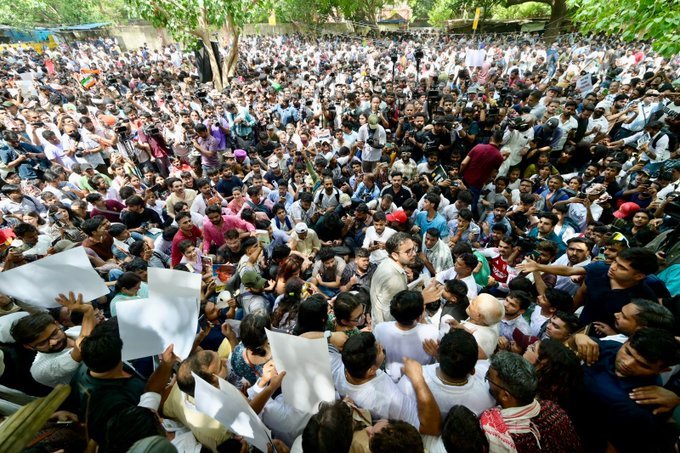
Web Desk: Hundreds of students, young professionals and activists have camped for days at Delhi’s Jantar Mantar, turning India’s most prominent protest site into the center of a growing youth-led agitation over alleged examination failures and demands for political accountability.
Despite temperatures crossing 40C, demonstrators have remained at the 18th-century observatory complex, sleeping on roads, sheltering under makeshift coverings and gathering behind police barricades as they continue their sit-in for a tenth consecutive day.
The protesters, who identify themselves as part of a satirical online collective called the Cockroach Janta Party (CJP), are demanding the resignation of Education Minister Dharmendra Pradhan. They accuse him of failing to take responsibility after the cancellation of the National Eligibility cum Entrance Test (Undergraduate), or NEET-UG, following allegations of a question paper leak.
Although the movement began as online satire, it has evolved into a broader platform for young people expressing frustration over unemployment, repeated exam irregularities and perceived lack of accountability in public institutions.
The group emerged after a controversial remark by Chief Justice Surya Kant, who was widely reported to have compared some unemployed youth involved in activism and journalism to “cockroaches” and “parasites.” He later clarified that his comments were directed at individuals with fake academic credentials, but the backlash had already spread widely on social media.
An online post that went viral among Gen-Z users helped accelerate the movement, eventually inspiring the creation of the Cockroach Janta Party. Using artificial intelligence tools, supporters even designed a logo featuring a suit-wearing cockroach, and adopted a name that parodies the ruling Bharatiya Janata Party.
What began as humour-driven content quickly shifted into organised mobilisation, with supporters turning online discussions into street protests. The group now claims a large digital following and has staged demonstrations in multiple Indian cities before returning to Jantar Mantar.
One of its founders, Dipke, said the movement was not initially intended to become political but gained momentum as frustrations over exam cancellations and job insecurity grew.
“People started saying this should become something more serious because no political party was addressing our concerns,” he said.
He added that repeated examination disruptions and lack of accountability pushed the group to focus first on education reforms.
Tensions escalated on Sunday when environmental activist Sonam Wangchuk joined the demonstrators and began an indefinite hunger strike in support of their demands.
Wangchuk said the education system faces deep structural problems and accused authorities of failing to respond to students’ concerns. He said he would continue his protest despite extreme heat conditions, adding that he was prepared for a prolonged fast.
Meanwhile, protest leaders vowed to remain at the site until the education minister resigns.
Education Minister Pradhan has rejected calls to step down, dismissing the protesters as politically motivated and accusing them of undermining national progress.
Separately, senior ruling party figures have criticised the movement, warning against what they described as disruptive elements attempting to destabilise institutions.
Despite a government-ordered re-test of NEET-UG held on June 21, protesters said the measure has not addressed their concerns about transparency and accountability.
At the protest site, demonstrators have also set up a memorial wall carrying photographs and names of students whose families say they died by suicide following the exam controversy. Organisers say the number has risen to nearly 20, though official confirmation is not available.
Messages written beneath the images call for justice and accountability, while supporters continue to arrive with food, water and supplies.
For many participants, the protest has become deeply personal.
A schoolteacher present at the site said many affected students came from economically weaker backgrounds and had placed significant financial and emotional hopes on the examination system.
Meanwhile, aspirants preparing for future recruitment exams said they feared similar disruptions could affect their prospects.
As evening crowds grow at Jantar Mantar each day, organisers say momentum is increasing, with support coming from student groups and civil society organisations.
However, despite growing attention and solidarity protests in multiple cities, both sides remain entrenched.
For now, demonstrators insist they will continue their sit-in until their demands are met, while organisers acknowledge that their broader struggle for accountability in education may extend far beyond the current confrontation.