



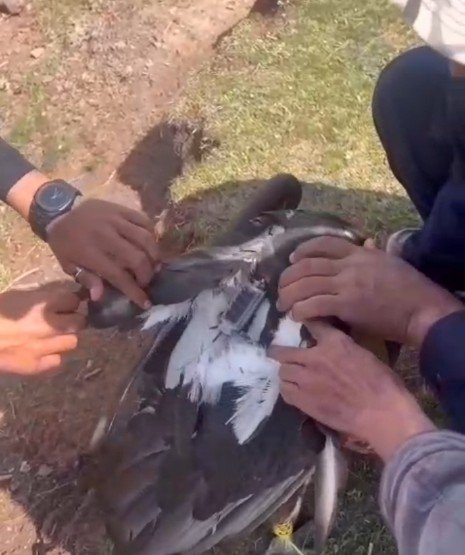
Web Desk: Residents in the mountainous outskirts of Muzaffarabad captured an eagle carrying a solar-powered tracking device near the scenic hilltop of Pir Chinasi, prompting wildlife experts to suggest the bird may be part of an international scientific monitoring program.
Authorities and local residents said the bird was found with a yellow wing tag marked “F49” and what appeared to be a GPS-enabled device attached to its body, indicating it was unlikely to be an ordinary wild raptor.
Wildlife specialists familiar with avian conservation programs said the device resembles a solar-powered GPS/GSM tracker commonly used in global bird migration and raptor conservation initiatives.
“These tags are typically deployed to monitor migration routes, habitat use and survival patterns of birds of prey,” wildlife experts said, adding that such programs often focus on species including eagles, vultures and falcons.
Moreover, experts noted that identification codes such as “F49” are widely used in international tracking systems to identify individual birds participating in research and conservation projects.
Researchers worldwide increasingly rely on satellite-linked devices to monitor the movement of migratory birds, particularly raptors that travel across continents.
Such tracking technology allows scientists to determine where birds fly, stop and nest, helping conservationists better understand environmental threats, migration corridors and breeding behavior.
In addition, solar-powered tracking systems enable long-term monitoring without frequent human intervention, making them especially useful for species that cover vast geographic distances.
Although officials have yet to verify the origin of the tagged eagle, wildlife experts suggested the bird may belong to a migratory raptor population linked to a research initiative in Central Asia or the Gulf region.
However, experts cautioned against speculation until the tracking code and device details are verified through relevant wildlife databases or conservation agencies.
It remained unclear whether local authorities had contacted wildlife departments or international conservation bodies to trace the bird’s registration and research origin.