



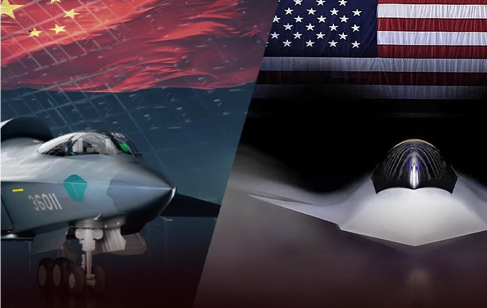
Web Desk: China and the United States are advancing two next-generation combat aircraft that could transform the way future air wars are fought, yet a direct specification-by-specification comparison remains difficult because both countries have kept critical details classified.
China’s aircraft, widely referred to by Western analysts as the Chengdu J-36, has already appeared in flight testing, while the United States formally selected Boeing in March 2025 to develop the F-47 under its Next Generation Air Dominance (NGAD) program.
Although both aircraft are associated with sixth-generation airpower, their visible designs and stated development goals point to somewhat different priorities.
The J-36 is currently the more visible of the two aircraft. Images and videos of its flight tests show a large, tailless platform with a broad diamond-shaped wing, three engine intakes and no conventional vertical stabilizers.
The unusual configuration appears designed with low observability in mind. Removing vertical tails can help reduce radar reflections, while the aircraft’s blended shape, aligned edges and internal weapons compartments suggest that stealth influenced its overall architecture.
The Royal United Services Institute has described the aircraft as a very large, tri-engine Chengdu triangular tailless design.
However, its actual radar cross-section remains unknown. China has not publicly released measurements that would allow analysts to determine how the J-36 compares with existing or future stealth aircraft.
The F-47 offers even fewer visual clues. The US Air Force has released an image showing a crewed aircraft with a broad nose and swept wings, but the service has identified it as an artist’s rendering rather than a detailed technical drawing.
The J-36’s three-engine configuration is among its most distinctive features and has been visible during flight testing. However, China has not publicly confirmed the aircraft’s engine type, thrust figures or maximum speed.
As a result, claims about its ability to supercruise, accelerate rapidly or outperform existing fighters in manoeuvrability remain speculative.
The F-47 faces similar uncertainty. No production engine has been publicly identified, although the aircraft is linked to the US Air Force’s Next Generation Adaptive Propulsion effort.
Still, Washington has disclosed one significant performance target. A US Air Force infographic released in May 2025 listed the F-47 as capable of exceeding Mach 2 and assigned it a combat radius of more than 1,000 nautical miles, or about 1,852 kilometres.
Those figures provide a clearer indication of the F-47’s intended performance than the publicly available data surrounding the J-36.
The J-36’s sheer size could give it an advantage in carrying fuel, sensors and weapons internally.
Images of the aircraft have led analysts to identify what appear to be multiple internal weapons compartments, including a large central bay and two smaller bays. However, Beijing has not confirmed their dimensions or the aircraft’s maximum weapons load.
That uncertainty makes precise comparisons impossible.
The F-47, by contrast, has an officially stated combat-radius target of more than 1,000 nautical miles. Such a range would support its intended role as a penetrating air-superiority aircraft capable of operating deep inside heavily defended areas.
The J-36 may ultimately prove to have greater endurance or weapons capacity, but there is currently insufficient verified data to establish that.
One of the clearest differences between the two programs concerns the role of unmanned aircraft.
The J-36’s large nose and expansive airframe could accommodate powerful radar arrays, electronic-warfare systems and distributed sensors. Nevertheless, China has not publicly disclosed the aircraft’s avionics architecture or confirmed how extensively it will operate alongside autonomous aircraft.
The US approach is more clearly defined.
The F-47 is being developed as the crewed centerpiece of the US Air Force’s NGAD family of systems. It is expected to work alongside autonomous Collaborative Combat Aircraft, allowing a pilot to operate as part of a wider network rather than relying solely on the capabilities carried by the fighter itself.
Consequently, the F-47’s effectiveness will depend not only on its own stealth and sensors but also on its ability to exchange information with other aircraft and coordinate missions across the battlespace.
Development timelines also reveal an important difference.
The J-36 was first publicly observed in December 2024 and has since appeared in flight testing. Although the aircraft’s official designation, specifications and development timetable remain unconfirmed by Beijing, its visible flight activity demonstrates that China has produced and flown at least an experimental platform.
The F-47, meanwhile, entered its engineering and manufacturing development phase after Boeing received the US Air Force contract in March 2025.
However, the program did not begin from scratch. The US Air Force has said experimental aircraft supporting the NGAD effort accumulated hundreds of flight hours during years of testing before Boeing received the development contract.
The F-47 is currently expected to make its first flight in 2028.
The two aircraft therefore appear to reflect different approaches to future air combat.
The J-36’s enormous tailless airframe points toward a platform optimised for long-range operations, substantial internal capacity and potentially large sensor and weapons payloads. Its design could be particularly relevant to China’s requirement to operate across the vast distances of the Indo-Pacific.
The F-47, meanwhile, is being built around penetrating air superiority, advanced stealth, long-range performance and cooperation with autonomous aircraft.
That distinction could become increasingly important as future air forces move away from the idea of a fighter operating as an independent platform.
For now, declaring either aircraft the superior sixth-generation fighter would go beyond the available evidence.
The J-36 has the advantage of being visibly further along in flight testing, while the F-47 has a more clearly defined publicly stated development architecture and an established manned-unmanned teaming concept.
Ultimately, the competition will not be decided by maximum speed or airframe appearance alone.
Sensors, electronic warfare, missile technology, stealth from different aspects, autonomous aircraft, communications networks, production capacity and operational readiness are all likely to determine which system delivers the greater combat advantage.
In that sense, the J-36 versus F-47 contest may be less about two individual aircraft and more about two competing visions for the future of air warfare.
Read more: SUPARCO reveals official name of Pakistan’s first moon rover