


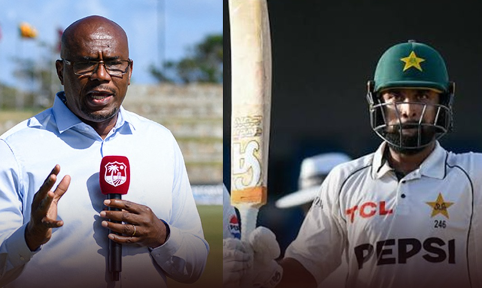
Web Desk: Pakistan batter Abdullah Shafique has credited years of demanding childhood training and an intensive red-ball campaign in domestic cricket after West Indies great Ian Bishop praised his technically disciplined batting.
Shafique made a striking return to Pakistan’s Test side in the second match against the West Indies in Port of Spain, producing an unbeaten 160 to help his team secure an eight-wicket victory and draw the two-match series 1-1.
Bishop, who was commentating during the match, linked Shafique’s elegant batting style to the literary tradition of his hometown, Sialkot, which is associated with figures including Allama Muhammad Iqbal and Faiz Ahmed Faiz.
The former West Indies fast bowler also revealed that Pakistan batter Babar Azam had given Shafique the nickname “Kitaabi player” because of his textbook technique.
Speaking to PCB Media, Shafique said praise from an established cricket figure was a source of pride and traced his batting fundamentals to his father and uncle, both former first-class cricketers.
He said the pair subjected him to demanding batting sessions during his formative years, helping him build the technique that later became a defining part of his game.
Shafique’s return to Test cricket could hardly have been more convincing. He occupied the crease for 117.3 of Pakistan’s 138.3 overs across the second Test, making an unbeaten 160 from 323 deliveries with 15 fours and three sixes.
He then remained unbeaten on 24 from 51 balls as Pakistan completed a 75-run chase with eight wickets in hand.
The 26-year-old’s century was his sixth in Test cricket and his first since October 2024. His score also became the first 150-plus innings by a Pakistan batter in the Caribbean in 49 years.
Moreover, Shafique faced more than 200 deliveries for the seventh time in 48 Test innings, underlining the patience that allowed him to absorb the West Indies attack.
The performance was particularly significant because he batted at No. 3, a position he had occupied only three times previously in international cricket.
Shafique joined the Test squad as a late replacement after Abdullah Fazal was ruled out of Pakistan’s West Indies and England tours with a lower-back injury. He travelled from Guyana to Trinidad on July 26 and subsequently replaced injured captain Shan Masood in the playing XI.
However, the foundation for his successful return had been laid months earlier.
After Lahore Qalandars’ HBL PSL 11 campaign ended in late April, Shafique accepted an invitation from MIT Solutions to compete in the President’s Trophy Grade-II Gold tournament.
The decision gave him an extended period of red-ball cricket across challenging conditions in Islamabad, Abbottabad and Peshawar.
Shafique said the tournament forced him to adapt to pitches offering both seam and spin while playing under intense summer heat and managing demanding travel schedules.
He also enlisted the help of his close friend Saif, who had previously learned specialized throwdown techniques. Saif took leave from his marketing job and travelled with Shafique to four cities, helping him conduct lengthy net sessions.
The arrangement proved valuable.
Shafique opened the tournament with an unbeaten 161 from 210 balls at Abbottabad Cricket Stadium. He followed that with a 66 from 126 deliveries in the team’s first victory before contributing scores of 75, 33, 39, 25 and 36 across subsequent matches.
He then produced a decisive 127 from 146 balls against Kingsmen Academy on a turning surface. MIT Solutions had slipped to 61 for five after Kingsmen were dismissed for 86, but Shafique’s innings helped turn the contest into a 10-wicket victory.
Shafique’s domestic campaign reached another peak in the semi-final, when he struck 193 from 201 balls, including 27 fours and three sixes.
He was the final batter dismissed as MIT Solutions posted 377 in 72.4 overs.
He was subsequently called into the National Cricket Academy’s red-ball camp but received permission to return to MIT Solutions for the tournament final.
There, Shafique again delivered under pressure. He scored 87 from 115 balls in the first innings and followed it with 60 from 103 in the second as MIT Solutions secured the first-innings advantage needed to claim the title after the match ended in a draw.
The sequence of long innings gave Shafique exactly the preparation he needed before returning to international cricket.
Shafique said he routinely arrived at grounds around two hours before his teammates during the domestic tournament and faced as many deliveries as possible before play began.
With matches often separated by only a day, much of the remaining time was spent travelling between venues.
He said the demanding schedule strengthened both his cricket and his ability to deal with adversity.
The batter also explained that his objective was not simply to score runs but to improve his red-ball game and return to international cricket as a more complete player.
That approach translated directly into his performance in Port of Spain.
Before the West Indies Test, Shafique said he carefully studied the home attack and prepared specifically for the conditions he expected to face.
He identified left-arm spinner Jomel Warrican as a key challenge and said he aimed to prevent the bowler from settling into a rhythm.
The strategy worked as Shafique remained at the crease for an extended period and helped Pakistan build the platform that eventually produced a series-levelling victory.
After the match, he called Saif in Sialkot to thank him for the support he had provided during the domestic campaign.
The pair also reflected on the plan they had developed in late April and how it had ultimately helped Shafique return to the international stage in outstanding form.
Shafique now turns his attention to Pakistan’s upcoming three-Test series in England.
He has some experience of English conditions, having represented Yorkshire in one County Championship match last summer. He also faced England in Pakistan in 2022 and 2024.
With his latest innings demonstrating his ability to occupy the crease for long periods, Shafique will enter the England assignment with renewed confidence.
For now, however, the “Kitaabi player” label appears to fit perfectly.
Rather than dismissing Bishop’s description, Shafique has embraced it as a reflection of the technical foundation built by his father and uncle and reinforced through months of demanding red-ball cricket.
His Port of Spain performance showed that those fundamentals remain central to his game and may have given Pakistan a significant boost ahead of a much tougher challenge in England.
Read more: Mitchell Starc becomes world’s most successful left-arm Test bowler