


Many India-obsessed people in Pakistan often taunt Pakistanis about their educational backwardness by pointing to highly educated Indian professionals holding key positions in global organisations. However, as the saying goes, appearances can be deceptive, and fraud is rampant within India’s education system.
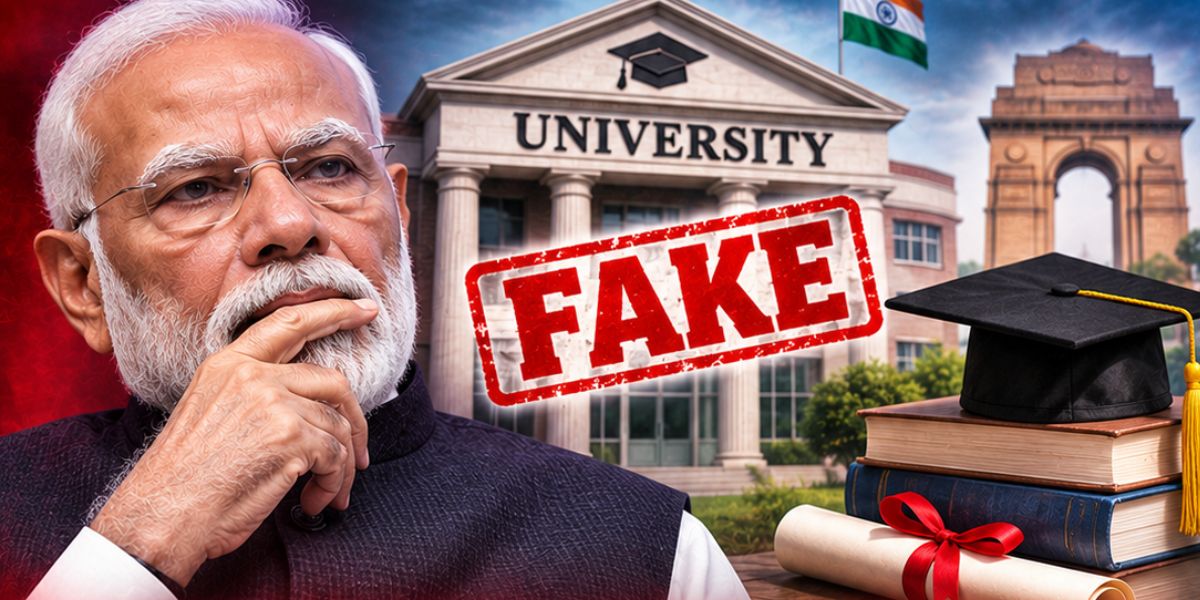
For several months, corruption in the examination system and paper leak scandals have remained subjects of public debate. Now, 32 fake universities have been identified in India, a country that prides itself on rapid development. The situation is particularly alarming in the national capital, Delhi, where 12 fake universities are operating.
Uttar Pradesh also has four fake universities. India’s university regulatory body, the University Grants Commission (UGC), has advised students to exercise caution.
The UGC’s latest list, updated in February 2026, identifies 32 institutions as fake universities across 12 states and union territories.
According to a report in the Indian media, students preparing to pursue higher education need to proceed cautiously. This is because, as India’s higher education sector expands, concerns are also growing about institutions that do not have the legal authority to award recognised degrees.
In a public advisory issued on November 17, the University Grants Commission (UGC) urged students and parents to verify the recognition and legal status of universities before seeking admission or making any educational or financial commitments.
The UGC’s latest list, updated in February 2026, identifies 32 institutions as fake universities across 12 states and union territories.
A comparison with the March 2023 list, which contained 20 institutions, shows that 18 of the previously identified institutions remain on the latest list. This means that 90 percent of the institutions flagged in 2023 are still included in the regulator’s records.
Delhi has the highest number of such institutions, with 12, compared with eight in 2023. All eight institutions identified in the previous list remain on the updated list, while four additional institutions have been included. Uttar Pradesh also has four institutions on the list.
The advisory was issued following an October 9, 2026, order by the Indian Supreme Court, which directed the UGC to warn the public against unauthorised educational institutions.
The commission advised students to verify whether an institution has been legally established, whether it possesses the authority to award degrees and whether it holds the necessary statutory approvals.
The UGC also warned students not to rely solely on claims made through advertisements, websites, brochures and social media.
The continued presence of institutions associated with fraudulent academic degrees on the list raises questions about the effectiveness of action taken against them. However, their continued inclusion does not necessarily prove that they are still operating or that no action has been initiated against them.
On August 5, India’s Ministry of Education stated in a written reply to Parliament that the UGC had issued clarification letters, compliance notices, show-cause notices and warnings to such institutions.
The ministry also said it had written to state governments, asking them to take appropriate action, including registering First Information Reports (FIRs).
The central government has urged state governments and union territories to initiate legal measures to shut down unauthorised institutions.
News outlet India Today sought a response from the Ministry of Education regarding the continued inclusion of these institutions on the list and the action taken against them. However, no response had been received at the time of the report.
Kiran Bhatti, founder and CEO of background verification and due diligence company Millow, told India Today that the issue of fraudulent academic certificates also affects national security.
He said several universities in western and southern India were issuing degrees to anyone, raising serious national security concerns.
According to Bhatti, these universities are connected to a larger network, and his company is attempting to play its part in addressing the issue through technology.
Also Read: Failed Indian aviation system causes another crash in Uttarakhand, six dead