


Web Desk: Sindh province faces renewed scrutiny over its governance and public services after a televised interview with Pakistan Peoples Party (PPP) Chairman Bilawal Bhutto Zardari raised questions about the party’s nearly 18 years in power.
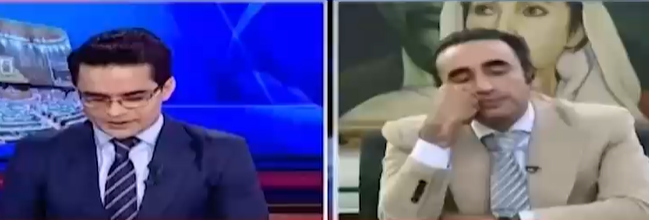
During an interview broadcast on Geo News on Thursday, journalist Shahzeb Khanzada challenged Bilawal over the provincial government’s record on education, urban development, public safety and healthcare, citing figures that highlighted persistent shortcomings in the country’s southern province.
The exchange also touched on the PPP’s political positions, its support for constitutional changes and its role in the federal coalition, putting the party’s governance record at the centre of a wider debate about accountability and democratic performance.
The PPP took office in Sindh in 2008, when the province’s literacy rate stood at approximately 59%, according to figures cited in the supplied data.
However, the 2025-26 Economic Survey puts the rate at 58%, suggesting that literacy has failed to improve over the period. The figures also raise questions about poverty reduction, with the data indicating that poverty has increased.
The party has governed the province through a period that included the 18th Constitutional Amendment, which expanded provincial autonomy, and successive transfers under the National Finance Commission (NFC) award.
The continued availability of federal resources and political continuity have nevertheless failed to produce the improvements in education and living standards that critics say residents expected.
Khanzada also questioned the government’s record on public safety, pointing to Karachi’s position near the bottom of an international ranking of 173 cities.
The city ranked 170th, according to figures cited during the programme, placing it among the world’s lowest-ranked urban centres.
He also highlighted the absence of a fully operational Safe City project in Karachi despite years of government commitments.
By comparison, the supplied figures indicate that 43 cities in Punjab and three in Khyber Pakhtunkhwa have completed Safe City projects.
The discussion also addressed Karachi’s water shortages, the influence of tanker operators and delays in major road infrastructure projects.
University Road became a particular point of contention. During the exchange, Bilawal acknowledged that the Frontier Works Organisation (FWO) had been assigned responsibility for completing the project.
The remarks prompted further questions about why the provincial government and Karachi’s municipal authorities had been unable to deliver the infrastructure independently.
Education featured prominently in the interview, with Khanzada citing figures showing that 44% of children in Sindh remain out of school.
The corresponding figures stood at 34% in Khyber Pakhtunkhwa and 27% in Punjab, according to the data presented during the broadcast.
The comparison placed Sindh behind the other two provinces, despite the PPP’s long tenure in government.
Child stunting and malnutrition also emerged as major concerns. The figures cited in the programme described Sindh’s performance in preventing impaired childhood growth as the weakest among Pakistan’s provinces.
These indicators have intensified questions about the effectiveness of provincial spending on education, healthcare and social development.
Bilawal responded to the criticism by questioning the journalist’s approach and accusing him of engaging in political commentary rather than impartial questioning.
He also made personal remarks about Khanzada and the television channel after facing questions about his party’s performance.
Khanzada rejected the criticism, saying the questions concerned the PPP’s record in government rather than personal or partisan politics.
He also challenged Bilawal over the party’s position in the federal political landscape, arguing that the PPP had helped sustain the coalition government through its parliamentary support while simultaneously presenting itself as politically marginalised.
The journalist further questioned the party’s changing position on political developments involving Pakistan Tehreek-e-Insaf (PTI).
The interview also examined the PPP’s position on constitutional reform, particularly its support for the 18th Amendment and subsequent political developments.
Khanzada questioned Bilawal over what he described as inconsistencies between the party’s earlier political positions and its later stance on constitutional changes.
The discussion raised broader questions about the PPP’s approach to provincial autonomy, federal relations and political alliances.
The exchange highlighted the tension between the party’s claims of democratic and constitutional leadership and demands for greater accountability over its record in Sindh.
The confrontation has brought renewed attention to the performance of successive provincial administrations and the effectiveness of Pakistan’s federal system.
Critics argue that Sindh’s longstanding development challenges warrant closer scrutiny, particularly in view of the provincial autonomy and financial resources available since the 18th Amendment.
The debate also raises questions about whether political continuity alone can deliver improvements in public services without stronger institutional accountability, effective planning and measurable development outcomes.
For the PPP, which has maintained control of Sindh since 2008, the central challenge remains demonstrating tangible progress in education, healthcare, public safety and urban infrastructure.
The interview was broadcast on Geo News’ programme Aaj Shahzeb Khanzada Kay Sath on Nov. 20, 2026.
Read more: Bilawal on the Defensive, Zardari Moves to the Negotiating Table Over New Provinces