


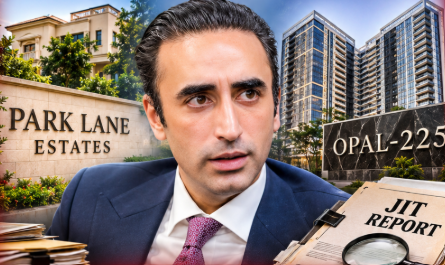
Web Desk: Questions surrounding Pakistan Peoples Party (PPP) Chairman Bilawal Bhutto Zardari’s corporate interests have resurfaced amid renewed attention to a Joint Investigation Team (JIT) report examining financial irregularities involving Park Lane Estates, the Opal-225 project and expenses associated with Bilawal House.
The investigation, submitted to the Supreme Court of Pakistan as part of the fake bank accounts case, examined transactions involving companies and individuals connected to a network of suspicious banking activities.
According to the supplied account of the JIT findings, investigators identified Bilawal as a shareholder and director of Park Lane Estates (Private) Limited, raising questions about his knowledge of and involvement in the company’s financial dealings.
The JIT reportedly identified Bilawal and his father, President Asif Ali Zardari, as equal shareholders and directors of Park Lane Estates, a company associated with valuable property holdings in Islamabad.
Investigators examined the company’s financial arrangements, including allegations that loans had been secured through intermediary businesses and transactions involving accounts suspected of facilitating illicit fund transfers.
The inquiry also considered whether borrowed funds had been redirected towards private commercial interests.
Bilawal’s reported corporate position has attracted scrutiny, although shareholding and directorship alone do not establish personal responsibility for disputed transactions.
Determining his involvement would require examining company records, board decisions, banking documents and any relevant judicial findings.
Meanwhile, investigators also examined the Opal-225 commercial and residential development in Karachi, which was reportedly connected to Park Lane Estates through a joint venture.
According to the supplied description of the investigation, the JIT identified transactions involving substantial sums that allegedly passed through accounts associated with businesses under investigation.
The inquiry sought to establish whether these transactions formed part of a wider network involving companies linked to the Omni Group.
Investigators reportedly reviewed connections between the development project, corporate entities and accounts suspected of being used to conceal the origins or destinations of funds.
However, the available material does not establish which transactions were ultimately found unlawful or whether any court attributed criminal responsibility to Bilawal in connection with the project.
Another aspect of the investigation concerned payments allegedly made towards expenses associated with Bilawal House properties in Karachi and Lahore.
The JIT reportedly examined financial records suggesting that accounts linked to the Omni Group and the suspected fake accounts network had been used to cover certain household and operational expenditures.
These included payments for food supplies, security services, travel and other expenses.
Investigators reviewed banking instruments, payment records and supporting documentation to determine how the transactions were processed and who benefited from them.
The allegations have prompted questions about the sources of funds used for these expenses.
Nevertheless, establishing that a payment benefited a particular property or household would not automatically prove that an individual associated with that property knew about or authorised an unlawful transaction.
The broader fake bank accounts investigation examined allegations of money laundering, questionable financial transfers and the use of corporate entities to move funds through Pakistan’s banking system.
Companies associated with the Omni Group featured prominently in the investigation.
The JIT sought to identify the individuals and businesses connected to suspicious accounts and determine whether financial arrangements had been used to disguise beneficial ownership or the movement of money.
The Park Lane and Opal-225 matters formed part of this wider examination of corporate relationships and financial transactions.
However, investigative allegations must be distinguished from charges formally brought before a court and findings established through judicial proceedings.
The renewed discussion has also intersected with Pakistan’s political debate over accountability and constitutional protections for senior officeholders.
Critics of the PPP leadership have questioned whether the party’s public commitments to transparency and democratic accountability are consistent with the unresolved questions raised by the investigation.
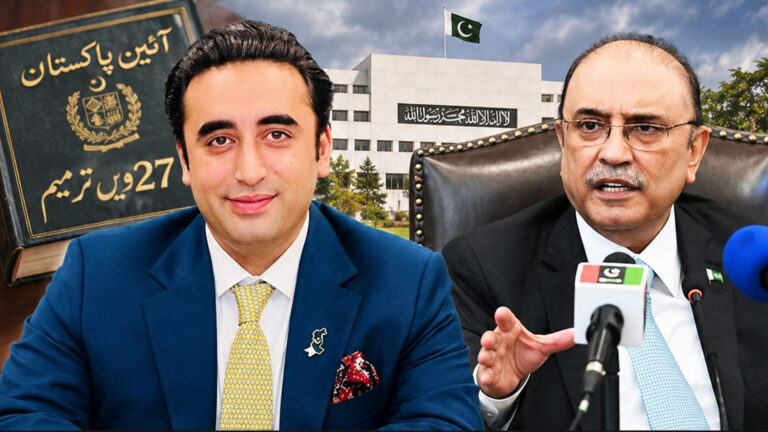
The debate has also extended to constitutional protections for President Zardari, particularly following controversy surrounding the 27th Constitutional Amendment.
However, questions about presidential immunity must be assessed separately from the allegations involving Park Lane Estates, Opal-225 and Bilawal House.
Constitutional protections do not establish whether the underlying financial allegations are true.
The reported findings have renewed attention to the relationship between political officeholders, family-controlled businesses and corporate financial arrangements.
A complete assessment would require access to the original JIT report, relevant banking and corporate records, subsequent proceedings and the latest judicial decisions.
For now, the reported links between Park Lane Estates, Opal-225 and Bilawal House remain matters requiring careful examination of the investigative record and subsequent court proceedings, rather than proof of criminal wrongdoing.
Read more: