Web Desk: A fragile US-Iran truce faced renewed uncertainty on Wednesday after President Donald Trump said a memorandum of understanding with Tehran appeared to be over, while leaving open the possibility of further negotiations.
Trump’s comments came after Washington and Tehran exchanged strikes across the Middle East, triggering fresh concerns over regional stability and sending global oil prices sharply higher.
Energy markets responded immediately to the uncertainty surrounding the agreement.
Brent crude, the international benchmark, rose 6.4% to $78.93 a barrel, while US West Texas Intermediate (WTI) crude climbed 6.5% to $74.99 a barrel. Global stock markets also declined as investors assessed the risk of a wider conflict.
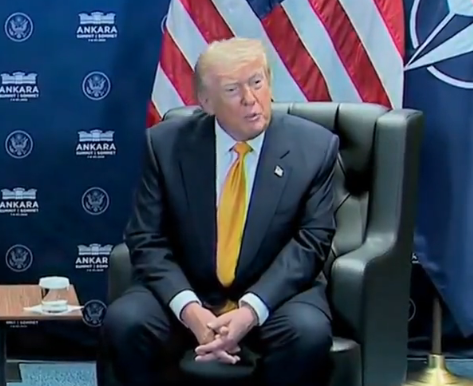
The price jump followed Trump’s remarks during the NATO summit in Turkey, where he said the understanding with Iran was no longer in effect.
Speaking in Ankara, Trump said the agreement was effectively finished but added that negotiators could continue discussions if they wished.
Although he expressed doubts about the value of further engagement, the US president said his team could still pursue a broader nuclear arrangement with Tehran.
Trump’s comments came after a negotiating team led by Vice President JD Vance had been working under a 60-day deadline to secure technical commitments from Iran aimed at limiting its nuclear activities.
The talks had made limited progress and largely focused on implementing the memorandum signed by Trump at the Palace of Versailles on June 17.
Meanwhile, Iran’s Islamic Revolutionary Guard Corps said it had carried out attacks against US military targets in Bahrain and Kuwait following American strikes on Iranian positions.
The escalation followed a series of tit-for-tat attacks, with Iran targeting commercial vessels in the Strait of Hormuz and the United States responding with strikes against Iranian military infrastructure.
The Strait of Hormuz remains one of the world’s most important energy shipping routes, and continued disruptions there have raised concerns about global oil supplies.
Trump had earlier reversed a key provision of the agreement that allowed Iran to continue selling oil on international markets.
The move effectively restored restrictions on Iranian oil exports, adding economic pressure on Tehran as diplomatic efforts remained uncertain.
Diplomatic efforts led by Pakistan and Qatar are expected to intensify as mediators attempt to restore the agreement and prevent further escalation.
However, Trump’s latest comments have complicated those efforts and increased uncertainty over whether negotiations can resume.
The latest developments are also being closely monitored in Israel, where officials have long expressed skepticism over diplomatic engagement with Iran.
Israeli Prime Minister Benjamin Netanyahu could interpret the breakdown in talks as an opportunity to continue military operations against Iranian-linked groups, including Hezbollah in Lebanon, or pursue further action targeting Iran itself.
The unfolding crisis has raised fears of a broader regional confrontation as Washington and Tehran remain locked in a cycle of military retaliation and diplomatic uncertainty.
Read more: US hits Iran with fresh strikes, revokes oil sanctions