Web Desk: Cristiano Ronaldo’s sixth and final FIFA World Cup ended in heartbreak, closing the curtain on a record-breaking international career that transformed modern football despite falling short of lifting the sport’s biggest prize.
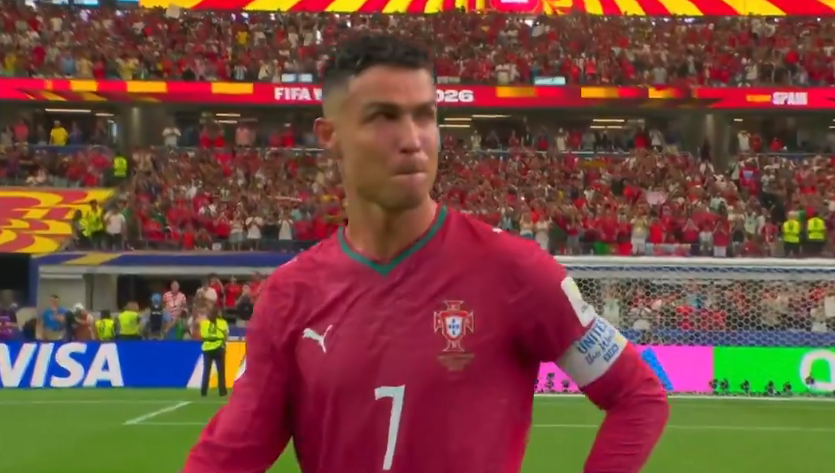
Portugal’s defeat to Spain ended the 41-year-old captain’s final World Cup campaign, bringing to a close a two-decade journey that featured six appearances at football’s premier tournament but never produced the title that many believed was missing from his glittering résumé.
Following the final whistle, Ronaldo lingered on the pitch, applauding supporters while struggling to contain his emotions as his hopes of becoming the oldest player to win a World Cup came to an end.
Although the World Cup trophy eluded him, Ronaldo’s place among football’s all-time greats remains firmly intact.
The Portuguese forward retires from the tournament as one of the highest scorers in World Cup history with 11 goals across six editions. However, his broader career has been defined by an unmatched collection of records that extend far beyond the global competition.
Ronaldo is football’s all-time leading scorer in official men’s matches at club and international level. He also holds the record for the most international goals, the most appearances for a men’s national team and remains Real Madrid’s all-time leading scorer after netting 450 goals in 438 matches.
In Europe, no player has scored more goals in the UEFA Champions League, where Ronaldo’s dominance helped define an era while winning five titles.
His individual achievements include five Ballon d’Or awards, league titles in England, Spain and Italy, and the UEFA European Championship with Portugal in 2016.
Despite his extraordinary consistency, the FIFA World Cup remained the one major title missing from Ronaldo’s career.
His best campaign came in Germany in 2006, when Portugal reached the semi-finals before losing to France. Ronaldo converted the decisive penalty in the quarter-final shootout against England, announcing himself on football’s biggest stage.
Subsequent tournaments brought flashes of brilliance but ended in disappointment.
In 2010, Portugal exited in the Round of 16 after defeat to eventual champions Spain.
Four years later, injuries hampered Ronaldo as Portugal failed to progress beyond the group stage in Brazil.
He produced one of the tournament’s most memorable individual performances at Russia 2018, scoring a hat-trick against Spain before Portugal were eliminated by Uruguay in the knockout rounds.
At Qatar 2022, Ronaldo became the first male player to score in five different World Cups, but Portugal’s campaign ended in the quarter-finals against Morocco.
His farewell appearance at the 2026 tournament again ended without the coveted trophy, despite contributing key goals during Portugal’s run.
For much of his career, Ronaldo’s World Cup performances were measured against those of longtime rival Lionel Messi, who lifted the trophy with Argentina in 2022.
Yet football analysts have long argued that Ronaldo’s legacy rests on far more than success in a single competition.
His longevity, relentless goal-scoring consistency and ability to excel across multiple leagues and international tournaments established him as one of the defining players of his generation.
While the World Cup remained an unfulfilled ambition, Ronaldo repeatedly maintained that one tournament would not determine his standing in football history.
His records, influence and sustained excellence over more than two decades continue to place him among the sport’s greatest icons.
Attention now turns to the next chapter of international football following the conclusion of the 2026 FIFA World Cup.
The 2030 edition will mark the tournament’s centenary and will be jointly hosted by Spain, Portugal and Morocco. In a historic first, Uruguay, Argentina and Paraguay will each stage one opening match to commemorate the inaugural World Cup held in Uruguay in 1930 before the competition moves to the three main host nations.
By then, Ronaldo’s playing career is expected to have ended. However, his influence on Portuguese football and on the global game is likely to endure long after his final World Cup appearance.
Although he never lifted the FIFA World Cup trophy, Ronaldo leaves the international stage with a legacy built on records, consistency and longevity that few players in football history have matched.
Read more: Belgian leaders, fans criticize Trump’s FIFA intervention