Web Desk: Pakistan has quietly launched a mediation effort between Libya’s rival eastern and western authorities, in a previously unreported diplomatic initiative that could expand Islamabad’s international profile if it succeeds.
The effort comes as the United States has intensified attempts to broker a political settlement in Libya, which has remained divided between competing administrations in the east and west since the conflict that followed the 2011 NATO-backed uprising that overthrew Muammar Gaddafi.
Pakistan has already played a key role this year in facilitating contacts between the United States and Iran, a role that officials in President Donald Trump’s administration have publicly acknowledged. One of the Pakistani sources said Washington was “fully aware and involved” in Islamabad’s mediation efforts in Libya.
The initiative is also receiving backing from Saudi Arabia, according to both sources. Islamabad and Riyadh signed a mutual defence agreement last year, while Saudi Arabia has long sought to strengthen its influence in Libya.
Both sources said the mediation began late last year after representatives from both Libyan camps approached Pakistan for assistance. However, it remains unclear how closely Islamabad has coordinated its efforts with other regional stakeholders.
Pakistan’s foreign ministry, the military’s media wing, officials representing Libya’s eastern and western administrations, and the foreign ministries of Saudi Arabia, Qatar, Turkey and the United States did not immediately respond to requests for comment.
Any agreement to reunify Libya would have to reconcile the competing interests of foreign powers while resolving longstanding disputes over political appointments, election rules and the distribution of oil revenues that have repeatedly undermined previous peace initiatives, analysts said.
“The United States has been pushing hard in Libya,” said Jalel Harchaoui, a contributor to Britain’s Royal United Services Institute. “But the format it is trying to impose is still loose and ill-defined.”
A summary of a proposed “Libya Reunification Plan”, reviewed by Reuters, outlines a 36-month transitional arrangement under a new Government of National Consensus and Presidential Council.
One Pakistani source cautioned that negotiations over the proposal remain ongoing.
Under the draft framework, Abdulhamid Dbeibah, prime minister of Libya’s internationally recognised Government of National Unity (GNU), would remain prime minister during the transition. Meanwhile, Saddam Haftar, deputy commander of the eastern-based Libyan National Army (LNA), would head the Presidential Council.
The proposal would also assign Khalifa Haftar, commander-in-chief of the LNA whose forces control many of Libya’s largest oilfields and strategic infrastructure, authority over the national budget.
One Pakistani source said Islamabad would continue playing “an active role in making sure this whole arrangement stays in play” as discussions progress.
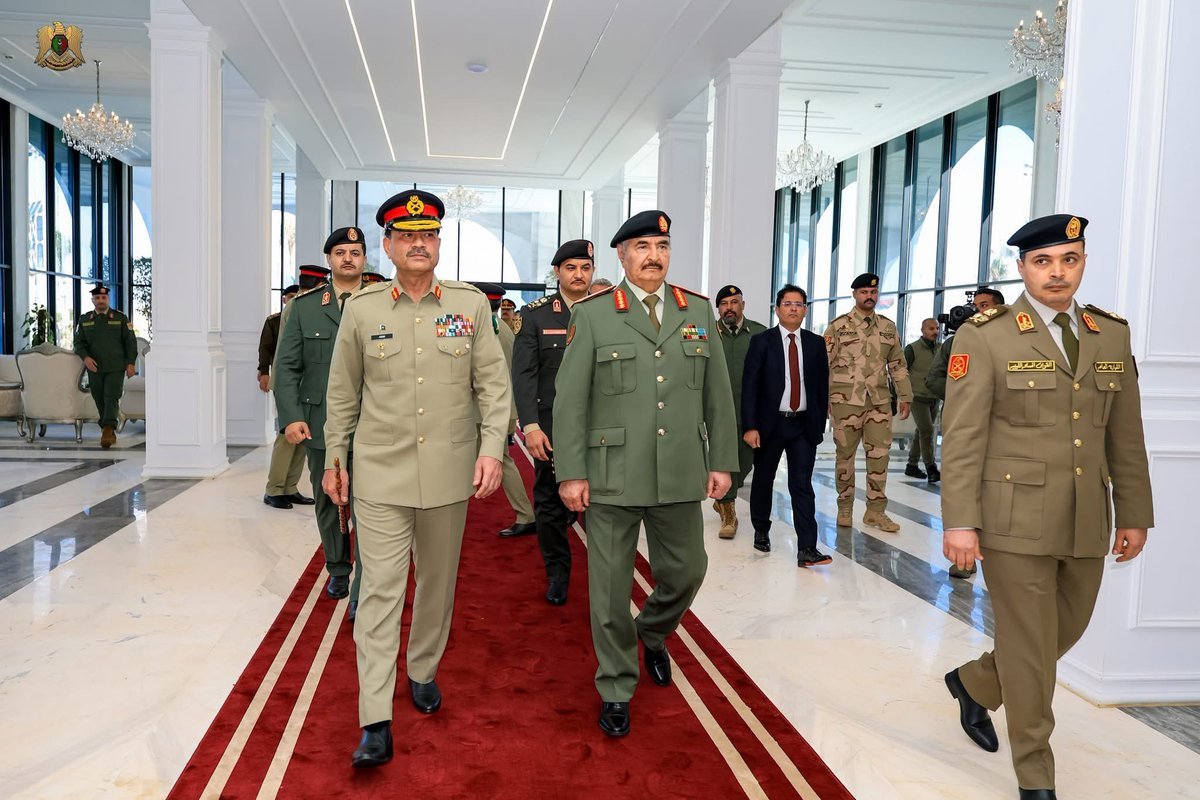
Pakistan’s mediation follows a meeting last month between Army Chief Field Marshal Asim Munir and Saddam Haftar in Rawalpindi. Days later, Saddam Haftar travelled to Washington, where he met US Secretary of State Marco Rubio.
Following that meeting, the US State Department said Rubio welcomed efforts by Libyan leaders to bridge political divisions and reaffirmed Washington’s support for Libya’s unity.
Although analysts consider Pakistan a relatively minor player in Libya compared with powers such as the United States, the United Arab Emirates, Turkey and Egypt, Islamabad has maintained working relationships with both rival Libyan camps.
Pakistan has also sought to deepen defence cooperation with the eastern-based LNA. Reuters reported in December that discussions included the possible sale of JF-17 fighter aircraft and Super Mushshak trainer planes despite a United Nations arms embargo.
At the same time, Libya’s western-based GNU recently sought direct discussions with Pakistan, according to a document reviewed by Reuters.
Two Pakistani sources familiar with the discussions said Qatar and Turkey, both key supporters of the GNU, encouraged Pakistan to take on a mediating role.
Despite the diplomatic momentum, analysts warned that reaching an agreement would not necessarily ensure lasting stability.
Tarek Megerisi, director of geopolitical advisory firm Informmi, said any agreement would still face significant implementation risks.
He pointed to last year’s peace accord between the leaders of Rwanda and the Democratic Republic of the Congo, which quickly unraveled despite initial optimism, as an example of the challenges facing negotiated settlements.
Read more: Iranian ambassador thanks Pakistan for attending Ali Khamenei’s funeral