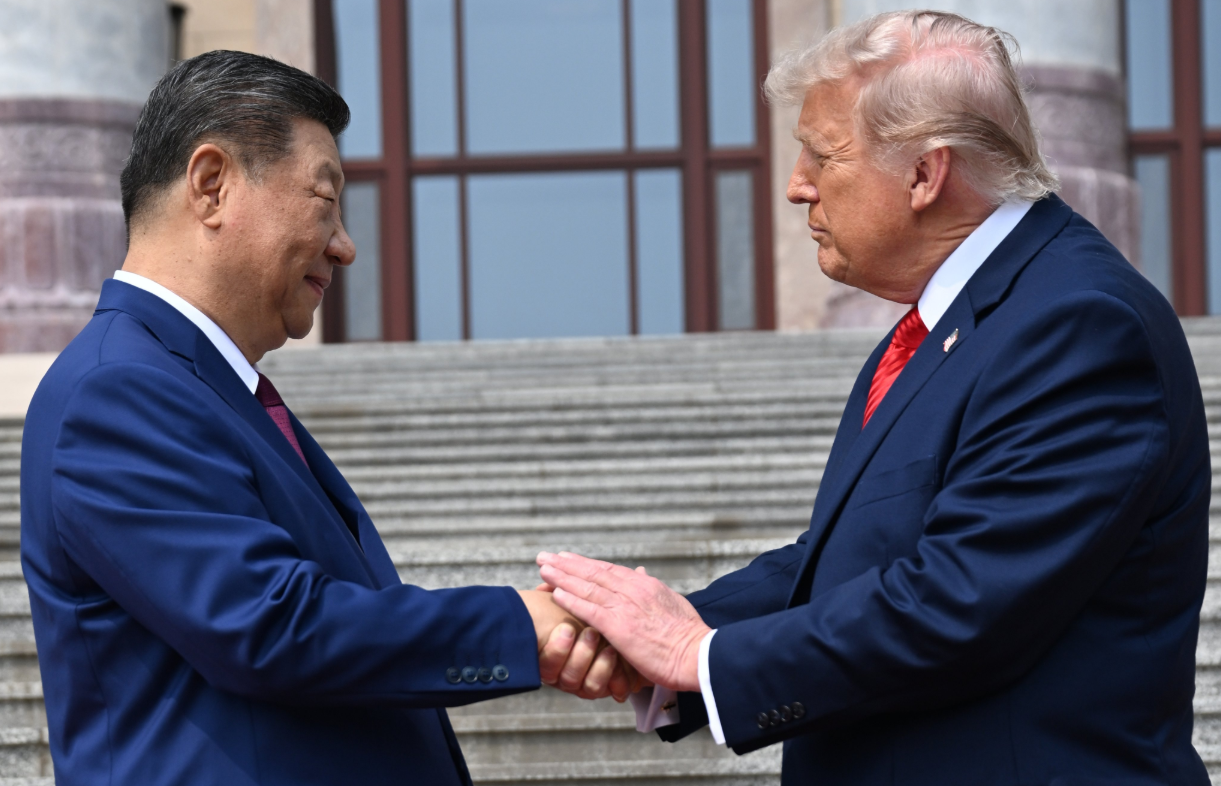
Web Desk: U.S. President Donald Trump departed China on Friday after two days of high-level talks with Chinese President Xi Jinping that produced tentative progress on trade, technology and regional security, as both powers sought to stabilize relations strained by economic rivalry and geopolitical tensions.
Trump boarded Air Force One at Beijing Capital International Airport following a farewell lunch and tea meeting with Xi at Zhongnanhai, the Chinese leadership compound in central Beijing. Chinese Foreign Minister Wang Yi attended the departure ceremony, where honor guards lined the tarmac and students waved Chinese and American flags.
The visit marked the first trip to China by a sitting U.S. president in nearly a decade and underscored efforts by Washington and Beijing to prevent deeper confrontation between the world’s two largest economies.
“We have a very strong relationship,” Trump told reporters during his final meeting with Xi. He added that both leaders agreed Iran “cannot have a nuclear weapon” and stressed the importance of keeping strategic waterways open amid instability in the Middle East.
“We want this situation ended because it’s dangerous for everybody,” Trump said, referring to the regional conflict involving Iran.
Xi, meanwhile, used the meeting to highlight the symbolic nature of hosting Trump at Zhongnanhai, a site historically reserved for China’s top leadership. He recalled Trump’s reception for him at the Mar-a-Lago resort in Florida during his first term in 2017.
“I chose this venue to return the hospitality shown to me,” Xi said.
The meetings produced fresh momentum in efforts to ease a prolonged tariff dispute that has weighed on both economies. Officials from both countries signaled support for extending temporary reductions on retaliatory tariffs while continuing negotiations on broader trade issues.
The easing of trade pressure could benefit U.S. agricultural exporters, energy producers and aircraft manufacturers, while also helping reduce inflation concerns and market uncertainty in the United States.
U.S. officials said China was considering major purchases of American goods, including Boeing aircraft, soybeans and energy supplies. Treasury Secretary Scott Bessent said Washington expected significant aircraft orders to emerge from the discussions.
For Beijing, the talks offered economic breathing room at a time when China faces slowing exports, a prolonged property downturn and weaker investor confidence.
In addition to trade, the leaders discussed a range of strategic issues, including Taiwan, artificial intelligence, semiconductor restrictions and rare earth supply chains.
China reportedly pressed for softer U.S. export controls on advanced chips and fewer restrictions on Chinese technology firms and students. Any easing of restrictions would support Beijing’s ambitions in artificial intelligence and semiconductor development.
The United States, meanwhile, sought greater coordination with China on Iran and broader Middle East stability, hoping Beijing could use its economic and diplomatic influence with Tehran to prevent further escalation.
Trump’s visit came against the backdrop of continuing tensions in the Gulf following U.S. and Israeli strikes on Iran in February, which triggered retaliatory attacks and disruptions in regional shipping routes, including temporary concerns over the Strait of Hormuz. An indefinite ceasefire is currently holding.
The summit provided diplomatic benefits for both sides despite the absence of major breakthrough agreements.
For Washington, the visit allowed Trump to project himself as a negotiator capable of managing competition with China while reopening economic opportunities for American companies.
For Beijing, hosting the U.S. president reinforced Xi’s image as the leader of a global power operating on equal footing with Washington. The talks also helped ease concerns about a complete economic decoupling between the two countries.
Trump arrived in Beijing on Wednesday for the visit, which had originally been planned for March but was postponed because of the Middle East conflict. He previously visited China in 2017 during his first term in office.
Read more: Trump extends US visit invitation to Chinese premier later this year