
Web Desk: The sight of humanoid robots working alongside airport staff is no longer confined to science fiction. Around the world, companies are testing machines designed to handle physically demanding tasks, raising a broader question: will such technology replace human workers or simply reshape their roles?
In Japan, the issue is particularly urgent. Japan Airlines plans to introduce humanoid robots on a trial basis at Haneda Airport starting next month, offering a real-world example of how automation could support overstretched labor forces.
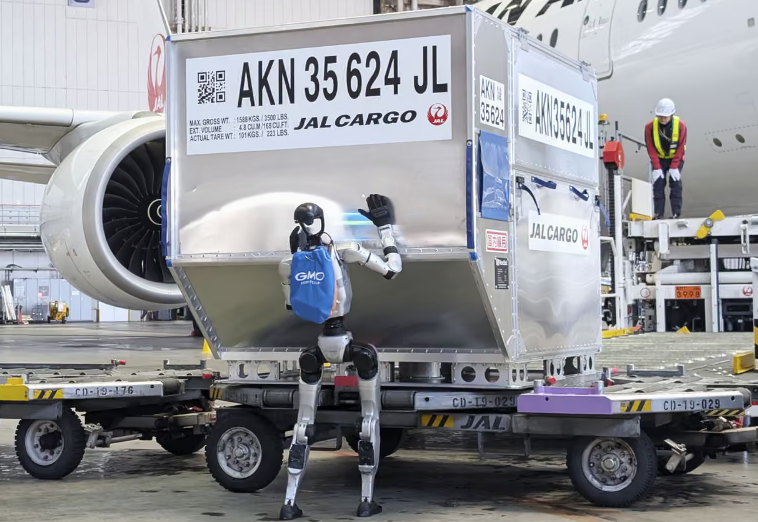
The robots will assist ground crews by moving luggage and cargo across the tarmac, tasks that typically require significant physical effort. Developed in collaboration with GMO Internet Group, the multi-year trial is intended to evaluate whether machines can reduce strain on workers while maintaining operational efficiency.
During a recent demonstration, a compact humanoid built by Unitree carefully transferred cargo onto a conveyor belt near an aircraft. The machine’s cautious, deliberate movements underscored both its potential and its current limitations.
Executives involved in the project say the goal is not full replacement but support. Tasks that require judgment, coordination, and safety oversight are expected to remain firmly in human hands.
Japan’s situation illustrates a wider global trend. The country is managing a surge in international travel alongside a rapidly aging population. Visitor numbers have climbed sharply in recent years, even as the domestic workforce shrinks.
That imbalance has intensified pressure on industries that depend on manual labor, from aviation to logistics and hospitality. While Japan has expanded its foreign workforce, political sensitivities around immigration complicate efforts to close the gap entirely.
As a result, automation is increasingly viewed as part of the solution rather than a standalone fix.
Beyond airports, humanoid robots are gradually taking on tasks in warehouses, manufacturing lines, and even cleaning operations. Some models assist with sorting packages, stocking shelves, or sanitising public spaces, particularly in environments where repetitive or physically taxing work is common.
At airports, future applications could include cabin cleaning or equipment handling, areas where consistency and endurance offer clear advantages. However, current machines still face constraints, including limited operating time before recharging and challenges in adapting to complex, unpredictable situations.
Industry experts emphasise that automation is unlikely to eliminate the need for human workers. Instead, it is expected to shift responsibilities toward supervision, maintenance, and decision-making roles that machines cannot easily replicate.
In the aviation sector, safety management, coordination during irregular operations, and customer-facing tasks continue to require human judgment and experience.
For now, Japan’s experiment highlights a middle path. Humanoid robots may ease workloads and fill critical gaps, but they are more likely to work alongside people than replace them entirely.
Read more: Five Chinese EVs cost less than one U.S. car