
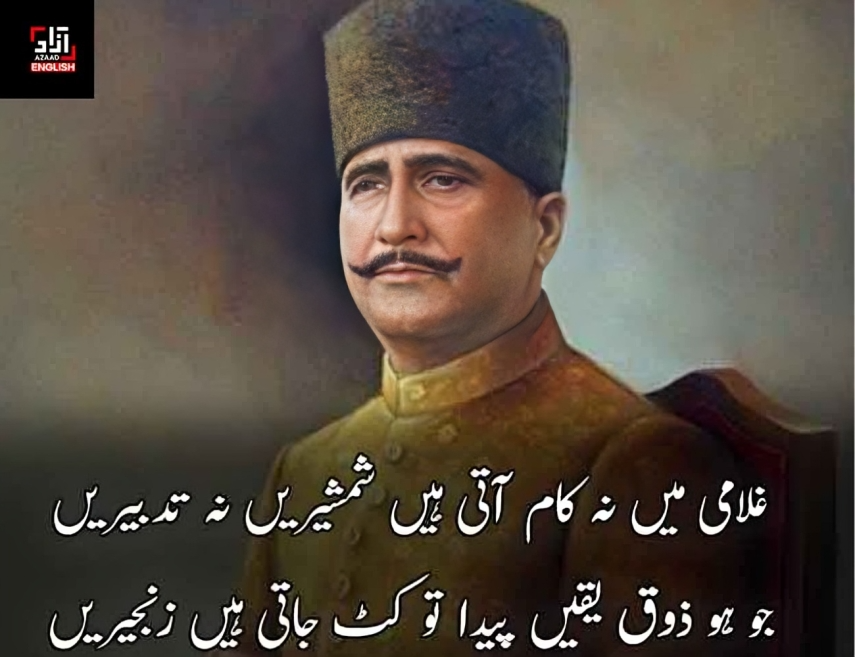
Web Desk: The poetry of Allama Muhammad Iqbal is gaining renewed traction among Gen Z audiences, as young readers reinterpret his philosophical ideas as a guide for self-discovery, ambition and purpose in a fast-changing world.
Although long regarded as classical literature, Iqbal’s work is increasingly being framed as a “roadmap” for personal growth, with its emphasis on inner strength, questioning norms and spiritual empowerment resonating across digital platforms.
At the center of this revival is the concept of Khudi, or the Self, presented in Iqbal’s Persian work Asrar-e-Khudi. The idea encourages individuals to elevate their sense of self-worth and take control of their destiny.
This message aligns closely with Gen Z’s focus on authenticity and self-actualisation. One of Iqbal’s most widely shared verses captures this ethos:
“Khudi ko kar buland itna ke har taqdeer se pehle,
Khuda bande se khud poochhe, bata teri raza kya hai.”
The verse has found new life online, where it is often used to promote confidence, independence and personal branding.
Meanwhile, Iqbal’s metaphor of the Shaheen or falcon, continues to symbolise ambition and a refusal to accept mediocrity. The imagery appears prominently in Bal-e-Jibril, where the bird represents vision, independence and relentless pursuit of higher goals.
“Tu shaheen hai, parwaz hai kaam tera,
Tere samne aasman aur bhi hain.”
The concept has gained popularity among young entrepreneurs and students, who interpret it as a call to aim higher and remain self-reliant.
Iqbal’s works such as Bang-e-Dara continue to influence youth through poems like “Tulu-e-Islam” and “Jawab-e-Shikwa,” which emphasise action over complaint and the importance of conviction.
“Amal se zindagi banti hai jannat bhi, jahannum bhi,”
he writes, underscoring the power of individual choices in shaping outcomes.
These ideas appeal to a generation navigating uncertainty, encouraging critical thinking and proactive change rather than passive frustration.
In addition, verses such as “Diyar-e-Ishq Mein” and “Saqi-Nama” promote creativity, continuous movement and breaking away from stagnation. These themes resonate with Gen Z’s interest in entrepreneurship and innovation.
“Diyar-e-Ishq mein apna maqam paida kar,
Naya zamana, nayi subh-o-sham paida kar.”
Such lines are increasingly cited in motivational content, reinforcing the relevance of Iqbal’s message in contemporary discourse.
As social media platforms accelerate the spread of short-form content, Iqbal’s poetry has found a new audience beyond traditional academic settings. His verses are frequently shared in videos, captions and discussions that reinterpret classical philosophy for modern challenges.
Consequently, what was once confined to textbooks is now shaping conversations around identity, ambition and purpose among a new generation, highlighting the enduring relevance of Iqbal’s vision.
Read more: Apple Inc. makes unexpected CEO change