



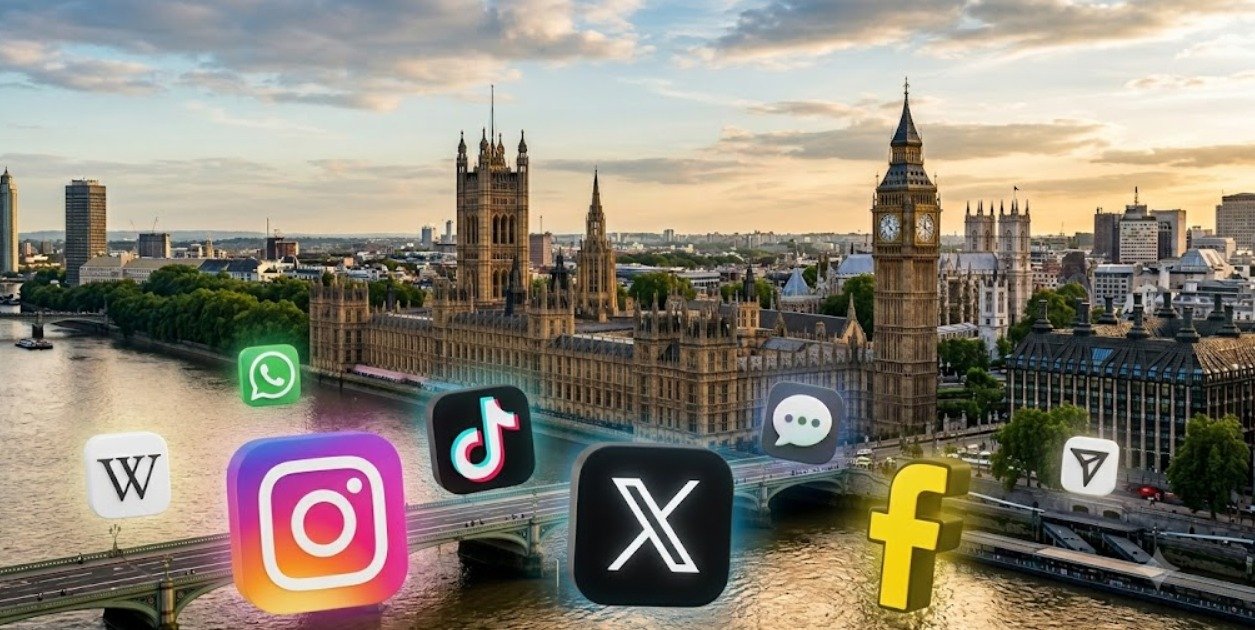
Web Desk: The British government will ban children under the age of 16 from using major social media platforms, pushing forward a sweeping legislative effort to protect minors from online harms and curb excessive screen time.
Prime Minister Keir Starmer announced the decision Monday during a Downing Street press conference, declaring that the government will introduce the regulations before Christmas. The prohibition is scheduled to take full effect by spring 2027.
The rules represent one of the most stringent digital interventions globally. Starmer emphasized that tech giants have failed to safeguard children, forcing the government to step in and set a new normal for future generations.
The upcoming legislation targets user-to-user platforms that rely on algorithmic amplification. The ban explicitly blocks under-16s from 10 major networks, including TikTok, Instagram, Facebook, X, Snapchat, YouTube, Threads, Twitch, Kick, and Reddit.
However, the restrictions exempt messaging applications such as WhatsApp and Signal, alongside educational services, e-commerce platforms, and music streaming networks.
Britain will go further than previous international models by targeting specific platform functionalities across a broader range of digital spaces. Under the new rules, the government will block livestreaming and stranger-to-child communication for minors on interactive sites, including gaming networks.
Furthermore, the policy mandates a strict adult-only rule for artificial intelligence chatbots designed to simulate romantic or sexual relationships. Officials are also reviewing secondary measures for older teens under 18, including potential overnight curfews and enforced breaks in infinite scrolling features.
Enforcement of the policy will place the legal and financial burden directly on technology companies rather than children or parents. Under the framework, platforms that fail to take reasonable steps to exclude underage users face multi-million-dollar fines from the media regulator, Ofcom.
To implement the restrictions, the government plans to deploy advanced age assurance criteria. Platforms must utilize technologies such as facial age estimation, photo ID matching, credit card checks, and digital identity services to verify user eligibility.
The proposal follows a massive national consultation that drew more than 116,000 responses. Government data shows that over 90 percent of participating parents backed a minimum age limit of 16 for social media access.
Despite public support, the announcement drew immediate skepticism from digital privacy advocates and academic experts. Critics from the Open Rights Group warned that robust verification checks will create digital checkpoints, requiring adults to routinely submit biometric or identity data to access everyday services.
Simultaneously, some online safety groups argued that a blanket ban is too blunt an instrument. Representatives from the Molly Rose Foundation noted that blocking access fails to address the underlying problem of harmful algorithms that manipulate user engagement.
Major technology companies have expressed resistance to the impending rules. Meta issued a statement arguing that outright bans risk isolating teenagers from vital online communities and information.
The United States government also raised concerns. The U.S. Embassy in London cautioned that digital regulations should remain narrow to avoid violating free speech protections or placing disproportionate burdens on American technology firms.
Britain joins a rapidly expanding roster of nations implementing age-based digital restrictions. Australia passed an under-16 social media ban last year, while Canada, Indonesia, and Malaysia have rolled out similar prohibitions or stringent age-verification mandates over the past six months.
Starmer stated that he plans to discuss the global coordination of child online safety with other world leaders at the Group of Seven summit in France.
Read more: Social media demands ban on Raftar TV