



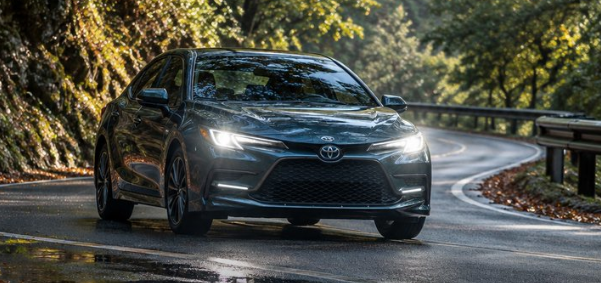
Web Desk: Toyota is preparing a major transformation of its globally popular Corolla, with the next-generation model expected to expand beyond traditional petrol and hybrid powertrains to include plug-in hybrid and fully electric versions.
The redesigned Corolla is reportedly due around 2027 as a 2028 model, according to a recent report by Car and Driver. Toyota is developing an architecture designed to accommodate multiple propulsion systems, allowing the automaker to offer petrol, hybrid, PHEV and battery-electric versions under the same nameplate.
The next Corolla Hybrid is expected to receive a new 1.5-liter four-cylinder petrol engine working alongside an electric motor.
The system could deliver about 134 horsepower, with approximately 94 hp generated by the combustion engine and 40 hp supplied by the electric motor. Reports also suggest the new setup could improve fuel efficiency by between 10% and 20% compared with the current Corolla Hybrid.
Toyota could additionally introduce an all-wheel-drive configuration by installing a separate electric motor on the rear axle.
Despite the industry’s shift toward electrification, Toyota is reportedly planning to keep a conventional petrol-powered Corolla in the next generation.
The automaker’s new 1.5-liter engine is capable of supporting turbocharging and could therefore serve as the basis for a petrol variant. Another possibility is an updated 2.0-liter four-cylinder engine already used in the current lineup.
Toyota has not yet confirmed which engine configuration will enter production.
For the first time, Toyota is also expected to add a plug-in hybrid Corolla.
Unlike the standard hybrid, the PHEV would use a larger battery pack, allowing the car to cover a longer distance using electric power before relying on its petrol engine.
Details such as battery capacity, electric-only range and final output have not yet been announced.
A battery-electric Corolla is reportedly part of Toyota’s plans for the next generation, although the company has not confirmed where it will be sold.
Reports indicate that markets such as the United States could potentially receive single- and dual-motor configurations. The electric model has also been linked to a possible range of at least 250 miles, or roughly 402 km, although those figures remain unconfirmed.
Toyota offered an early glimpse of its vision for the next Corolla through a concept presented at the Japan Mobility Show in 2025.
The prototype featured a more aggressive design, including a sharply angled windscreen, narrow lighting units and a streamlined body intended to improve aerodynamic performance.
Toyota’s future architecture is reportedly being engineered to accommodate different powertrains while maintaining practical interior and cargo space.
The cabin is also expected to receive a substantial redesign, potentially featuring larger digital displays, fewer physical controls and additional passenger space.
The Corolla remains a cornerstone of Toyota’s global vehicle lineup. Since its introduction in 1966, the nameplate has surpassed 50 million sales worldwide, placing it among the industry’s most successful models.
For now, Toyota has not disclosed production specifications, pricing or confirmed launch markets for the next-generation Corolla. The final mix of petrol, hybrid, plug-in hybrid and electric models is expected to become clearer as the vehicle moves closer to production.
Read more: Heavy rain fall: Two days holiday announced in Bangkok