



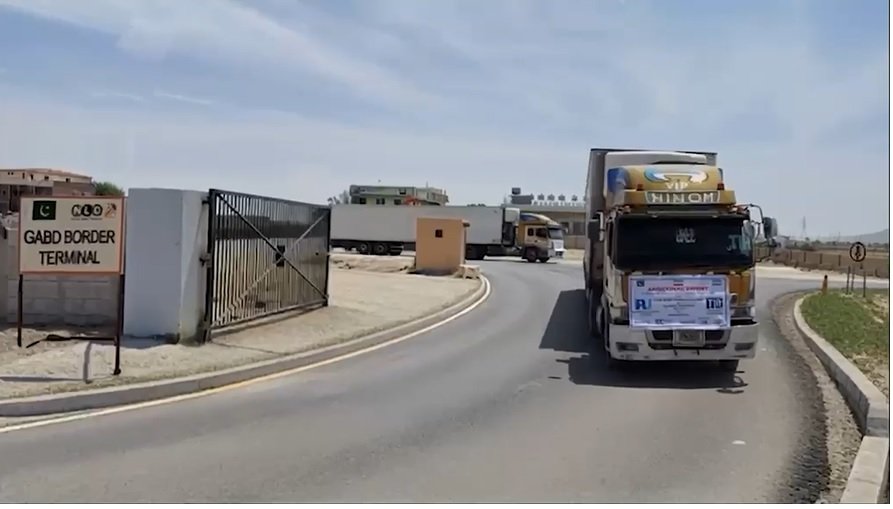
Web Desk: Pakistan significantly boosted its regional trade ambitions by activating the Gabd border terminal with Iran for international transit, providing a direct, secure corridor to Central Asian markets that circumvents traditional routes through Afghanistan.
The National Logistics Corporation (NLC), Pakistan’s leading logistics organization, operationalized the terminal under the Transports Internationaux Routiers (TIR) convention, officials confirmed this week. This strategic move formalizes and streamlines trade passing from Pakistan through Iran to landlocked Central Asian states.
To mark this milestone, the terminal facilitated the priority handling and customs clearance of meat containers originating from Karachi and destined for Tashkent. Following completion of customs formalities, the consignment proceeded to Uzbekistan via Iran under the TIR framework.
Shortening the Path to Central Asia
Consequently, this new pathway offers a substantial alternative to the long-standing, volatile route through Afghanistan. Economists and logistics experts describe the Iran corridor as shorter, safer, and more modernized compared to the traditional northern option.
While relying on Afghanistan has often presented security challenges and bureaucratic delays, the Gabd-Iran route ensures reliable access to Central Asia. Crucially, it effectively ends Pakistan’s dependence on the Afghan route for northern trade transit.
This development aligns with NLC’s broader strategy to operationalize multiple trade corridors. The organization already facilitates trade links connecting China, Iran, Central Asian republics, and other regional partners.
Formalizing Pakistan-Iran Commerce
The NLC originally constructed the Gabd border terminal in March 2024 specifically to formalize and regulate trade between Pakistan and Iran. Located near the strategic Gwadar Port, the Gabd-Rimdan corridor is expected to emerge as a primary trade artery in the near future.
Economically, experts predict this strategic shift will yield significant benefits. By using this route, Pakistani exporters can now increase shipments to Central Asia via Iran, mirroring the robust trade links already established with China to the east.
Furthermore, specialists note that the new route dramatically reduces transit distances and logistics costs. By improving overall trade efficiency and eliminating reliance on Afghanistan, the initiative is poised to transform Pakistan into a vital regional connectivity hub. Finally, it provides direct, cost-effective access to the lucrative markets of Central Asia.
Read more: Who will lead the U.S. delegation in second phase of Islamabad peace talks?