
Web Desk: Global markets reeled on Monday as escalating tensions in the Middle East triggered a flight to safety, sending oil prices sharply higher and equities lower after the United States signaled a major military move targeting Iran’s maritime activity.
Asian stock markets led the decline, with benchmarks in Japan and South Korea posting notable losses as investors reacted to the prospect of prolonged instability and rising energy costs.
At the same time, crude prices spiked above $100 per barrel, with Brent climbing about 7 percent and US West Texas Intermediate gaining roughly 8 percent. The surge renewed fears of inflationary pressure on economies heavily dependent on energy imports.
Investors shifted toward traditional safe-haven assets. The US dollar strengthened modestly, while gold prices slipped around 1 percent as traders weighed the likelihood of tighter monetary policy in response to higher oil prices.
Analysts said the abrupt change in sentiment reflected the collapse of diplomatic efforts that had previously raised hopes for de-escalation.
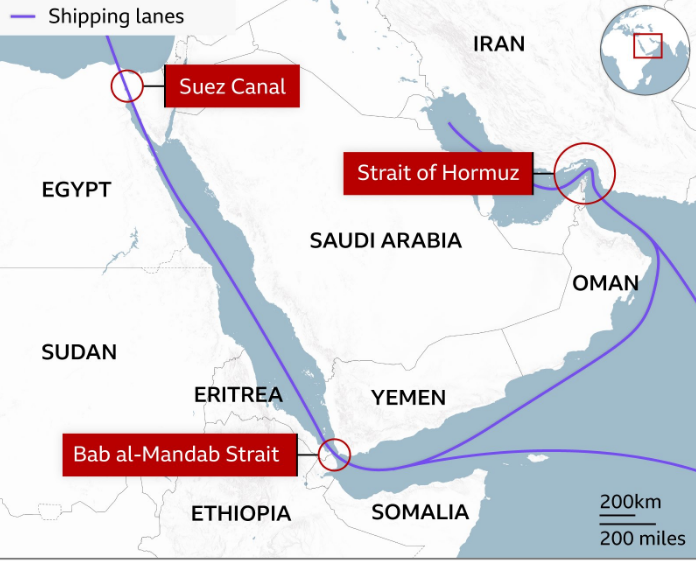
The United States military announced it would begin restricting maritime access to Iranian ports, applying the measure to vessels entering or leaving those locations. The move followed a directive from President Donald Trump, who earlier indicated a broader blockade linked to the strategically vital Strait of Hormuz.
However, US Central Command later clarified that international shipping through the strait itself would not be fully obstructed, creating uncertainty over the scope of the operation.
Conflicting statements from US leadership and military officials added to market volatility. While earlier remarks suggested sweeping restrictions across the strait, subsequent guidance indicated a narrower focus on Iranian port traffic.
The Strait of Hormuz remains a critical artery for global energy supplies, handling roughly one-fifth of the world’s oil and liquefied natural gas shipments. Any disruption to flows through the corridor has immediate global repercussions.
The latest developments follow the breakdown of high-stakes negotiations between Washington and Tehran held in Islamabad over the weekend. The failure to reach an agreement dashed expectations that tensions could ease in the near term.
Market strategists noted that investors had begun pricing in a potential diplomatic breakthrough, making the sudden escalation particularly damaging to sentiment.
Iranian officials pushed back strongly, warning of consequences if US actions escalate further. Military authorities indicated that any perceived violations near Iranian waters would draw a firm response, while political leaders accused Washington of undermining near-final agreements during negotiations.
Experts in Tehran also questioned the feasibility of enforcing such restrictions, arguing that control over the region cannot be unilaterally dictated.
Since the outbreak of conflict earlier this year, traffic through the Strait of Hormuz has already slowed significantly, disrupting global supply chains. Iran has maintained limited transit for select vessels while continuing its own operations, further complicating the situation.
With tensions rising and diplomacy stalled, investors now face growing uncertainty over energy supplies, inflation risks, and the broader economic fallout of a potentially prolonged conflict.
Read more: Govt rolls out plan to curb power outages and ease electricity prices