


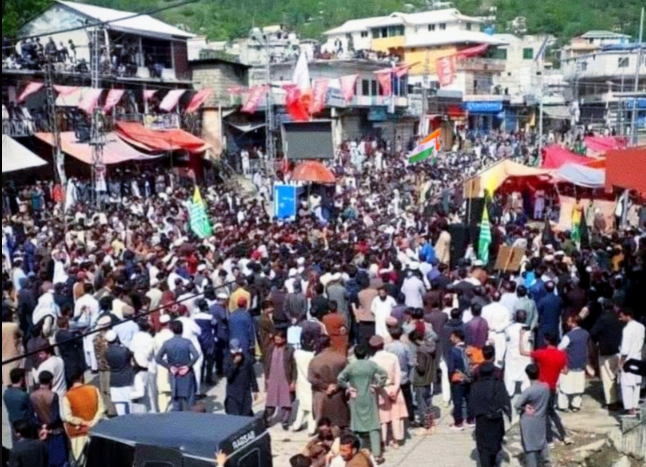
Web Desk: The Indian Army reportedly displayed footage of protests linked to the now-defunct Joint Action Committee at a site near the Line of Control (LoC) on Aug. 14, according to claims circulating in Pakistan.
The footage was allegedly shown at around 6 p.m. on a screen at the Keran Monument on the Indian-administered side of the Neelum Valley, according to the account.
The reported display came a day before Pakistan’s Independence Day celebrations and has drawn criticism from Pakistani commentators, who accused the Indian military of using local protest footage as part of an information campaign.
According to the claims, videos showing demonstrations associated with the Joint Action Committee were played publicly at the Keran Monument.
The Joint Action Committee, which had previously organised protests over a range of local issues, is described in the material as defunct.
The reported use of the footage has prompted accusations that the demonstrations were being repurposed to convey a political message across the LoC.
However, the claims about the purpose of the display and any alleged coordination between the protest organisers and India could not be independently verified.
The reported incident highlights the continuing role of competing narratives and information campaigns in the disputed Kashmir region.
Both India and Pakistan regularly use political messaging and media coverage to reinforce their positions over Kashmir, while developments along the LoC can quickly become part of the broader information contest between the two countries.
The alleged display of protest footage therefore adds another dimension to tensions surrounding the disputed territory.
The account circulating in Pakistan characterized the reported display as evidence of an Indian effort to portray the protests in a particular political context.
The demonstrations had been exploited to generate media material favorable to India.
The incident, if confirmed, would underscore how footage from local political protests can be incorporated into wider messaging efforts in one of South Asia’s most sensitive and heavily militarised regions.