



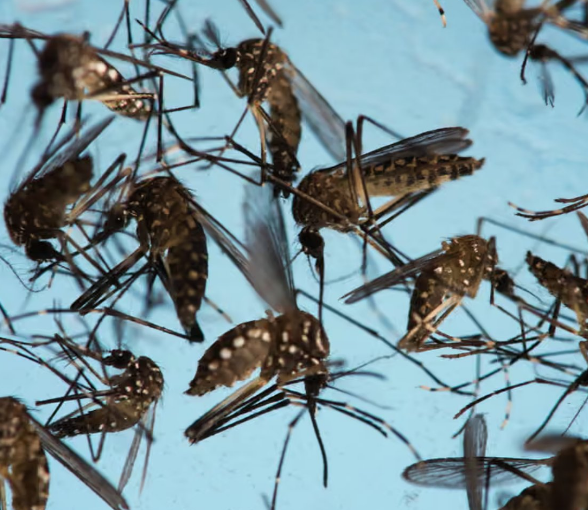
Web Desk: Millions of sterile mosquitoes could soon take flight over parts of the United States in an unusual bid to curb the spread of dengue, Zika and other viral diseases.
Scientists working with Alphabet’s life sciences research initiative, known as Debug, plan to release up to 16 million male mosquitoes in both Florida and California as part of a pilot program. If approved, the releases would be repeated next year.
Health researchers say the strategy hinges on a simple idea: fight mosquitoes with mosquitoes.
The project focuses on Aedes aegypti, an invasive mosquito originally from Africa that transmits dengue, yellow fever, Zika and chikungunya. The species has spread widely across tropical and subtropical regions and has established populations in parts of the United States, particularly Florida.
Instead of spraying more insecticides, researchers aim to breed male Aedes aegypti mosquitoes infected with Wolbachia, a naturally occurring bacterium. When wild females mate with these males, their eggs fail to hatch.
Because female mosquitoes typically mate only once in their lifetime, scientists say the impact can multiply quickly. A single female can lay more than 100 eggs, meaning each unsuccessful mating could prevent an entire batch of offspring.
Male mosquitoes do not bite, so researchers say the releases would not increase the risk of mosquito bites for humans.
If enough sterile males are released, the wild population should shrink with each generation, reducing the number of insects capable of spreading disease.
Before any release can take place, the project requires clearance from the US Environmental Protection Agency. Alphabet has filed for a permit, and regulators are reviewing the proposal.
Separating male and female mosquitoes at scale presents another challenge. Program engineers are developing automated systems that use sensors and machine-learning algorithms to distinguish males from females quickly and accurately. Only males would be released.
Scientists say such precision is critical, since releasing biting females would undermine public health goals.
Florida has some of the longest-established Aedes aegypti populations in the United States. Researchers say the species has also shown resistance to certain insecticides, making traditional control measures less effective.
Public health experts warn that insecticide resistance can develop when chemicals are widely used, similar to how bacteria can evolve resistance to antibiotics.
Entomologists note that Aedes aegypti is not native to Florida. Because it is invasive, they say reducing its numbers is unlikely to disrupt local ecosystems in the way targeting native species might.
The U.S. proposal mirrors efforts by the World Mosquito Program, a global initiative led by Australia’s Monash University. The group releases mosquitoes carrying Wolbachia in multiple countries across Asia, Oceania and the Americas.
According to monitoring data from those programs, Wolbachia can spread through mosquito populations over time and reduce the insects’ ability to transmit viruses. In areas where the bacterium has become widespread, the organization reports significant declines in dengue outbreaks.
Even so, the approach raises broader questions about human intervention in ecosystems.
Some critics question whether large-scale population suppression, even of disease-carrying pests, sets a troubling precedent. Supporters counter that invasive mosquitoes pose a direct threat to human life and require decisive action.
Researchers involved in mosquito control efforts argue that Aedes aegypti thrives in close association with humans and has followed human settlement patterns around the globe. As a result, they say, people bear responsibility for managing the risks the species creates.
If regulators grant approval, millions of lab-bred males could soon join their wild counterparts not to multiply, but to ensure that fewer of the next generation survive.
Read more: Italy expands doors for Pakistanis with new worker quota and thousands of student visas