


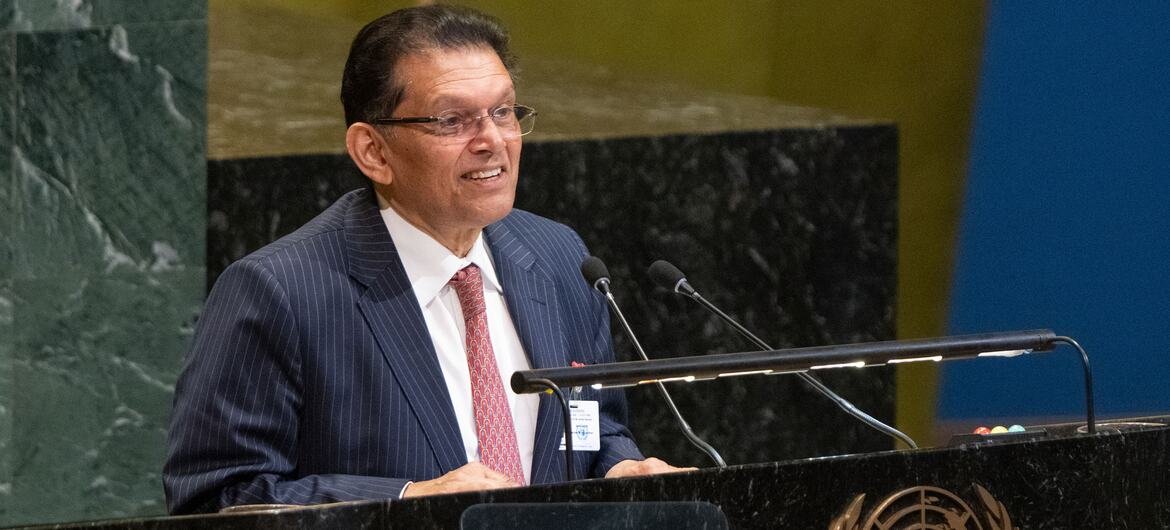
Web Desk: Bangladesh Foreign Minister Khalilur Rahman won election as president of the 81st session of the United Nations General Assembly on Tuesday, securing the role at a pivotal moment for the world body as it prepares to choose a successor to Secretary-General António Guterres.
In a secret-ballot vote, Rahman received 99 votes, defeating Greece’s candidate Andreas Kakouris, who garnered 91. All 190 ballots cast were valid, with no abstentions recorded.
Under the UN’s regional rotation system, the presidency of the General Assembly for its 81st session is allocated to the Asia-Pacific group. Rahman will assume office on Sept. 8 for a one-year term.
His tenure will coincide with one of the most significant developments on the UN agenda: the process to select the next secretary-general before Guterres’ term concludes on Dec. 31, 2026.
Rahman brings more than 40 years of diplomatic and multilateral experience to the position. Appointed Bangladesh’s foreign minister earlier this year, he previously served as national security adviser and as the government’s high representative on Rohingya affairs.
Since joining Bangladesh’s foreign service in 1979, he has held a series of senior diplomatic assignments, including leadership roles within the United Nations in New York and Geneva.
Speaking after his election, Rahman said he accepted the responsibility with humility at a time when confidence in international institutions faces mounting challenges.
“The UN will enter its ninth decade at a moment when trust in our organisation is being tested on multiple fronts,” he told member states.
He warned that a combination of global crises and institutional pressures risked weakening public confidence in the UN’s ability to fulfill its mandate.
The election comes as the United Nations grapples with deep geopolitical divisions and increasing pressure on the multilateral system.
Outgoing General Assembly President Annalena Baerbock described the current environment as one of the most difficult periods in recent years for international cooperation.
Addressing delegates after the vote, she said the organisation was operating under intense strain, with consensus becoming harder to achieve and the defense of the UN Charter requiring constant vigilance.
“The role of the president of the General Assembly is no longer simply procedural,” Baerbock said.
Moreover, she cautioned that the coming year is unlikely to bring relief as member states continue efforts to implement the Pact for the Future, pursue institutional reforms through the UN80 initiative and navigate widening geopolitical fault lines.
Secretary-General Guterres echoed those concerns, pointing to a world marked by armed conflicts, political polarisation, widening inequality and escalating climate-related disruptions.
He also cited lagging progress toward the Sustainable Development Goals, shrinking resources for humanitarian and development programs, and international institutions that have struggled to adapt to contemporary realities.
According to Guterres, many global governance structures remain rooted in frameworks established after World War II and no longer adequately reflect present-day challenges.
Rahman outlined six principal areas that will guide his presidency: maintaining international peace and security, accelerating implementation of the Sustainable Development Goals, advancing climate and environmental action, promoting human rights, strengthening governance of emerging technologies including artificial intelligence, and advancing UN reform.
In addition, he pledged to draw on Bangladesh’s extensive experience in UN peacekeeping operations to support preventive diplomacy, peacebuilding initiatives and the protection of civilians in conflict zones.
He also emphasized the need to close financing gaps that hinder development efforts, implement commitments under the Global Digital Compact and improve the effectiveness of the United Nations amid growing demands on the institution.
Rahman selected “Restoring Trust, Managing Transformation: A United Nations that Delivers for All” as the overarching theme of the upcoming session.
Guterres welcomed the theme, describing it as a timely appeal to strengthen multilateral cooperation and renew confidence in the international system.
For his part, Rahman said he intends to serve as a bridge-builder among member states and foster dialogue across political divides.
“As your president, I will dedicate myself to rebuilding trust, nurturing consensus and creating opportunities for constructive negotiations that produce outcomes shared by all,” he said.
He also pledged to uphold the principles of the UN Charter, ensure geographical and gender balance within his office and remain attentive to the concerns of smaller delegations.
The General Assembly, often described as the world’s most representative diplomatic forum, includes all 193 UN member states, each holding one vote.
Although its resolutions are generally non-binding, the body remains the principal platform for international debate on issues ranging from peace and security to development, human rights and international law.
The 81st session will formally open on Sept. 8. Two weeks later, heads of state and government from around the world are expected to gather at U.N. Headquarters in New York for the annual high-level debate.
Read more: Iranian Ambassador lauds FM Asim Munir’s mediation efforts