
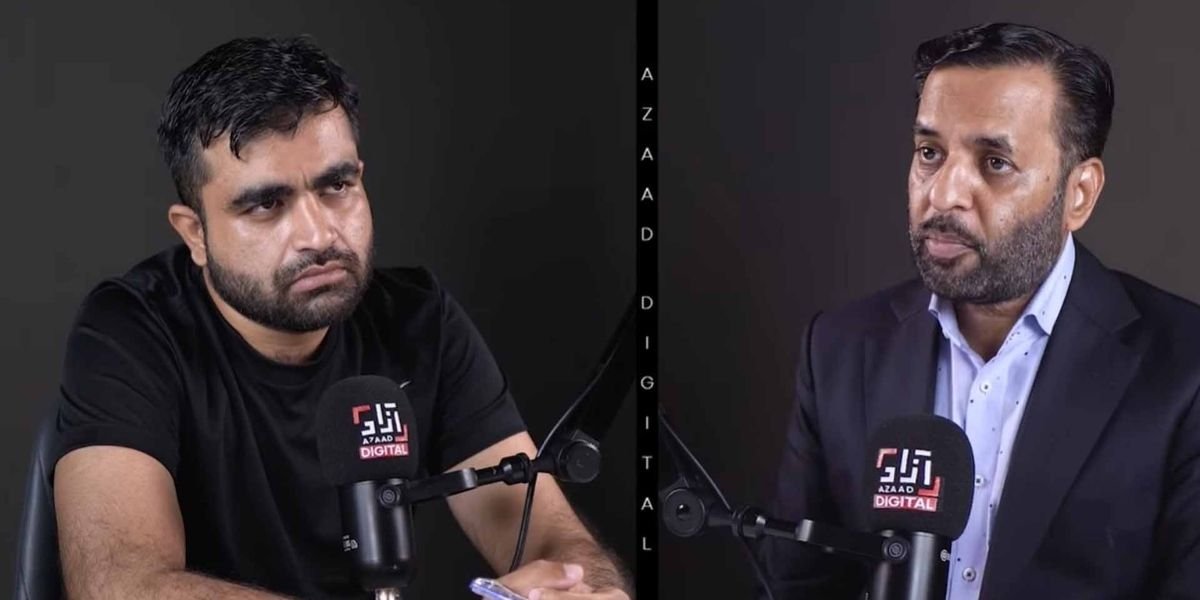
Federal Minister for Health Mustafa Kamal, in an exclusive interview with Azad Digital, spoke in detail about the development of Karachi, the local government system, new administrative units and the creation of provinces, the Pakistan Peoples Party’s position, constitutional amendments, the financial resources received by Sindh, medicine prices, and his tenure as city mayor, among other important issues.
Mustafa Kamal strongly supported the creation of new administrative units and provinces in Pakistan, saying that the existing administrative structure of four provinces is no longer compatible with the country’s current population and needs.
He said that when Pakistan was established, the country’s population was approximately 37 million and there were four provinces, but today the population has exceeded 260 million and there are still the same four provinces administratively.
He said that Punjab, Sindh, Khyber Pakhtunkhwa and Balochistan are, in terms of area, larger than many countries in the world. Therefore, he said, creating new units is necessary for administrative convenience and to bring power closer to the people.
Giving the example of India and various other countries, Mustafa Kamal said that as populations and administrative needs have increased, many countries around the world have created new provinces and administrative units.
He said that at the time of independence India had nine provinces, which have now increased to 38, while Turkey, Iran, Afghanistan, the United States and other countries have also established multiple units according to population and administrative requirements.
He said the purpose of creating new administrative units is not to eliminate the identity of any area, but to provide people with a better administrative system closer to them.
Mustafa Kamal said that leaders of the Pakistan Peoples Party present the issue of administrative units as though it were an unconstitutional or unacceptable demand.
He said PPP leaders should object not to him but to their own leader, Zulfikar Ali Bhutto, because the 1973 Constitution contains a procedure for the creation of new provinces.
He said the Constitution is not a book that cannot be changed according to changing times and circumstances. Numerous constitutional amendments have been made over the past several decades, and if a system no longer meets the needs of the time, it can be amended.
Mustafa Kamal rejected the position that the creation of new administrative units would amount to the division of Sindh, saying that administrative division and historical or cultural identity are two separate matters.
Giving the example of Karachi, he said that for administrative purposes Karachi was divided from one district into seven districts, but neither did Karachi cease to exist nor was the identity of Sindh affected.
He said that just as additional rooms or floors can be added to a house when it becomes too large, administrative units can likewise be created as the population increases.
Mustafa Kamal criticized the Sindh government and claimed that Sindh received approximately Rs22 trillion over the past 18 years, but despite this, there is a severe lack of basic facilities in both the province’s urban and rural areas.
Referring to conditions in interior Sindh, he said that in some areas women are forced to use extremely poor-quality water for drinking, while the health and education systems are also facing difficulties.
He said that if the people remain deprived of basic facilities despite such large financial resources, questions arise about the existing administrative and governance system.
According to him, as a result of this strategy Karachi became one of the 12 fastest-developing cities in the world, whereas today the city is facing severe problems despite having access to such substantial resources.
Mustafa Kamal also questioned the census figures, claiming that Karachi and Hyderabad were deliberately shown as having smaller populations in order to maintain specific political control over the provincial government.
He said that, according to his assessment, despite the allegedly incorrect census, Karachi and Hyderabad together account for approximately 43 percent of Sindh’s population. However, despite this, the people of these areas are not in a position to change the chief minister through their votes.
Mustafa Kamal said that the creation of new administrative units would ensure that resources are spent at the local level and that people would be able to directly question their elected representatives.
He said that under the existing system, a few specific individuals govern the entire province, while ordinary citizens do not have an effective administrative mechanism through which they can directly replace them.
Referring to Article 140-A of the Constitution, Mustafa Kamal said that the powers of local governments should have constitutional protection so that provincial governments cannot change the local government system according to their own wishes.
Mustafa Kamal said that during the 26th and 27th constitutional amendments, a draft concerning the transfer of powers to the grassroots level was also under consideration, but it could not move forward because of opposition from the Pakistan Peoples Party.
He said that very soon a time would come when this constitutional amendment would be approved and powers and resources would be transferred to the streets and neighborhoods throughout Pakistan.
He said that all major political parties and Parliament are reluctant to transfer powers to the grassroots because development powers exercised through MPAs and MNAs also become a source of political influence.
According to Mustafa Kamal, the fundamental responsibility of an MNA or MPA is legislation. Building drains and roads should be the responsibility of the local government or mayor.
Mustafa Kamal said that whenever powers have been transferred to local governments in Pakistan, this has mostly happened during periods of military rule.
He said democratic governments should also seriously work on giving local governments full financial and administrative powers.
Mustafa Kamal said that the federal government transfers billions of rupees to the provinces from the divisible pool, but these resources do not reach the grassroots.
He questioned that if provinces receive resources through the NFC Award, why do they not transfer this money to local governments through the PFC Award?
He said that instead of resources remaining concentrated in the hands of a few chief ministers and provincial governments, they should go directly to local governments.
Mustafa Kamal said that the entire state has to bear the consequences of mismanagement and waste of resources at the provincial level.
He said that after problems resulting from poor governance arise, the military and other state institutions are often required to step in to manage law-and-order situations.
Speaking about Muhajir politics, Mustafa Kamal said that he considers himself an ordinary Pakistani and a politician for the entire country.
Explaining the demand to hand Karachi over to the federal government, Mustafa Kamal said that this did not mean running the city through bureaucratic rule from Islamabad.
According to him, the demand is that Karachi’s rights and funds should go directly to the locally elected government rather than the provincial government so that urban problems can be resolved at the local level.
Comparing his tenure as Karachi mayor with his current position as a federal minister, Mustafa Kamal said that as mayor he could make many decisions himself, whereas in a federal ministry, even the smallest administrative decision has to pass through various stages.
Mustafa Kamal said that if Karachi is provided with its rightful powers and resources, significant improvements can be brought to the city within the next two years.
Mustafa Kamal claimed that, according to various financial formulas and tax revenues, Karachi’s annual rightful share comes to approximately Rs850 billion.
He said that Karachi does not even receive its rightful share, let alone the full Rs80 billion allocated for development work, while the regional taxes generated by the city are very substantial.
Mustafa Kamal said that the MQM’s current constitutional agenda is not limited to Karachi or Sindh, but is a plan to take powers and resources to the streets and neighborhoods throughout Pakistan.
He said that strong local governments, smaller administrative units, fair distribution of resources, and accountability at the public level are necessary for Pakistan’s better future.
He said that if the existing system is not meeting the needs of the people, political parties and state institutions will have to sit together and bring about changes to it.
Also Read: Punjab govt rejects dawn report on collapsed hindu mandir in Narowal