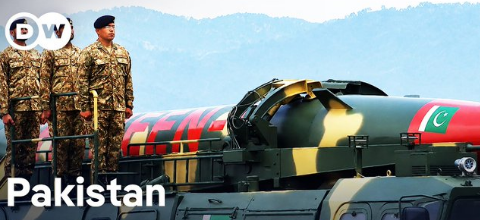
Web Desk: A sharp debate has emerged over an English-language documentary produced by Germany’s state-funded international broadcaster Deutsche Welle (DW), with critics in Pakistan accusing the network of presenting a one-sided and misleading portrayal of the country’s nuclear program and broader political landscape.
The 52-minute documentary, titled “Pakistan — Nuclear Power at a Crossroad,” examines Pakistan’s political, economic and security challenges while questioning whether those pressures could affect the safety and security of the country’s nuclear arsenal.
Critics of the documentary argue that it relies on outdated narratives and selectively presents historical events to cast doubt on the legitimacy and safety of Pakistan’s nuclear capability.
They object to the film’s assertion that Pakistan “illegally developed” nuclear weapons, describing the characterisation as misleading. International law does not provide a universally accepted legal pathway for acquiring nuclear weapons and argue that the documentary applies a different standard to Pakistan than to other nuclear-armed states.
In addition, the documentary links Pakistan’s nuclear program with religious extremism by recycling long-standing allegations without providing balanced context and factual data.
The documentary also faces criticism for its treatment of Pakistan’s 1998 nuclear tests.
While the film notes Pakistan publicly declared its nuclear capability through the May 1998 tests, it fails to adequately emphasise that the tests came in response to India’s nuclear detonations earlier that month. Omitting this sequence of events overlooks a key factor behind South Asia’s nuclearisation.
The absence of that historical context contributes to what they describe as an unfair portrayal of Pakistan’s strategic decisions.
The documentary has also prompted criticism of DW’s editorial approach.
Some commentators have accused the German broadcaster of failing to meet professional standards by presenting Pakistan’s internal political, economic and security challenges without sufficiently acknowledging the country’s perspective or the regional security environment.
The production focuses heavily on political polarisation, economic difficulties, rising extremism and the military’s influence over governance while offering little discussion of the external factors affecting Pakistan’s security calculus.
DW’s documentary portrays Pakistan as facing multiple crises, including growing extremism, intolerance, economic difficulties, political instability and institutional weaknesses.
It argues that these overlapping challenges could pose risks to the stewardship of Pakistan’s nuclear arsenal, although it does not propose specific policy recommendations for addressing those concerns.
The documentary instead calls attention to what it describes as the implications of Pakistan’s domestic trajectory for regional and international security.
The criticism has extended beyond the documentary itself, with some commentators linking the broadcast to Germany’s broader international standing.
Mushahid Hussain Syed former information minister pointed to Germany’s unsuccessful bid for a non-permanent seat on the UN Security Council in June 2026 and referenced remarks made by German Chancellor Friedrich Merz in 2025 regarding the conflict involving Israel and Iran, arguing that those developments raise broader questions about Berlin’s foreign policy and international credibility.