Web Desk: The newly elected Bharatiya Janata Party (BJP) government in India’s eastern state of West Bengal is facing criticism after proposing to replace eggs with vegetarian alternatives in government school lunches, with opponents accusing the administration of abandoning its pre-election messaging and imposing dietary preferences through public policy.
The proposal, which remains under discussion, would hand the preparation of meals for schools run by the Kolkata Municipal Corporation to the International Society for Krishna Consciousness (ISKCON), whose Annamitra Foundation serves only vegetarian food.
If implemented, eggs currently provided under the school meal program would be replaced with vegetarian sources of protein.
Leaders of the opposition All India Trinamool Congress (TMC) said the proposal runs counter to the BJP’s campaign messaging before the state elections, when party leaders repeatedly sought to reassure voters that local food traditions would not be affected if the party came to power.
The BJP won control of West Bengal earlier this year for the first time.
State Chief Minister Suvendu Adhikari rejected allegations that the proposal was driven by religious ideology, saying the objective was to provide students with “good and pure food.” He also said no one would be compelled to adopt any religious practices.
The project has not yet been implemented, and ISKCON said discussions with the state government are continuing.
The organisation said its vegetarian menu would provide adequate protein and vitamins while maintaining high nutritional and hygiene standards.
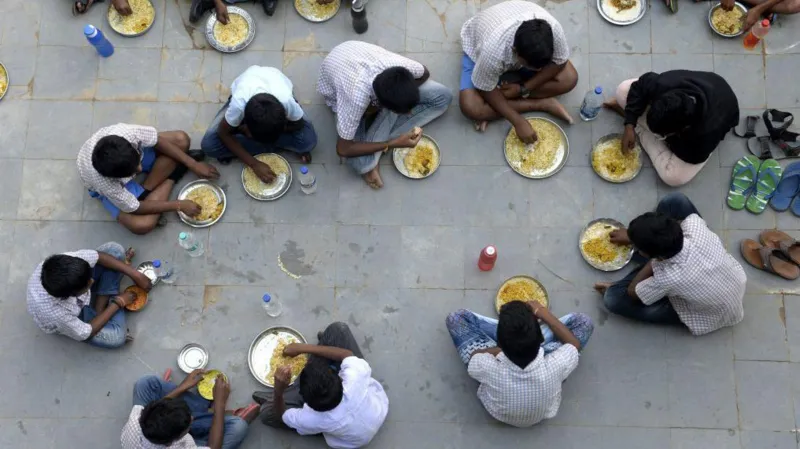
The proposal has reignited a wider debate over nutrition in India’s publicly funded school meal program, which serves more than 110 million children each school day.
Nutritionists argue that eggs remain one of the most affordable and complete sources of protein for growing children, particularly those from low-income households. They warn that replacing eggs without nutritionally equivalent alternatives could affect children’s growth, immunity and learning over time.
Although foods such as soybeans, pulses and cottage cheese contain protein, experts say they are either more expensive or less practical to standardize across a large public feeding program.
Teachers said the school meal program plays a crucial role in encouraging attendance, particularly among children from disadvantaged families who often rely on the lunch as their most nutritious meal of the day.
Some parents also questioned the proposal, saying eggs provide reassurance that children receive adequate nutrition during school hours.
Others supported allowing students to choose between eggs and vegetarian alternatives, arguing that such an approach would accommodate different dietary preferences without compromising nutrition.
India’s school meal initiative, launched nationwide in 1995 and rooted in a school feeding program that began in the then-Madras Presidency before India’s independence, has long been credited with improving child nutrition and boosting school enrollment.
The latest proposal in West Bengal has now placed the program at the center of a broader national debate over nutrition, cultural traditions and the role of politics in public welfare policies.
Read more: Modi deserves ‘butcher of Gujarat’ title, not an award: Ikhtiar Wali